Pregabalin Capsule
Product Images NDC 71610-754

View Photos of Packaging, Regulatory Labels, and Product Appearance

Product Visual Gallery

This gallery contains 16 technical images submitted to the FDA as part of the official labeling for Pregabalin (NDC 71610-754). Unlike standard consumer photos, these assets often include clinical data figures, molecular chemical structures, and official manufacturer packaging layouts.

As provided by Aphena Pharma Solutions - Tennessee, Llc, these visuals offer a comprehensive scientific overview of the product's physical and chemical identity, aiding pharmacists and researchers in product verification and study.

FDA Label Image

Bottle Label 200 mg (71610 0754 30)

Bottle Label 200 mg (71610 0754 30)
Pregabalin 200 mg capsule bottle label for 30 capsules, labeled by Aphena Pharma Solutions - Tennessee, LLC. The label includes storage instructions, warnings, the National Drug Code (NDC 71610-754-30), lot and expiration date fields, and manufacturer information from ScieGen Pharmaceuticals Inc., Hauppauge, NY.*
FDA Label Image

Aphena Pharma Solutions (TN)

FDA Label Image

Figure 1 (Pregabalin Fig01)

Figure 1 (Pregabalin Fig01)
A line graph depicting percent of patients improved versus percent improvement in pain from baseline. It compares four groups: Pregabalin 200 mg three times a day, 100 mg three times a day, 25 mg three times a day, and placebo, showing varying levels of patient improvement across pain reduction percentages.*
FDA Label Image

Figure 2 (Pregabalin Fig02)

Figure 2 (Pregabalin Fig02)
A line graph showing percent of patients improved against percent improvement in pain from baseline. Two lines compare Pregabalin 100 mg three times a day versus placebo, depicting patient response rates across different levels of pain improvement.*
FDA Label Image

Figure 3 (Pregabalin Fig03)

Figure 3 (Pregabalin Fig03)
A line graph depicting percent of patients improved versus percent improvement in pain from baseline. It compares four groups: Pregabalin 300 mg twice daily, 150 mg twice daily, 75 mg twice daily, and placebo, showing the relationship between increasing pain improvement percentages and patient improvement rates for each treatment.*
FDA Label Image

Figure 4 (Pregabalin Fig04)

Figure 4 (Pregabalin Fig04)
A line graph showing the percent of patients improved plotted against the percent improvement in pain from baseline. The graph compares Pregabalin 200 mg three times a day, Pregabalin 100 mg three times a day, and placebo, indicating higher patient improvement with Pregabalin doses versus placebo across increasing pain improvement percentages.*
FDA Label Image

Figure 5 (Pregabalin Fig05)

Figure 5 (Pregabalin Fig05)
A line graph showing percent improvement in pain from baseline on the x-axis and percent of patients improved on the y-axis. It compares three groups: Pregabalin 100 mg three times a day, Pregabalin 50 mg three times a day, and placebo, illustrating patient improvement rates across varying pain improvement percentages.*
FDA Label Image

Figure 6 (Pregabalin Fig06)

Figure 6 (Pregabalin Fig06)
A bar graph comparing responder rates (%) in two clinical studies labeled Study E1 and Study E3. The X-axis shows treatment groups with dosages and placebo, and the Y-axis shows responder rates from 0% to 60%. The graph includes data for placebo and various dosing regimens, indicating statistically significant differences from placebo with asterisks.*
FDA Label Image

Figure 7 (Pregabalin Fig07)

Figure 7 (Pregabalin Fig07)
A line chart depicting seizure reduction as median percentage change from baseline versus dose in mg/day. The chart compares four studies identified as E1 BD, E2 TID, E3 BD, and E3 TID, each represented by different markers. Statistically significant p-values are indicated along the plotted lines, with dose points ranging approximately from 0 to 600 mg/day.*
FDA Label Image

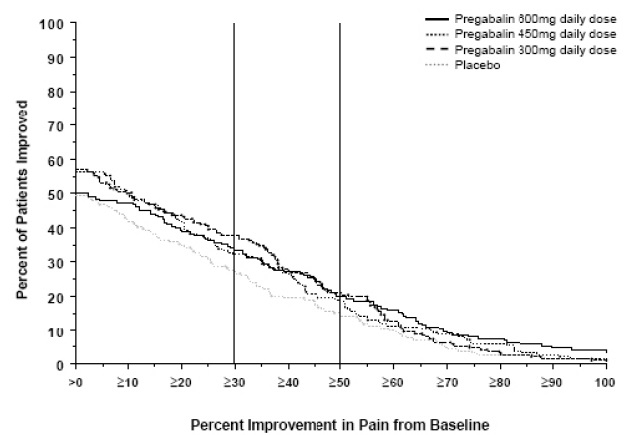
Figure 9 (Pregabalin Fig08)

Figure 9 (Pregabalin Fig08)
A line graph illustrating the percent of patients improved versus percent improvement in pain from baseline for Pregabalin at different daily doses (800 mg, 450 mg, 300 mg) and placebo. The x-axis represents percent improvement in pain from baseline, and the y-axis shows percent of patients improved. Multiple dose responses and placebo are compared.*
FDA Label Image

Figure 10 (Pregabalin Fig09)

Figure 10 (Pregabalin Fig09)
A line graph illustrating the percentage of subjects without LTR (loss to response) over a period of 180 days, comparing Pregabalin and placebo groups. The vertical axis shows the estimated percentage of subjects without LTR, ranging from 0% to 100%, and the horizontal axis represents time in days. The solid line represents Pregabalin, showing a higher percentage of subjects without LTR over time compared to the dashed line representing placebo.*
FDA Label Image

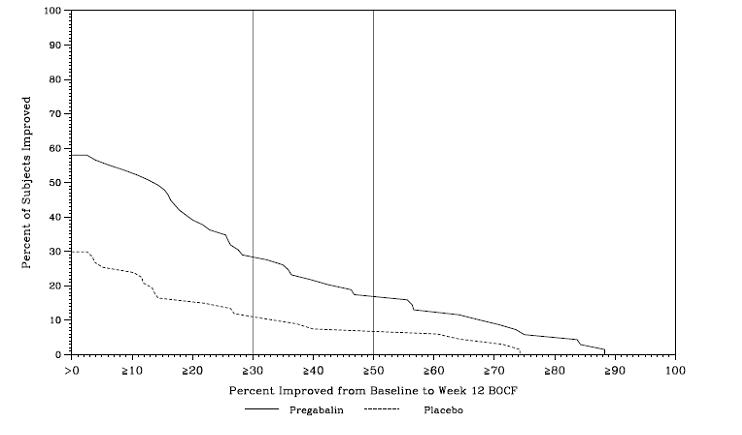
Figure 11 (Pregabalin Fig10)

Figure 11 (Pregabalin Fig10)
A line graph showing the percent of subjects improved versus percent improved from baseline to Week 12 BOCF for Pregabalin capsules (200 mg) compared to placebo. The x-axis represents the percent improved from baseline, and the y-axis represents the percent of subjects improved, with Pregabalin demonstrating higher improvement rates than placebo across most values.*
FDA Label Image

Figure 12 (Pregabalin Fig11)

Figure 12 (Pregabalin Fig11)
A line graph comparing the percent of subjects improved versus the percent improvement from baseline to week 16 BOCF for Pregabalin and placebo groups. The x-axis shows percent improvement from 0 to 100%, and the y-axis shows the percent of subjects improved from 0 to 100%. Pregabalin is represented by a solid line and placebo by a dotted line, with Pregabalin consistently showing higher improvement rates.*
FDA Label Image

Figure 13 (Pregabalin Fig13)

Figure 13 (Pregabalin Fig13)
A bar graph depicting responder rates (%) for three groups: placebo (22.6% responder rate, N=93), 2.5 mg/kg/day dose (29.1% responder rate, N=103), and 10 mg/kg/day dose (40.6% responder rate, N=96). The y-axis represents responder rate in percentage, and the x-axis shows the treatment groups with sample sizes.*
FDA Label Image

Cockcroft And Gault Equation (Pregabalin Formula)

Cockcroft And Gault Equation (Pregabalin Formula)
A text panel displaying the formula for calculating creatinine clearance (CLcr), involving age in years, weight in kilograms, serum creatinine in mg/dL, and an adjustment factor for female patients (0.85). This is a pharmacokinetic-related calculation often referenced in drug dosing panels.*
FDA Label Image

Chemical Structure (Pregabalin Str)

Chemical Structure (Pregabalin Str)
Chemical structure of Pregabalin, showing its molecular arrangement including the amino group (NH2), carboxyl group (CO2H), and hydrocarbon chain with an isobutyl side group.*

* About these descriptions: Image descriptions on this page are generated by automated AI analysis of the product label images from the manufacturer's FDA label submission (SPL). They are provided for reference only and may contain errors or omissions. Always rely on the printed label itself and the official FDA labeling, and consult a pharmacist or healthcare professional with any questions about this product.