- Parenteral drug products should be inspected visually for particulate matter and discoloration prior to administration. Do not administer if discolored or if the vial contains visible particles.
- Do not mix with or administer as an infusion with other medicinal products.
- Prepare the IV infusion line with 1.2 micron in-line filter extension set.
- Administer the IV infusion solution over 60 minutes.
- oThe diluted EBANGA IV solution can be infused via a central line or peripheral catheter. Do not administer EBANGA as an IV push or bolus.
- oDo not co-administer other drugs simultaneously through the same infusion line.
- oInfusions may be slowed or stopped if necessary, to alleviate any side effects.
- At the end of the infusion, if a syringe pump was used, then remove the syringe and flush the line with 2 to 5 mL of diluent, but not to exceed the total infusion volume. If an infusion bag was used, replace the empty bag and flush the line by infusing at least 25 mL of the diluent, to ensure complete product administration.
Common Adverse Events
Table 2 summarizes the adverse events that were reported in the PALM trial from a pre-defined list of signs and symptoms that occurred during EBANGA infusion. The evaluation of adverse events in participants who received EBANGA may have been confounded by the signs and symptoms of the underlying Orthoebolavirus zairense infection. Twenty nine percent (n=51) of participants who received EBANGA in the PALM Trial experienced a pre-specified infusion-related adverse event. The most common pre- specified infusion-related adverse event reported in at least 10% of participants who received EBANGA was fever (Table 2). The adverse event profile in adult and pediatric participants treated with EBANGA was similar.
Table 2: Adverse Events That Occurred During Infusion in >10% of Adult and Pediatric Participants in the PALM Trial| Adverse Event Adverse events in this table were reported on the day of infusion, and included signs and symptoms that occurred during or immediately after infusion | EBANGA
(N=173)
% | Control Investigational therapy administered as three separate infusions
(N=168)
% |
|---|
Pyrexia | 17 | 58 |
Tachycardia | 9 | 32 |
Diarrhea Adverse events that occurred during infusion but were not pre-specified. | 9 | 18 |
Vomiting | 8 | 23 |
Hypotension | 8 | 31 |
Tachypnea | 6 | 28 |
Chills The term chills includes other similar adverse events including rigors and tremors | 5 | 33 |
Hypoxia | 3 | 11 |
The following pre-specified symptoms, which were assessed on a daily basis during admission while admitted to the treatment unit, were reported in ≥40% of participants who received EBANGA: diarrhea, pyrexia, abdominal pain, and vomiting. Evaluation of these symptoms may have been confounded by the underlying Orthoebolavirus zairense infection.
Discontinuation and Infusion Rate Adjustments
Approximately 99% of participants who received EBANGA in the PALM trial were able to complete their dose within one hour. Two participants who received EBANGA (1%) did not receive their complete infusion. In eight participants (5%) the EBANGA infusion rate was decreased due to an AE [see Warnings and Precautions (5.1)].
Selected Laboratory Abnormalities in the PALM Trial
Table 3 presents selected laboratory abnormalities (worsening to Grade 3 or 4 compared to baseline) in the PALM trial.
Table 3: Selected Grade 3 and 4 Laboratory AbnormalitiesGraded per Division of AIDS (DAIDS) v2.1
, Worsened Grade from Baseline in the PALM Trial| Laboratory Test | EBANGA
N=173
% | Control
N=168
% |
|---|
| ULN= upper limit of normal |
Sodium, high ≥ 154 mmol/L | 5 | 4 |
Sodium, low < 125 mmol/L | 7 | 11 |
Potassium, high ≥ 6.5 mmol/L | 15 | 12 |
Potassium, low < 2.5 mmol/L | 6 | 8 |
Creatinine (mg/dL) > 1.8 × ULN or ≥ 1.5 × baseline Based on a ULN of 1.2 mg/dL. | 27 | 23 |
Alanine aminotransferase (U/L) ≥ 5 × ULN Based on a ULN of 47 U/L. | 12 | 14 |
Aspartate aminotransferase (U/L) ≥ 5 × ULN Based on a ULN of 38 U/L. | 13 | 18 |
Risk Summary
Orthoebolavirus zairense infection is life-threatening for both the mother and fetus and treatment should not be withheld due to pregnancy (see Clinical Considerations). Available data from the PALM trial in which pregnant women with Orthoebolavirus zairense infection were treated with EBANGA demonstrate the high rate of maternal and fetal/neonatal morbidity consistent with published literature regarding the risk associated with underlying maternal Orthoebolavirus zairense infection. These data are insufficient to evaluate for a drug associated risk of major birth defects, miscarriage, or adverse maternal/fetal outcome.
Animal reproduction studies with ansuvimab-zykl have not been conducted. Monoclonal antibodies, such as EBANGA, are transported across the placenta; therefore, EBANGA has the potential to be transferred from the mother to the developing fetus.
Clinical Considerations
Disease-associated maternal and/or embryo/fetal risk
Maternal, fetal and neonatal outcomes are poor among pregnant women infected with Orthoebolavirus zairense. The majority of such pregnancies result in maternal death with miscarriage, stillbirth, or neonatal death. Treatment should not be withheld due to pregnancy.
Risk Summary
The Centers for Disease Control and Prevention recommend that mothers with confirmed Orthoebolavirus zairense not breastfeed their infants to reduce the risk of postnatal transmission of Orthoebolavirus zairense infection.
There are no data on the presence of ansuvimab-zykl in human or animal milk, the effects on the breastfed infant, or the effects on milk production. Maternal IgG is known to be present in human milk. The effects of local gastrointestinal exposure and limited systemic exposure in the breastfed infant to ansuvimab-zykl are unknown.
Specific Populations
The effect of age, renal impairment or hepatic impairment on the pharmacokinetics of ansuvimab-zykl is unknown.
Mechanism of Action
EBANGA (ansuvimab-zykl) is a recombinant, human IgG1κ monoclonal antibody that binds to the glycan cap and inner chalice of the EBOV GP1 subunit. The epitope to which it binds is located within the receptor binding domain of EBOV consisting of amino acids LEIKKPDGS (GP residues 111–119).
Ansuvimab-zykl binds EBOV GP without the mucin-like domain with a KD of 0.2 nM at pH 7.4 and 0.6 nM at pH 5.3 as measured by biolayer interferometry. Ansuvimab-zykl blocks binding of EBOV GP1 to the Neiman Pick cell receptor 1 in host cells (half-maximal effective concentration (EC50) value of 0.09 μg/mL), inhibiting virus entry into the host cell. Ansuvimab-zykl exhibited Fc-mediated Antibody Dependent Cellular Cytotoxicity (ADCC) activity against cells expressing EBOV GP when effector cells were added.
Antiviral Activity
In a live virus plaque-reduction neutralization assay performed in Vero E6 cells, ansuvimab-zykl neutralized Orthoebolavirus zairense Mayinga with an EC50 value of 0.06 µg/mL. In a pseudotyped EBOV GP lentivirus infectivity assay using HEK293 cells, ansuvimab-zykl inhibited Orthoebolavirus zairense Mayinga with an EC50 value of 0.09 μg/mL and Orthoebolavirus zairense Makona with an EC50 value of 0.15 μg/mL. The ADCC activity of ansuvimab-zykl was assessed in EBOV GP-transduced and non-transduced HEK293T target cells in the presence of antibody with effector cells added at an effector-to-target cell ratio 1:50 and analyzed via flow cytometry. Ansuvimab-zykl mediated ADCC, with maximal activity observed at mAb concentration of 0.03 μg/mL. Treatment of Orthoebolavirus zairense infected rhesus macaques with a single IV dose of ansuvimab-zykl (50 mg per kg) generally protected infected animals from Orthoebolavirus zairense mediated death when drug was administered 5 days post-infection.
Antiviral Resistance
No in-vivo nonclinical or clinical studies specifically evaluating resistance to ansuvimab-zykl have been conducted. The possibility of resistance to ansuvimab-zykl should be considered in patients who either fail to respond to therapy or who develop relapse of disease after an initial period of responsiveness.
Immune Response
Interaction studies with recombinant live EBOV vaccines and EBANGA have not been conducted [see Drug Interactions (7.1)].
How Supplied
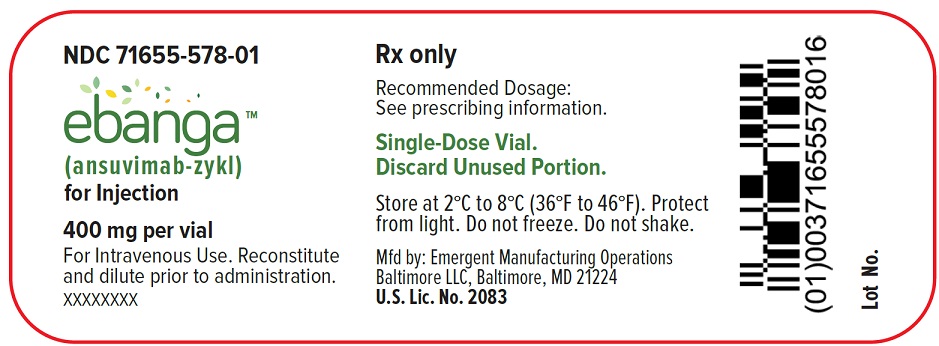
EBANGA (ansuvimab-zykl) for injection is supplied as a sterile, preservative-free, off-white to white lyophilized powder in a single-dose vial (NDC 71655-578-01) for reconstitution and further dilution.
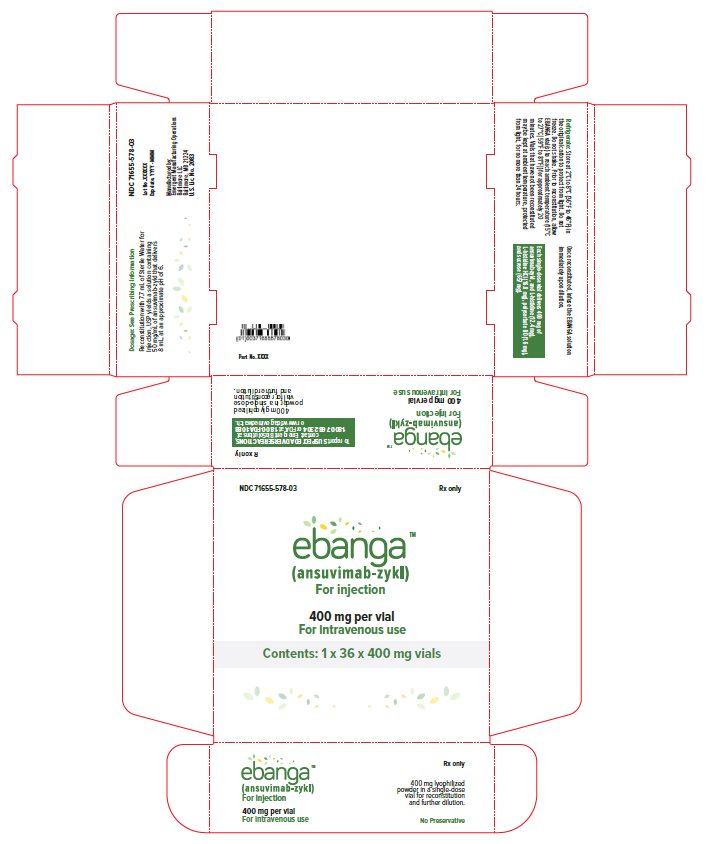
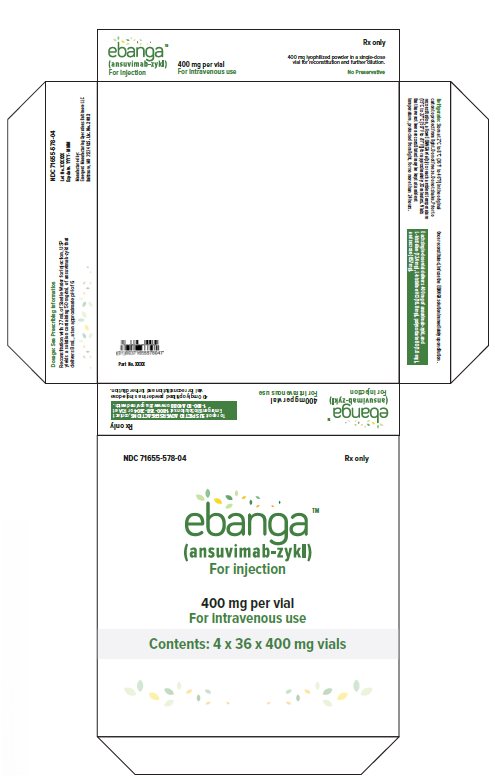
One primary carton (NDC 71655-578-02) contains thirty-six 400 mg vials packaged in a box containing either one primary carton (NDC 71655-578-03), four primary cartons (NDC 71655-578-04), or eight primary cartons (NDC 71655-578-08).
Hypersensitivity Reactions Including Infusion-Associated Events
Inform patients that hypersensitivity reactions including infusion-associated events have been reported during and post-infusion with EBANGA and to immediately report if they experience any symptoms of systemic hypersensitivity reactions [see Warnings and Precautions (5.1)].
Lactation
Instruct patients with Orthoebolavirus zairense not to breastfeed because of the risk of passing Orthoebolavirus zairense to the baby [see Use in Specific Populations (8.2)].
Manufactured by:
Emergent Manufacturing Operations Baltimore LLC
5901 East Lombard St.
Baltimore, MD 21224
U.S. Lic. No. 2083
[EBANGA™ is a trademark of Ridgeback Biotherapeutics, LP]
© 2024 Emergent Manufacturing Operations Baltimore LLC. All rights reserved.