- 1)NUZYRA must be reconstituted and then further diluted under aseptic conditions. To prepare the required dose for intravenous infusion, reconstitute and dilute the appropriate number of vials, as determined from Table 3 below.
- 2)Reconstitute each 100 mg vial of NUZYRA with 5 mL of Sterile Water, 0.9% Sodium Chloride Injection, USP, or 5% Dextrose Injection, USP, for Injection.
- 3)Gently swirl the contents and let the vial stand until the cake has completely dissolved and any foam disperses. Do not shake the vial.
- 4)The reconstituted NUZYRA solution should be yellow to dark orange in color; if not, the solution should be discarded. Visually inspect the reconstituted NUZYRA solution for particulate matter and discoloration prior to further dilution and administration. If necessary, invert the vial to dissolve any remaining powder and swirl gently to prevent foaming.
- 5)Immediately (within 1 hour), withdraw 5 mL or 10 ml of the reconstituted solution and further dilute to a 100 mL (nominal volume) of 0.9% Sodium Chloride Injection, USP, or 5% Dextrose Injection, USP, bag for injection. The concentration of the final diluted infusion solution will either be 1 mg/mL or 2 mg/mL in accordance with Table 3 below. Discard any unused portion of the reconstituted solution.
- 6)Parenteral drug products should be inspected visually for particulate matter and discoloration prior to administration, whenever solution and container permit.
Table 3: Preparation of NUZYRA Intravenous Infusion| NUZYRA for Injection Dose | Number of Vials to Reconstitute for Further Dilution | Volume of Reconstituted Solution (5 mL/vial) to Withdraw for Further Dilution | Final Infusion Concentration of NUZYRA |
|---|
| 200 mg | 2 Vials | 10 mL | 2 mg/mL |
| 100 mg | 1 Vial | 5 mL | 1 mg/mL |
Storage of the Diluted Infusion Solution
The NUZYRA diluted infusion solution may be used within 24 hours at room temperature (less than or equal to 25°C) or within 7 days when refrigerated (2°C to 8°C). Do not freeze. Allow the infusion bag to reach room temperature prior to use.
Administration
After reconstitution and dilution, administer NUZYRA by intravenous infusion, using a total infusion time of 60 minutes for a 200-mg dose, or a total infusion time of 30 minutes for a 100-mg dose [see Dosage and Administration (2.2, 2.3)].
Administer NUZYRA intravenously through a dedicated line or through a Y-site. If the same intravenous line is used for sequential infusion of several drugs, the line should be flushed with 0.9% Sodium Chloride Injection, USP, or 5% Dextrose Injection, USP, before and after infusion of NUZYRA. The compatibility of NUZYRA with other drugs and infusion solutions other than 5% Dextrose Injection, USP or 0.9% Sodium Chloride Injection, USP has not been established.
Overview of the Safety Evaluation of NUZYRA
NUZYRA was evaluated in three Phase 3 clinical trials (Trial 1, Trial 2 and Trial 3). These trials included a single Phase 3 trial in CABP patients (Trial 1) and two Phase 3 trials in ABSSSI patients (Trial 2 and Trial 3). Across all Phase 3 trials, a total of 1073 patients were treated with NUZYRA (382 patients in Trial 1 and 691 in Trials 2 and 3 of which 368 patients were treated with only oral NUZYRA.
Clinical Trial Experience in Patients with Community-Acquired Bacterial Pneumonia
Trial 1 was a Phase 3 CABP trial that enrolled 774 adult patients, 386 randomized to NUZYRA (382 received at least one dose of NUZYRA and 4 patients did not receive the study drug) and 388 randomized to moxifloxacin (all 388 received at least one dose of moxifloxacin). The mean age of patients treated with NUZYRA was 61 years (range 19 to 97 years) and 42% were greater than or equal to 65 years of age. Overall, patients treated with NUZYRA were predominantly male (53.7%), white (92.4%), and had a mean body mass index (BMI) of 27.3 kg/m2. Approximately 47% of NUZYRA treated patients had CrCl <90 ml/min. Patients were administered an IV to oral switch dosage regimen of NUZYRA. The total treatment duration was 7 to 14 days. Mean duration of IV treatment was 5.7 days and mean total duration of treatment was 9.6 days in both treatment arms.
Imbalance in Mortality
In Trial 1, eight deaths (2%) occurred in 382 patients treated with NUZYRA as compared to four deaths (1%) in 388 patients treated with moxifloxacin. All deaths, in both treatment arms, occurred in patients >65 years of age. The causes of death varied and included worsening and/or complications of infection and underlying conditions. The cause of the mortality imbalance has not been established [see Warnings and Precautions (5.1)].
Serious Adverse Reactions and Adverse Reactions Leading to Discontinuation
In Trial 1, a total of 23/382 (6.0%) patients treated with NUZYRA and 26/388 (6.7%) patients treated with moxifloxacin experienced serious adverse reactions.
Discontinuation of treatment due to any adverse reactions occurred in 21/382 (5.5%) patients treated with NUZYRA and 27/388 (7.0%) patients treated with moxifloxacin.
Most Common Adverse Reactions
Table 4 lists the most common adverse reactions occurring in ≥2% of patients receiving NUZYRA in Trial 1.
Table 4: Adverse Reactions Occurring in ≥2% of Patients Receiving NUZYRA in Trial 1| Adverse Reaction | NUZYRA
(N = 382) | Moxifloxacin
(N = 388) |
|---|
| Alanine aminotransferase increased | 3.7 | 4.6 |
| Hypertension | 3.4 | 2.8 |
| Gamma-glutamyl transferase increased | 2.6 | 2.1 |
| Insomnia | 2.6 | 2.1 |
| Vomiting | 2.6 | 1.5 |
| Constipation | 2.4 | 1.5 |
| Nausea | 2.4 | 5.4 |
| Aspartate aminotransferase increased | 2.1 | 3.6 |
| Headache | 2.1 | 1.3 |
Clinical Trials Experience in Patients with Acute Bacterial Skin and Skin Structure Infections
Trial 2 was a Phase 3 ABSSSI trial that enrolled 655 adult patients, 329 randomized to NUZYRA and 326 randomized to linezolid. Trial 3 was a Phase 3 ABSSSI trial that enrolled 735 adult patients, 368 randomized to NUZYRA and 367 randomized to linezolid.
In Trial 2 (IV to oral switch trial), the mean age of patients treated with NUZYRA was 47 years (range 19 to 88). Overall, patients treated with NUZYRA were predominantly male (62.8%), white (91.0%) and had a mean BMI of 28. kg/m2.
In Trial 3 (oral only trial), the mean age of patients was 43 years (range 18 to 86). Patients treated with NUZYRA were predominantly male (65.8%), white (88.9%), and had a mean BMI of 27.9 kg/m2.
In Trials 2 and 3, approximately 12% of NUZYRA treated patients had CrCl <90 ml/min. Overall, the mean and median calculated lesion area was similar across both trials. Trial 2 required at least 3 days of IV treatment followed by switch to oral regimen based on physician's discretion. Mean duration of IV treatment in Trial 2 was 4 days and mean total duration of treatment was 9 days in both treatment arms. In Trial 3, only oral therapy was administered, and mean total duration of treatment was 8 days in both treatment arms. The median days on treatment in the pooled ABSSSI trials was 9 days for both NUZYRA and linezolid.
Serious Adverse Reactions and Adverse Reactions Leading to Discontinuation
In the pooled ABSSSI trials, serious adverse reactions occurred in 16/691 (2.3%) of patients treated with NUZYRA and 13/689 (1.9%) of patients treated with comparator. Discontinuation of treatment due to adverse events occurred in 12 (1.7%) NUZYRA treated patients, and 10 (1.5%) comparator treated patients. There was 1 death (0.1%) reported in NUZYRA treated patients and 3 deaths (0.4%) reported in linezolid patients in ABSSSI trials.
Most Common Adverse Reactions
Table 5 includes the most common adverse reactions occurring in ≥2% of patients receiving NUZYRA in Trials 2 and 3.
Table 5: Adverse Reactions Occurring in ≥2% of Patients Receiving NUZYRA in Pooled Trials 2 and 3| Adverse Reaction | NUZYRA
(N = 691) | Linezolid
(N = 689) |
|---|
| Nausea In Trial 2, which included IV to oral dosing of NUZYRA, 40 (12%) patients experienced nausea and 17 (5%) patients experienced vomiting in NUZYRA treatment group as compared to 32 (10%) patients experienced nausea and 16 (5%) patients experienced vomiting in the comparator group. One patient (0.3%) in the NUZYRA group discontinued treatment due to nausea and vomiting.
In Trial 3, which included the oral loading dose of NUZYRA, 111 (30%) patients experienced nausea and 62 (17%) patients experienced vomiting in NUZYRA treatment group as compared to 28 (8%) patients experienced nausea and 11 (3%) patients experienced vomiting in the linezolid group. One patient (0.3%) in the NUZYRA group discontinued treatment due to nausea and vomiting | 21.9 | 8.7 |
| Vomiting | 11.4 | 3.9 |
| Infusion site reactions Infusion site extravasation, pain, erythema, swelling, inflammation, irritation, peripheral swelling and skin induration. | 5.2 | 3.6 |
| Alanine aminotransferase increased | 4.1 | 3.6 |
| Aspartate aminotransferase increased | 3.6 | 3.5 |
| Headache | 3.3 | 3.0 |
| Diarrhea | 3.2 | 2.9 |
Selected Adverse Reactions Occurring in Less Than 2% of Patients Receiving NUZYRA in Trials 1, 2 and 3
The following selected adverse reactions were reported in NUZYRA-treated patients at a rate of less than 2% in Trials 1, 2 and 3.
Cardiovascular System Disorders: tachycardia, atrial fibrillation
Blood and Lymphatic System Disorders: anemia, thrombocytosis
Ear and Labyrinth Disorders: vertigo
Gastrointestinal Disorders: abdominal pain, dyspepsia
General Disorders and Administration Site Conditions: fatigue
Immune System Disorders: hypersensitivity
Infections and Infestations: oral candidiasis, vulvovaginal mycotic infection
Investigations: creatinine phosphokinase increased, bilirubin increased, lipase increased, alkaline phosphatase increased
Nervous System Disorders: dysgeusia, lethargy
Respiratory, Thoracic, and Mediastinal disorders: oropharyngeal pain
Skin and Subcutaneous Tissue Disorders: pruritus, erythema, hyperhidrosis, urticaria
Risk Summary
NUZYRA, like other tetracycline-class antibacterial drugs, may cause discoloration of deciduous teeth and reversible inhibition of bone growth when administered during the second and third trimester of pregnancy [see Warnings and Precautions (5.2, 5.3), Data, Use in Specific Populations (8.4)].
The limited available data of NUZYRA use in pregnant women is insufficient to inform drug associated risk of major birth defects and miscarriages. Animal studies indicate that administration of omadacycline during the period of organogenesis resulted in fetal loss and/or congenital malformations in pregnant rats and rabbits at 7 times and 3 times the mean AUC exposure, respectively, of the clinical intravenous dose of 100-mg and the oral dose of 300-mg. Reductions in fetal weight occurred in rats at all administered doses (see Data). In a fertility study, administration to rats during mating and early pregnancy resulted in embryo loss at 20 mg/kg/day; systemic exposure based on AUC was approximately equal to the clinical exposure level [see Nonclinical Toxicology (13.1)]. Results of studies in rats with omadacycline have shown tooth discoloration.
The estimated background risk of major birth defects and miscarriage for the indicated population is unknown. All pregnancies have a background risk of birth defect, loss, or other adverse outcomes. In the U.S. general population, the estimated background risk of major birth defects and miscarriage in clinically recognized pregnancies is 2 to 4% and 15-20%.
Data
Animal Data
Intravenous infusion of omadacycline to pregnant rats during organogenesis (gestation days 6-17) at doses of 5 to 80 mg/kg/day resulted in maternal lethality at 80 mg/kg/day. Increased embryo-fetal lethality and fetal malformations (whole body edema) occurred at 60 mg/kg/day (7 times the clinical AUC), dose-dependent reductions in fetal body weight occurred at all doses, and delayed skeletal ossification occurred at doses as low as 10 mg/kg/day (Systemic exposure based on AUC at a similar dose in unmated female rats in a separate study was approximately half the clinical exposure). In pregnant rabbits, intravenous infusion of 5, 10 or 20 mg/kg/day during organogenesis (gestation days 7-18) resulted in maternal lethality and body weight loss at 20 mg/kg/day. Embryo-fetal lethality, congenital malformations of the skeleton, and reduced fetal weight also occurred at 20 mg/kg/day (7 times the clinical AUC). Cardiac and lung malformations were present in dose-related incidence at 10 and 20 mg/kg/day. The fetal no-adverse-effect-level in the rabbit embryo-fetal development study was 5 mg/kg/day, at approximately 1.2 times the clinical steady state AUC.
Intravenous infusion of omadacycline to pregnant and lactating rats at doses of 7.5, 15 and 30 mg/kg/day did not adversely affect survival, growth (other than lower pup body weights and/or gains at the high dose that were only statistically significant at sporadic intervals), postnatal development, behavior, or reproductive capability of offspring at maternal doses up to 30 mg/kg/day (approximately equivalent to 3 times the IV clinical dose of 100 mg/day, based on doses normalized for total body surface area), the highest dose tested, although dosing was discontinued early in a number of animals in this group due to injection site intolerance.
Results of animal studies indicate that tetracyclines cross the placenta, are found in fetal tissues, and can have toxic effects on the developing fetus (often related to retardation of skeletal development). Evidence of embryotoxicity also has been noted in animals treated early in pregnancy.
Risk Summary
There is no information on the presence of omadacycline in human milk, the effects on the breastfed infant or the effects on milk production. Tetracyclines are excreted in human milk; however, the extent of absorption of tetracyclines, including omadacycline, by the breastfed infant is not known. Because there are other antibacterial drug options available to treat CABP and ABSSSI in lactating women and because of the potential for serious adverse reactions, including tooth discoloration and inhibition of bone growth, advise patients that breastfeeding is not recommended during treatment with NUZYRA and for 4 days (based on half-life) after the last dose.
Contraception
Females
NUZYRA may produce embryonic or fetal harm [see Use in Specific Populations (8.1)]. Advise patients to use an acceptable form of contraception while taking NUZYRA.
Infertility
Males
In rat studies, injury to the testis and reduced sperm counts and motility occurred in male rats after treatment with omadacycline [see Nonclinical Toxicology (13.1)].
Females
In rat studies, omadacycline affected fertility parameters in female rats, resulting in reduced ovulation and increased embryonic loss at intended human exposures [see Nonclinical Toxicology (13.1)].
Cardiac Electrophysiology
Based on the nonclinical and clinical data, including electrocardiogram evaluation in the phase 3 clinical trials, one of which had moxifloxacin as a control group, no clinically relevant QTc prolongation was observed at the maximum recommended dose of omadacycline.
Cardiac Physiology-Increase in Heart Rate
In phase 1 studies conducted in healthy volunteers, reversible dose-dependent increases in heart rate have been observed following administration of single and multiple doses of omadacycline. The clinical implication of this finding is unknown [see Adverse Reactions (6.1)].
In a standard radiolabeled ligand binding assays, omadacycline was shown to inhibit binding of H-scopolamine to the M2 subtype of the muscarinic acetylcholine receptor. In the heart, muscarinic M2 receptors serve as mediators of the parasympathetic input that normally is received via the vagus nerve and stimulation of the receptor increases membrane potassium conductance through the acetylcholine-dependent channel, which slows depolarization and reduces pacemaker activity in the sinoatrial node.
Absorption
The exposure to omadacycline is similar between a 300-mg oral dose and a 100-mg intravenous dose of NUZYRA in healthy fasted subjects.
Effect of Food
Ingestion of a standard high-fat nondairy meal (855 calories; 59% calories from fat) and standard high-fat meal including dairy (985 calories; 60% calories from fat) 2-hours before administration of a single 300-mg oral dose of NUZYRA decreased the rate (Cmax) and extent of absorption (AUC) by 40% and 42%, and 59% and 63%, respectively compared to administration of NUZYRA under fasting conditions. The rate and extent of absorption of NUZYRA were not substantially decreased when a high-fat nondairy meal (800-1000 calories; 50% calories from fat) was ingested 4 hours pre-dose.
Following ingestion of either a light non-fat (300-350 calories; ≤5% calories from fat), or a standard low-fat (800-1000 calories; 30% calories from fat), or a standard high fat (800-1000 calories; 50% calories from fat) meal 2 hours post-dose, the AUC and Cmax were not substantially altered, as compared to fasting conditions.
Distribution
Plasma protein binding of omadacycline is approximately 20% and is not concentration dependent. The mean (% CV) volume of distribution of omadacycline at steady-state following IV administration of NUZYRA in healthy subjects was 190 (27.7) L.
Elimination
Renal clearance of omadacycline following IV administration of NUZYRA ranged from 2.4 to 3.3 L/h in healthy subjects.
Metabolism
In vitro studies using human liver microsomes and hepatocytes demonstrated that omadacycline is not metabolized.
Excretion
Following a 100-mg IV dose of NUZYRA, 27% of the dose was recovered as unchanged omadacycline in the urine. In healthy male volunteers receiving 300-mg oral [14C] NUZYRA, 77.5% to 84.0% of the dose was recovered in the feces, approximately 14.4 % (range 10.8% to 17.4%) in the urine, with 95.5% of the administered radioactive dose recovered after 7 days.
Lung Penetration
The mean omadacycline concentrations over time for alveolar cells (AC), epithelial lining fluid (ELF), and plasma following IV administration of multiple doses of 100-mg of NUZYRA to healthy volunteers are shown in Figure 1. The steady-state omadacycline AUC0-24h (302.5 hr*mcg/mL) in AC was 25.8-fold higher than the plasma AUC0-24h, and the AUC0-24h (17.2 hr*mcg/mL) in ELF was 1.5-fold higher than the AUC0-24h in plasma.
Figure 1: Mean (± SD) Concentrations of Omadacycline in Alveolar Cells, Epithelial Lining, and Plasma Following Multiple 100 mg IV Doses of NUZYRA to Healthy Subjects During Bronchoscopy Sampling Times
Specific Populations
No clinically significant differences in the pharmacokinetics of omadacycline were observed based on age, gender, race, weight, renal impairment or end-stage renal disease, and hepatic impairment.
Patients with Renal Impairment
A study was conducted to compare NUZYRA pharmacokinetics following 100-mg IV administration in 8 subjects with end-stage renal disease (ESRD) on stable hemodialysis, with and 8 -matched healthy control subjects. In the ESRD subjects, NUZYRA was administered on two separate occasions; immediately prior to dialysis and after dialysis, and the AUC, Cmax, and CL of NUZYRA were comparable between the renally impaired subjects and the matching healthy subjects. During dialysis, 7.9% of omadacycline was recovered in the dialysate. Renal impairment did not impact NUZYRA elimination.
Patients with Hepatic Impairment
A study was conducted to compare NUZYRA pharmacokinetics following intravenous and oral dosing to 5 subjects with mild hepatic impairment (Child-Pugh Class A), 6 subjects with moderate hepatic impairment (Child-Pugh Class B), and 6 subjects with severe hepatic impairment (Child-Pugh Class C) as compared to 12 matched healthy control subjects. The AUC and Cmax of NUZYRA were comparable between the hepatically impaired subjects and the matching healthy subjects, and similar clearance was observed across all cohorts. Hepatic impairment did not impact NUZYRA elimination.
Drug Interaction Studies
Clinical Studies
Administration of oral verapamil (P-gp inhibitor) two hours prior to a single 300 mg oral dose of NUZYRA increased omadacycline AUC by approximately 25% and Cmax by approximately 9%.
In vitro Studies
In vitro studies in human liver microsomes indicate that omadacycline does not inhibit nor induce metabolism mediated by CYP 1A1, 1A2, 2A6, 2B6, 2C8, 2C9, 2C19, 2D6, and 3A4/5, or UGT1A1. Therefore, NUZYRA is not expected to alter the pharmacokinetics of drugs metabolized by the above stated human hepatic enzymes.
Omadacycline is not an inhibitor of P-gp and organic anion transporting polypeptide (OATP) 1B1 and OATP1B3. Omadacycline is a substrate of P- gp (see Clinical Studies above). Omadacycline is not a substrate or inhibitor of the major organic anion transporters (OAT-1 and 3), breast cancer resistance protein (BCRP), or multidrug resistance-associated protein 2 (MRP2). Omadacycline was not an OATP1B1 or OATP1B3 substrate at supra-therapeutic concentrations (5-13 fold higher than clinically relevant concentrations).
Mechanism of Action
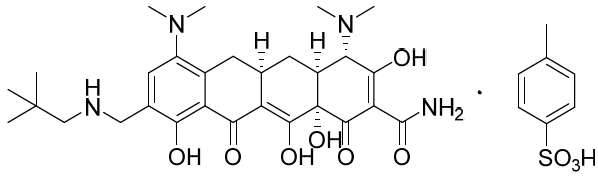
Omadacycline is an aminomethylcycline antibacterial within the tetracycline class of antibacterial drugs. Omadacycline binds to the 30S ribosomal subunit and blocks protein synthesis. In general, omadacycline is considered bacteriostatic; however, omadacycline has demonstrated bactericidal activity against some isolates of S. pneumoniae and H. influenzae.
Resistance
The following in vitro data are available, but their clinical significance is unknown. Omadacycline was active in vitro against Gram-positive bacteria expressing ribosomal protection proteins (TetM) and tetracycline resistance active efflux pumps (TetK and TetL), and in Enterobactericeae expressing the TetB efflux pump. Additionally, omadacycline was active against some S. aureus, S. pneumoniae, and H. influenzae strains carrying macrolide resistance genes (ermA, B and/or C), or ciprofloxacin resistance genes (gyrA and parC) and beta-lactamase positive H. influenzae.
Interaction with Other Antimicrobials
In vitro studies have not demonstrated antagonism between omadacycline and other commonly used antibacterials (ampicillin, ceftazidime, ceftriaxone, imipenem, piperacillin/tazobactam, gentamicin, vancomycin, daptomycin, linezolid).
Antimicrobial Activity
Omadacycline has been shown to be active against most isolates of the following bacteria, both in vitro and in clinical infections [see Indications and Usage (1.1, 1.2)].
Community-Acquired Bacterial Pneumonia (CABP)
- Gram-positive bacteria
Streptococcus pneumoniae
Staphylococcus aureus (methicillin-susceptible isolates)