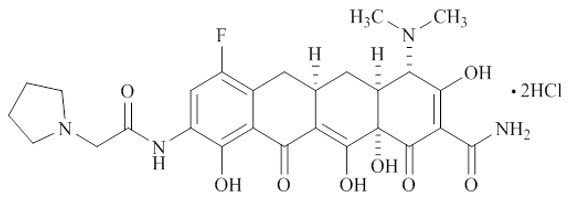
Following single-dose intravenous administration, eravacycline AUC and Cmax increase approximately dose-proportionally over doses from 1 mg/kg to 3 mg/kg (3 times the approved dose).
The mean exposure of eravacycline after single and multiple intravenous infusions (approximately 60 minutes) of 1 mg/kg administered to healthy adults every 12 hours is presented in Table 2.
There is approximately 45% accumulation following intravenous dosing of 1 mg/kg every 12 hours.
Table 2 Mean (%CV) Plasma Exposure of Eravacycline After Single and Multiple Intravenous Dose in Healthy AdultsAbbreviations: Cmax = maximum observed plasma concentration, CV = coefficient of variation; AUC0-12 = area under the plasma concentration-time curve from time 0 to 12 hours.
a AUC of day 1 equals AUC0-12 after the first dose of eravacycline.
b AUC of day 10 equals steady state AUC0-12. |
| Exposure [Arithmetic Mean (%CV)] |
| Cmax (ng/mL) | AUC0-12 (ng∙h/mL) |
Day 1 | 2125 (15) | 4305 (14)a |
Day 10 | 1825 (16) | 6309 (15)b |
Distribution
Protein binding of eravacycline to human plasma proteins increases with increasing plasma concentrations, with 79% to 90% (bound) at plasma concentrations ranging from 100 to 10,000 ng/mL. The volume of distribution at steady-state is approximately 321 L.
Elimination
The mean elimination half-life is 20 hours.
Metabolism
Eravacycline is metabolized primarily by CYP3A4- and FMO-mediated oxidation.
Excretion
Following a single intravenous dose of radiolabeled eravacycline 60 mg, approximately 34% of the dose is excreted in urine and 47% in feces as unchanged eravacycline (20% in urine and 17% in feces) and metabolites.
Specific Populations
No clinically significant differences in the pharmacokinetics of eravacycline were observed based on age (18-86 years), sex, and race.
Patients with Renal Impairment
The geometric least square mean Cmax for eravacycline was increased by 8.8% for subjects with end stage renal disease (ESRD) versus healthy subjects with 90% CI -19.4, 45.2. The geometric least square mean AUC0-inf for eravacycline was decreased by 4.0% for subjects with ESRD versus healthy subjects with 90% CI -14.0, 12.3 [see Use in Specific Populations (8.7)].
Patients with Hepatic Impairment
Eravacycline Cmax was 13.9%, 16.3%, and 19.7% higher in subjects with mild (Child-Pugh Class A), moderate (Child-Pugh Class B), and severe (Child‑Pugh Class C) hepatic impairment versus healthy subjects, respectively. Eravacycline AUC0-inf was 22.9%, 37.9%, and 110.3% higher in subjects with mild, moderate, and severe hepatic impairment versus healthy subjects, respectively [see Dosage and Administration (2.2) and Use in Specific Populations (8.6)].
Drug Interaction Studies
Clinical Studies
Concomitant use of rifampin (strong CYP3A4/3A5 inducer) decreased eravacycline AUC by 35% and increased eravacycline clearance by 54% [see Dosage and Administration (2.3) and Drug Interactions (7.1)].
Concomitant use of itraconazole (strong CYP3A inhibitor) increased eravacycline Cmax by 5% and AUC by 32%, and decreased eravacycline clearance by 32%.
In Vitro Studies
Eravacycline is not an inhibitor of CYP1A2, 2B6, 2C8, 2C9, 2C19, 2D6, or 3A4/5. Eravacycline is not an inducer of CYP1A2, 2B6, or 3A4.
Eravacycline is not a substrate for P-glycoprotein (P-gp), breast cancer resistance protein (BCRP), bile salt export pump (BSEP), organic anion transporter peptide (OATP)1B1, OATP1B3, organic ion transporter (OAT)1, OAT3, OCT1, OCT2, multidrug and toxin extrusion (protein) (MATE)1, or MATE2-K transporters.
Eravacycline is not an inhibitor of BCRP, BSEP, OATP1B1, OATP1B3, OAT1, OAT3, OCT1, OCT2, MATE1, or MATE2-K transporters.