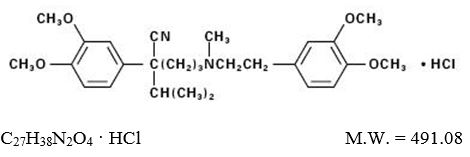
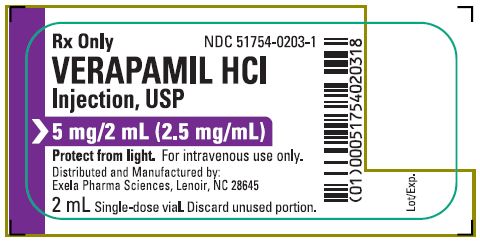
Drug interactions: (See
Warnings: Concomitant antiarrhythmic therapy.) Intravenous Verapamil has been used concomitantly with other cardioactive drugs (e.g., digitalis) without evidence of serious negative drug interactions. In rare instances, including when patients with severe cardiomyopathy, congestive heart failure, or recent myocardial infarction were given
intravenous beta-adrenergic blocking agents or disopyramide concomitantly with intravenous Verapamil, serious adverse effects have occurred. Concomitant use of Verapamil with agents that decrease adrenergic function may result in an exaggerated hypotensive response. Animal studies suggest concomitant use of intravenous Verapamil and intravenous dantrolene sodium may result in cardiovascular collapse. The clinical relevance of these findings is unknown.
Cimetidine has no effect on intravenous Verapamil kinetics. As Verapamil is highly bound to plasma proteins, it should be administered with caution to patients receiving other highly protein-bound drugs.
Animal experiments have shown that inhalation anesthetics depress cardiovascular activity by decreasing the inward movement of calcium ions. When used concomitantly, inhalation anesthetics and calcium antagonists, such as Verapamil, should each be titrated carefully to avoid excessive cardiovascular depression.
Clinical data and animal studies suggest that Verapamil may potentiate the activity of neuromuscular blocking agents (curare-like and depolarizing). It may be necessary to decrease the dose of Verapamil and/or the dose of the neuromuscular blocking agent when the drugs are used concomitantly.
Telithromycin:
Hypotension and bradyarrhythmias have been observed in patients receiving concurrent telithromycin, an antibiotic in the ketolide class.
Clonidine: Sinus bradycardia resulting in hospitalization and pacemaker insertion has been reported in association with the use of clonidine concurrently with Verapamil. Monitor heart rate in patients receiving concomitant Verapamil and clonidine.
HMG-CoA reductase inhibitors: The use of HMG-CoA reductase inhibitors that are CYP3A4 substrates in combination with Verapamil has been associated with reports of myopathy/rhabdomyolysis.
Co-administration of multiple doses of 10 mg of Verapamil with 80 mg simvastatin resulted in exposure to simvastatin 2.5-fold that following simvastatin alone. Limit the dose of simvastatin in patients on Verapamil to 10 mg daily. Limit the daily dose of lovastatin to 40 mg. Lower starting and maintenance doses of other CYP3A4 substrates (e.g., atorvastatin) may be required as Verapamil may increase the plasma concentration of these drugs.
Ivabradine: Concurrent use of verapamil increases exposure to Ivabradine and may exacerbate bradycardia and conductions disturbances. Avoid concomitant use of Ivabradine and verapamil.
Pregnancy: Pregnancy Category C. Reproduction studies have been performed in rabbits and rats at oral Verapamil doses up to 1.5 (15 mg/kg/day) and 6 (60 mg/kg/day) times the human oral daily dose, respectively, and have revealed no evidence of teratogenicity. In the rat, however, this multiple of the human dose was embryocidal and retarded fetal growth and development, probably because of adverse maternal effects reflected in reduced weight gains of the dams. This oral dose has also been shown to cause hypotension in rats. There are, however, no adequate and well-controlled studies in pregnant women. Because animal reproduction studies are not always predictive of human response, this drug should be used during pregnancy only if clearly needed.
Labor and delivery: There have been few controlled studies to determine whether the use of Verapamil during labor or delivery has immediate or delayed adverse effects on the fetus, or whether it prolongs the duration of labor or increases the need for forceps delivery or other obstetric intervention. Such adverse experiences have not been reported in the literature, despite a long history of use of intravenous Verapamil in Europe in the treatment of cardiac side effects of beta-adrenergic agonist agents used to treat premature labor.
Nursing mothers: Verapamil crosses the placental barrier and can be detected in umbilical vein blood at delivery. Also, verapamil is excreted in human milk. Because of the potential for serious adverse reactions in nursing infants from Verapamil, nursing should be discontinued while Verapamil is administered.
Pediatric use: Controlled studies with Verapamil have not been conducted in pediatric patients, but uncontrolled experience with intravenous administration in more than 250 patients, about half under 12 months of age and about 25% newborn, indicates that results of treatment are similar to those in adults. However, in rare instances, severe hemodynamic side effects have occurred following the intravenous administration of verapamil in neonates and infants. Caution should therefore be used when administering Verapamil to this group of pediatric patients. The most commonly used single doses in patients up to 12 months of age have ranged from 0.1 to 0.2 mg/kg of body weight, while in patients aged 1 to 15 years, the most commonly used single doses ranged from 0.1 to 0.3 mg/kg of body weight. Most of the patients received the lower dose of 0.1 mg/kg once, but in some cases, the dose was repeated once or twice every 10 to 30 minutes.