Description
Propranolol Hydrochloride, USP is a synthetic beta-adrenergic receptor blocking agent chemically described as (+)-1-(isopropylamino)-3-(1-naphthyloxy)-2-propanol hydrochloride. Its structural formula is:
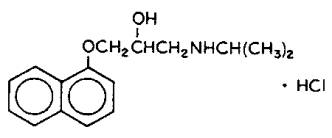
Structural Formula (Propranolol Injection 1)
C 16H 21NO 2•HCl
Propranolol Hydrochloride, USP is a stable, white, crystalline solid which is readily soluble in water and ethanol. Its molecular weight is 295.80.
Propranolol Hydrochloride Injection, USP is available as a sterile injectable solution for intravenous administration. Each mL contains 1 mg of Propranolol Hydrochloride, USP in Water for Injection, USP. The pH is adjusted with anhydrous Citric Acid, USP.


