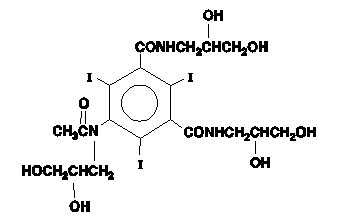
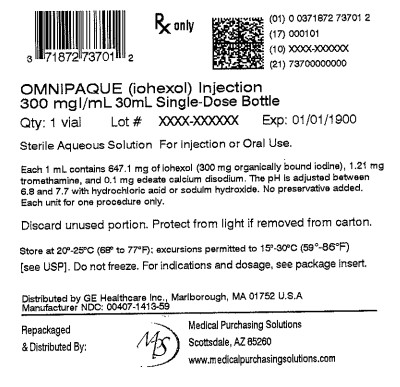
Adverse reactions reported in pediatric patients following intra-arterial or intravenous administration of OMNIPAQUE were generally similar in quality and frequency to those reported in adults. A total of 391 pediatric patients in clinical trials were administered OMNIPAQUE 240 mg iodine/mL, 300 mg iodine/mL, or 350 mg iodine/mL by intra-arterial or intravenous injection for pediatric cardiac ventriculography, excretory urography, and CT head imaging.
Adverse reactions (≥1%) were vomiting (2%) and nausea (1%).
- Cardiac disorders:Ventricular tachycardia, 2:1 heart block, hypertension, anemia
- General disorders and administration site conditions:Pain, fever
- Nervous system disorders:Convulsion, taste abnormality
- Respiratory, thoracic and mediastinal disorders:Congestion, apnea
- Endocrine disorders:Hypoglycemia
- Skin and subcutaneous tissue disorders:Rash
Oral or Rectal Administration for Examination of the Gastrointestinal Tract
Adults
A total of 54 adult patients were administered undiluted OMNIPAQUE 350 mg iodine/mL by oral route for radiographic examination of the gastrointestinal tract in clinical trials. Adverse reactions (≥1%) are presented in Table 19.
Table 19. Adverse Reactions (≥1%) in Adult Patients Following Oral Administration of Undiluted OMNIPAQUE 350 mg Iodine/mL in Clinical Trials| System Organ Class | Adverse Reaction | Incidence
N=54
|
|---|
| Gastrointestinal disorders | Diarrhea | 42% |
| Nausea | 15% |
| Vomiting | 11% |
| Abdominal Pain | 7% |
| Flatulence | 2% |
| Nervous system disorders | Headache | 2% |
Pediatrics Patients
A total of 58 pediatric patients were administered OMNIPAQUE by oral or rectal administration in clinical trials. Adverse reactions (≥1%) are presented in Table 20.
Table 20. Adverse Reactions (≥1%) in Pediatric Patients Following Oral or Rectal Administration of OMNIPAQUE in Clinical Trials| System Organ Class | Adverse Reaction | Incidence
N=58
|
|---|
| Gastrointestinal disorders | Diarrhea | 36% |
| Vomiting | 9% |
| Nausea | 5% |
| Abdominal pain | 2% |
| General disorders and administration site conditions | Fever | 5% |
| Skin and subcutaneous tissue disorders | Urticaria | 2% |
| Vascular disorders | Hypotension | 2% |
Oral Administration for CT of the Abdomen in Conjunction with Intravenous Administration
Adults
A total of 44 adult patients received diluted OMNIPAQUE (4-9 mg iodine/mL) by oral route in conjunction with intravenously injected OMNIPAQUE 300 mg iodine/mL for CT examination of the abdomen in clinical trials. Adverse reactions (≥1%) were limited to a single report of vomiting (2.3%).
Pediatric Patients
A total of 69 pediatric patients received diluted OMNIPAQUE (9-29 mg iodine/mL) by oral route in conjunction with intravenously administered OMNIPAQUE 240 mg iodine/mL or OMNIPAQUE 300 mg iodine/mL for CT examination of the abdomen in clinical trials. Adverse reactions (≥1%) were limited to a single report of vomiting (1.4%).
Intraarticular Administration
Arthrography in Adults
A total of 285 adult patients received OMNIPAQUE 240 mg iodine/mL, 300 mg iodine/mL, or 350 mg iodine/mL for various body cavity examinations in clinical trials. The most frequent adverse reactions (≥1%) were administration site pain (26%) and swelling (22%) in arthrography. Patients also experienced heat (7%).
Body Cavity Use
VCU in Pediatric Patients
No new adverse reactions associated with the use of OMNIPAQUE for VCU procedures were reported in 51 pediatric patients studied.
General
Immune system disorders:Hypersensitivity reactions, anaphylactic or anaphylactoid reactions, anaphylactic or anaphylactoid shock including life-threatening or fatal anaphylaxis
General disorders and administration site conditions:Pyrexia, chills, pain and discomfort, asthenia, administration site conditions including extravasation
Intrathecal Administration
Nervous system disorders:Meningism, aseptic meningitis, seizures or status epilepticus, disorientation, coma, depressed or loss of consciousness, transient contrast-induced toxic encephalopathy (including amnesia, hallucination, paralysis, paresis, speech disorder, aphasia, dysarthria), restlessness, tremors, hypoesthesia
Musculoskeletal and connective tissue disorders: Pain, muscle spasms or spasticity
Psychiatric disorders:Confusional state, agitation, anxiety
Eye disorders:Transient visual impairment including cortical blindness
Renal and urinary disorders:Acute kidney injury
Intra-arterial or Intravenous Administration
Cardiac disorders:Severe cardiac complications (including cardiac arrest, cardiopulmonary arrest), shock, peripheral vasodilatation, palpitations, vasospasm including spasm of coronary arteries, myocardial infarction, syncope, cyanosis, pallor, flushing, chest pain
Vascular disorders:Vasospasm and thrombophlebitis following intravenous injection
Blood and lymphatic system disorders:Neutropenia
Nervous system disorders:Disorientation, coma, depressed or loss of consciousness, transient contrast-induced toxic encephalopathy (including amnesia, hallucination, paralysis, paresis, speech disorder, aphasia, dysarthria), restlessness, tremors, hypoesthesia
Psychiatric disorders:Confusional state, agitation
Eye disorders:Eye irritation or itchiness, periorbital edema, ocular or conjunctival hyperemia, lacrimation
Renal and urinary disorders:Acute kidney injury, toxic nephropathy (CIN), transient proteinuria, oliguria or anuria, increased serum creatinine
Gastrointestinal disorders:Abdominal pain, pancreatitis aggravated, salivary gland enlargement
Endocrine disorders:Hyperthyroidism, hypothyroidism
Respiratory, thoracic and mediastinal disorders:Respiratory distress, respiratory failure, pulmonary edema, bronchospasm, laryngospasm, throat irritation, throat tightness, laryngeal edema, wheezing, chest discomfort, asthmatic attack
Skin and subcutaneous tissue disorders:Contrast media reactions range from mild (e.g., pleomorphic rashes, drug eruption, erythema and skin discoloration, blisters, hyperhidrosis, angioedema, localized areas of edema) to severe (e.g., Stevens-Johnson syndrome and toxic epidermal necrolysis [SJS/TEN], bullous or exfoliative dermatitis, acute generalized exanthematous pustulosis [AGEP] and drug reaction with eosinophilia and systemic symptoms [DRESS])
Oral Administration
Gastrointestinal disorders:Dysphagia, abdominal pain
Body Cavity Administration
Gastrointestinal disorders:Pancreatitis
Musculoskeletal and connective tissue disorders:Arthritis (arthrography)
Hysterosalpingography: Injection of OMNIPAQUE for hysterosalpingography is associated with immediate, transient pain. Monitor injection pressure and volume instilled to minimize pain and to avoid disruptive distention of the uterus and fallopian tubes. Fluoroscopic monitoring is recommended.
Nervous system disorders: Pain (49%), somnolence and fever each with an individual incidence of 3%
Gastrointestinal disorders: Nausea (3%)
Metformin
In patients with renal impairment, metformin can cause lactic acidosis. Iodinated contrast agents appear to increase the risk of metformin-induced lactic acidosis, possibly as a result of worsening renal function. Stop metformin at the time of, or prior to, OMNIPAQUE administration in patients with an eGFR between 30 and 60 mL/min/1.73 m
2; in patients with a history of hepatic impairment, alcoholism or heart failure; or in patients who will be administered intra-arterial iodinated contrast. Re-evaluate eGFR 48 hours after the imaging procedure, and reinstitute metformin only after renal function is stable.
Radioactive Iodine
OMNIPAQUE may interfere with thyroid uptake of radioactive iodine (I-131 and I-123) and decrease therapeutic and diagnostic efficacy. Avoid thyroid therapy or testing for up to 6 weeks post OMNIPAQUE.
Protein-Bound Iodine Test
Iodinated contrast agents, including OMNIPAQUE, will temporarily increase protein-bound iodine in blood. Do not perform protein-bound iodine test for at least 16 days following administration of OMNIPAQUE. However, thyroid function tests that do not depend on iodine estimation, e.g., T
3resin uptake or direct thyroxine assays, are not affected.
Risk Summary
Hysterosalpingography is contraindicated in pregnant women due to the potential risk to the fetus from an intrauterine procedure
[see
Contraindications (4)].
There are no data with iohexol use in pregnant women to inform any drug-associated risks. Iohexol crosses the placenta and reaches fetal tissues in small amounts
(see
Data)
. In animal reproduction studies, no developmental toxicity occurred with intravenous iohexol administration to rats and rabbits at doses up to 0.4 (rat) and 0.5 (rabbit) times the maximum recommended human intravenous dose (
see
Data).
The estimated background risk of major birth defects and miscarriage for the indicated population is unknown. All pregnancies have a background risk of birth defect, loss or other adverse outcomes. In the U.S. general population, the estimated background risk of major birth defects and miscarriage in clinically recognized pregnancies is 2 to 4% and 15 to 20%, respectively.
Data
Human Data
Literature reports show that intravenously administered iohexol crosses the placenta and is visualized in the digestive tract of exposed infants after birth.
Animal Data
Iohexol was neither embryotoxic nor teratogenic in either rats or rabbits at the following dose levels tested: 1.0, 2.0, 4.0 g iodine/kg in rats, administered intravenously to 3 groups of 25 dams once daily during days 6 through 15 of pregnancy; 0.3, 1.0, 2.5 g iodine/kg in rabbits, administered intravenously to 3 groups of 18 rabbits dosed once a day during days 6 through 18 of pregnancy.
Risk Summary
Published literature reports that breast feeding after intravenous iohexol administration to the mother would result in the infant receiving an oral dose of approximately 0.7% of the maternal intravenous dose; however, lactation studies have not been conducted with oral, intrathecal, or intracavity administration of iohexol. There is no information on the effects of the drug on the breastfed infant or on milk production. Iodinated contrast agents are excreted unchanged in human milk in very low amounts with poor absorption from the gastrointestinal tract of a breastfed infant. Exposure to iohexol to a breastfed infant can be minimized by temporary discontinuation of breastfeeding (see
Clinical Considerations). The developmental and health benefits of breastfeeding should be considered along with the mother's clinical need for OMNIPAQUE and any potential adverse effects on the breastfed infant from OMNIPAQUE or from the underlying maternal condition.
Clinical Considerations
Interruption of breastfeeding after exposure to iodinated contrast agents is not necessary because the potential exposure of the breastfed infant to iodine is small. However, a lactating woman may consider interrupting breastfeeding and pumping and discarding breast milk for 10 hours (approximately 5 elimination half-lives) after OMNIPAQUE administration to minimize drug exposure to a breastfed infant.
Intrathecal Use
The safety and effectiveness of OMNIPAQUE have been established in pediatric patients aged 2 weeks and older for myelography and CT myelography (lumbar, thoracic, cervical, total columnar) and for CT cisternography. Use of OMNIPAQUE is supported by controlled clinical studies in adults for myelography, in addition to clinical studies in pediatric patients undergoing myelography.
The safety and effectiveness of OMNIPAQUE have not been established for intrathecal use in pediatric patients less than 2 weeks of age.
The safety and effectiveness of OMNIPAQUE for CT cerebral ventriculography have not been established in pediatric patients.
Intra-arterial or Intravenous Use
Cardiac Ventriculography, Aortography, and Pulmonary Angiography
The safety and effectiveness of OMNIPAQUE have been established in pediatric patients from birth to 17 years of age for cardiac ventriculography, aortography, and pulmonary angiography. Use of OMNIPAQUE is supported by controlled clinical studies in adults for cardiac ventriculography and aortography, in addition to controlled clinical studies in pediatric patients undergoing cardiac ventriculography, including aortography.
Excretory Urography
The safety and effectiveness of OMNIPQUE have been established in pediatric patients from birth to 17 years of age for excretory urography. Use of OMNIPAQUE is supported by controlled clinical studies in adults for urography, in addition to controlled clinical studies in pediatric patients undergoing urography and clinical safety data in pediatric patients down to birth.
CT of the Head and Body
The safety and effectiveness of OMNIPAQUE have been established in pediatric patients from birth to 17 years of age for CT imaging of the head and body. Use of OMNIPAQUE is supported by controlled clinical studies in adults for head and body CT, in addition to clinical studies in pediatric patients undergoing head CT and in 69 pediatric patients undergoing CT of the abdomen after oral administration of diluted OMNIPAQUE plus intravenous administration of OMNIPAQUE.
Selective Coronary Arteriography, Cerebral and Peripheral Arteriography, Intra-arterial Digital Subtraction Angiography, Peripheral Venography, and Intravenous Digital Subtraction Angiography
The safety and effectiveness of OMNIPAQUE have not been established in pediatric patients for selective coronary arteriography, cerebral or peripheral arteriography, intra-arterial digital subtraction angiography, peripheral venography, and intravenous digital subtraction angiography.
Oral or Rectal Use
Examination of the GI Tract
The safety and effectiveness of OMNIPAQUE have been established in pediatric patients, from birth to 17 years of age for examination of the GI tract. Use of OMNIPAQUE is supported by controlled studies in adults for examination of the GI tract, in addition to clinical studies in pediatric patients undergoing examination of the GI tract.
CT of the Abdomen and Pelvis in Conjunction with Intravenous Use
The safety and effectiveness of OMNIPAQUE for CT of the abdomen and pelvis have been established in pediatric patients from birth to 17 years of age. Use is supported by clinical trials in adults, in addition to clinical studies in 69 pediatric patients undergoing CT of the abdomen.
Intraarticular Use
The safety and effectiveness of OMNIPAQUE have not been established in pediatric patients for arthrography.
Body Cavity Use
Voiding Cystourethrography
OMNIPAQUE is indicated for use in pediatric patients from birth to 17 years of age for voiding cystourethrography (VCU). Use for voiding cystourethrography is supported by clinical studies in 51 pediatric patients undergoing VCU.
ERCP, Herniography, and Hysterosalpingography
The safety and effectiveness of OMNIPAQUE have not been established in pediatric patients for ERCP, herniography, or hysterosalpingography.
In general, the frequency of adverse reactions in pediatric patients was similar to that seen in adults
[s
ee
Adverse Reactions (6.1)]
. Pediatric patients at higher risk of experiencing adverse events during contrast-medium administration may include those having asthma, a sensitivity to medication and/or allergens, congestive heart failure, a serum creatinine greater than 1.5 mg/dL or those less than 12 months of age.
Thyroid function tests indicative of thyroid dysfunction, characterized by hypothyroidism or transient thyroid suppression have been reported following iodinated contrast media administration in pediatric patients, including term and preterm neonates. Some patients were treated for hypothyroidism. After exposure to iodinated contrast media, individualize thyroid function monitoring in pediatric patients 0 to 3 years of age based on underlying risk factors, especially in term and preterm neonates
[see
Warnings and Precautions (5.9)and
Adverse Reactions (6.2)]
.
Intrathecal Administration
The initial concentration and volume of the contrast medium, in conjunction with patient manipulation and the volume of cerebrospinal fluid (CSF) into which the contrast medium is placed, will determine the extent of the contrast that can be achieved. Following intrathecal injection in conventional radiography, OMNIPAQUE 180 mg iodine/mL, 240 mg iodine/mL, and 300 mg iodine/mL will continue to provide contrast for at least 30 minutes. Slow diffusion of iohexol takes place throughout the CSF with subsequent absorption into the bloodstream. At approximately 1 hour following injection, contrast will no longer be sufficient for conventional myelography.
After administration into the lumbar subarachnoid space, computerized tomography shows the presence of contrast medium in the thoracic region in about 1 hour, in the cervical region in about 2 hours, and in the basal cisterns in 3 to 4 hours.
Intravenous or Intra-arterial Administration
Following intravenous or intra-arterial administration of OMNIPAQUE, the degree of contrast enhancement is directly related to the iodine concentration of an administered dose; peak iodine blood concentrations occur immediately (15 seconds to 120 seconds) following rapid intravenous injection. The time to maximum contrast enhancement can vary, depending on the organ, from the time that peak blood iodine concentrations are reached to one hour after intravenous bolus administration. When a delay between peak blood iodine concentrations and peak contrast is present, it suggests that radiographic contrast enhancement is at least in part dependent on the accumulation of iodine containing agent within the lesion and outside the blood pool.
Oral Administration
Orally administered OMNIPAQUE produces visualization of the gastrointestinal tract. Less than 1% of orally administered iohexol is recovered in the urine, suggesting minimal amounts are absorbed from the normal gastrointestinal tract. This amount may increase in the presence of bowel perforation or bowel obstruction.
Intraarticular Administration
Visualization of the joint spaces can be accomplished by direct injection of contrast medium. For intraarticular cavities, the injected iohexol is absorbed into the surrounding tissue and subsequently absorbed into systemic circulation.
Body Cavity Administration
For most body cavities, the injected iohexol is absorbed into the surrounding tissue and subsequently absorbed into systemic circulation. Examinations of the uterus (hysterosalpingography) and bladder (voiding cystourethrography) involve the almost immediate drainage of contrast medium from the cavity upon conclusion of the radiographic procedure.
Absorption
As evidenced by the amount recovered in urine, <1% of orally administered iohexol is absorbed from the normal gastrointestinal tract. This amount may increase in the presence of bowel perforation or bowel obstruction.
Distribution
In 16 adult subjects (receiving between 500 mg iodine/kg to 1,500 mg iodine/kg intravenous iohexol) the plasma volume of distribution was165 (108 to 219) mL/kg.
In five adult patients receiving 16 mL to 18 mL of OMNIPAQUE (180 mg iodine/mL) by lumbar intrathecal injection the plasma volume of distribution was 559 (350 to 849) mL/kg.
Elimination
Metabolism
No significant metabolism, deiodination or biotransformation occurs.
Excretion
Following intravenous, intra-arterial or intrathecal administration, iohexol is excreted unchanged by glomerular filtration. Approximately 90% of the intravenously injected iohexol dose is excreted within the first 24 hours. Following intravenous or intraarterial administration, peak urine concentration occurs in the first hour after injection.
How Supplied
OMNIPAQUE (iohexol) injection and OMNIPAQUE (iohexol) oral solution are colorless to pale yellow solutions available in the following presentations:
| Dosage Form | Concentration
(mg iodine/mL)
| Package Size | Package Type & Material | Sale Unit | NDC |
|---|
| Injection | 140 | 50 mL | Single-Dose Polymer Bottles | Boxes of 10 | 0407-1401-52 |
| 180 | 10 mL | Single-Dose Glass Vials | Boxes of 10 | 0407-1411-10 |
| 240 | 10 mL | Single-Dose Glass Vials | Boxes of 10 | 0407-1412-10 |
| 20 mL | Single-Dose Glass Vials | Boxes of 10 | 0407-1412-20 |
| 50 mL | Single-Dose Polymer Bottles | Boxes of 10 | 0407-1412-30 |
| 100 mL | Single-Dose Polymer Bottles | Boxes of 10 | 0407-1412-33 |
| 300 | 10 mL | Single-Dose Glass Vials | Boxes of 10 | 0407-1413-10 |
| 30 mL | Single-Dose Polymer Bottles | Boxes of 10 | 0407-1413-59 |
| 50 mL | Single-Dose Polymer Bottles | Boxes of 10 | 0407-1413-61 |
| 100 mL | Single-Dose Polymer Bottles | Boxes of 10 | 0407-1413-63 |
| 125 mL | Single-Dose Glass Bottles | Boxes of 10 | 0407-1413-53 |
| 150 mL | Single-Dose Polymer Bottles | Boxes of 10 | 0407-1413-65 |
| 500 mL
OMNIPAQUE injection 300 mg iodine/mL and OMNIPAQUE injection 350 mg iodine/mL in bottles of 500 mL can be used as either an Imaging Bulk Package or a Pharmacy Bulk Package
[see
Dosage and Administration (2.10,
2.11)]
.
| Imaging or Pharmacy Bulk Package Polymer Bottles | Boxes of 10 | 0407-1413-72 |
| 350 | 50 mL | Single-Dose Polymer Bottles | Boxes of 10 | 0407-1414-89 |
| 75 mL | Single-Dose Polymer Bottles | Boxes of 10 | 0407-1414-90 |
| 100 mL | Single-Dose Polymer Bottles | Boxes of 10 | 0407-1414-91 |
| 125 mL | Single-Dose Glass Bottles | Boxes of 10 | 0407-1414-76 |
| 150 mL | Single-Dose Polymer Bottles | Boxes of 10 | 0407-1414-93 |
| 200 mL | Single-Dose Polymer Bottles | Boxes of 10 | 0407-1414-94 |
| 500 mL
| Imaging or Pharmacy Bulk Package Polymer Bottles | Boxes of 10 | 0407-1414-72 |
| Oral Solution | 9 | 500 mL | Single-Dose Polymer Bottles | Boxes of 10 | 0407-1415-09 |
| 12 | 500 mL | Single-Dose Polymer Bottles | Boxes of 10 | 0407-1416-12 |
The container closure system components (bottle, vial, stopper, and cap) of OMNIPAQUE injection and OMNIPAQUE oral solution are not made with natural rubber latex.
Hypersensitivity Reactions
Advise the patient concerning the risk of hypersensitivity reactions that can occur both during and after OMNIPAQUE administration. Advise the patient to report any signs or symptoms of hypersensitivity reactions during the procedure and to seek immediate medical attention for any signs or symptoms experienced after discharge
[see
Warnings and Precautions (5.3)].
Advise patients to inform their physician if they develop a rash after receiving OMNIPAQUE
[see
Warnings and Precautions (5.12)].
Acute Kidney Injury
Advise the patient concerning appropriate hydration to decrease the risk of contrast-induced acute kidney injury
[see
Warnings and Precautions (5.4)]
.
Extravasation
If extravasation occurs during injection, advise patients to seek medical care for progression of symptoms
[see
Warnings and Precautions (5.7)].
Lactation
Advise a lactating woman that interruption of breastfeeding is not necessary. However, to avoid any exposure, a lactating woman may consider pumping and discarding breast milk for 10 hours after OMNIPAQUE administration
[see
Use in Specific Populations (8.2)].
Thyroid Dysfunction
Advise parents/caregivers about the risk of developing thyroid dysfunction after OMNIPAQUE administration. Advise parents/caregivers about when to seek medical care for their child to monitor for thyroid function
[see
Warnings and Precautions (5.9)].
Distributed by GE Healthcare Inc., Marlborough, MA 01752 U.S.A.
OMNIPAQUE is a trademark of GE HealthCare or one of its subsidiaries.
GE is a trademark of General Electric Company used under trademark license.
© 2026 GE HealthCare