Trial 1 was a randomized, double‑blind, active‑controlled, international, multi‑center clinical trial (NCT#03729362) in patients ≥18 years old diagnosed with LOPD. Patients were randomized 2:1 to receive POMBILITI (20 mg/kg by intravenous infusion) in combination with Opfolda (260 mg orally for those ≥50 kg or 195 mg orally for those ≥40 kg to <50 kg) or a non-U.S.-approved alglucosidase alfa product with placebo every other week for 52 weeks. The efficacy population included a total of 123 patients of whom 95 (77%) had received prior treatment with U.S.-approved alglucosidase alfa or a non-U.S.-approved alglucosidase alfa product (ERT‑experienced) and 28 (23%) were ERT‑naïve. More than two thirds (n=64, 67%) of ERT‑experienced patients had been on ERT treatment for more than 5 years prior to entering Trial 1 (mean of 7.4 years).
Demographics, baseline sitting forced vital capacity (FVC) (% predicted), and 6-minute walk distance (6MWD) were generally similar between the 2 treatment groups (see Table 5 for baseline sitting FVC [percent predicted] values). Of the 123 randomized patients, 56 were males, baseline mean age was 47 years old (range from 19 to 74 years old), and mean age at diagnosis was 39 years old (range from 1 to 66). The racial groups for the patients consisted of 104 White (85%), 6 Japanese (5%), 6 Other racial group (5%), 4 Asian (3%), 1 Native Hawaiian or other Pacific Islander (1%), 1 American Indian or Alaska Native (1%), and 1 Black or African American (1%).
Key efficacy endpoints included assessment of sitting FVC (% predicted) and 6MWD (Table 5 and Table 6).
Sitting FVC (Percent‑predicted) at 52 Weeks
Patients treated with POMBILITI in combination with Opfolda showed a mean change in sitting FVC from baseline at Week 52 of -1.1% as compared with patients treated with a non-U.S. approved alglucosidase alfa product with placebo of -3.3%; the estimated treatment difference was 2.3% (95% CI: 0.02, 4.62).
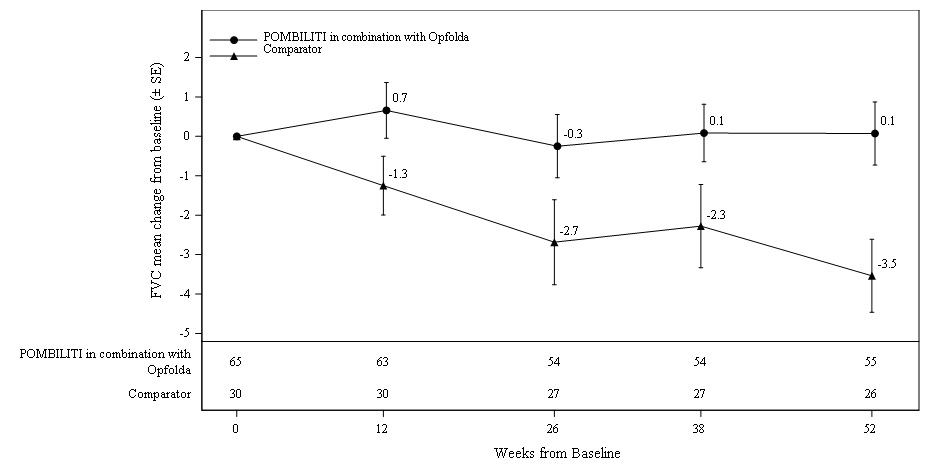
The ERT‑experienced patients treated with POMBILITI in combination with Opfolda showed a numerically favorable change in sitting FVC from baseline at Week 52 (Table 5 and Figure 2).
Table 5. Summary of Sitting FVC in Adults with LOPD by ERT Status at 52 Weeks in Trial 1
| FVC: forced vital capacity; LOPD: late-onset Pompe disease; ERT: enzyme replacement therapy; SD: standard deviation; Diff.: difference; SE: standard error; CI: confidence interval |
| ∗ POMBILITI in combination with Opfolda is not approved for use in ERT-naïve patients with LOPD [see Indications and Usage (1)]. The ERT-naïve patient subgroup enrolled too few patients to conclusively interpret the data. For the ERT-naïve group, the treatment difference was estimated using a 2-sample t-test. |
| † A U.S.-approved alglucosidase alfa product was not used in this clinical trial. Conclusions cannot be drawn from this clinical trial regarding comparative effectiveness between a U.S.-approved alglucosidase alfa product and POMBILITI in combination with Opfolda for the treatment of adult patients with LOPD weighing ≥40 kg and who are not improving on their current ERT. |
| ‡ For the ERT‑experienced group, the treatment difference of the mean was estimated by analysis of covariance which included treatment, gender, baseline FVC, age, weight, and height in the model. Nominal p=0.006. Missing data at Week 52 was imputed using last observed values. |
| Efficacy Endpoint | ERT-experienced | ERT-naïve* |
Sitting FVC
(% predicted) | POMBILITI in Combination with Opfolda | A Non-U.S.-Approved Alglucosidase alfa Product† with Placebo | POMBILITI in Combination with Opfolda | A Non-U.S.-Approved Alglucosidase alfa Product† with Placebo |
Baseline
n
Mean (SD)
Median |
n=65
67.9 (19.1)
68.0 |
n=30
67.5 (21.0)
69.0 |
n=20
80.2 (18.7)
82.3 |
n=8
79.6 (21.0)
88.5 |
Change from baseline at Week 52
n
Mean (SD)
Median |
n=55
0.1 (5.9)
0.5 |
n=26
-3.5 (4.7)
-2.5 |
n=19
-4.7 (6.2)
-4.5 |
n=7
-2.4 (6.3)
-3.0 |
Change to Week 52
Diff. of means (SE)
(95% CI) |
3.5 (1.3)
(1.0, 6.0)‡ |
-1.9 (2.7)
(-7.3, 3.6) |
Figure 2. Mean Change (± SE) in Sitting FVC (% predicted) from Baseline to Week 52 in ERT-experienced Adults with LOPD in Trial 1*
SE: standard error; FVC: forced vital capacity; ERT: enzyme replacement therapy; LOPD: late-onset Pompe disease
∗ A U.S.-approved alglucosidase alfa product was not used in this clinical trial. Conclusions cannot be drawn from this clinical trial regarding comparative effectiveness between a U.S.-approved alglucosidase alfa product and POMBILITI in combination with Opfolda for the treatment of adult patients with LOPD weighing ≥40 kg and who are not improving on their current ERT.
6 Minute Walk Distance (6MWD) at 52 Weeks
Patients treated with POMBILITI in combination with Opfolda walked on average 21 meters farther from baseline as compared to those treated with a non-U.S.-approved alglucosidase alfa product with placebo who walked 8 meters farther from baseline; the estimated treatment difference was 14 meters (95% CI: -1, 28).
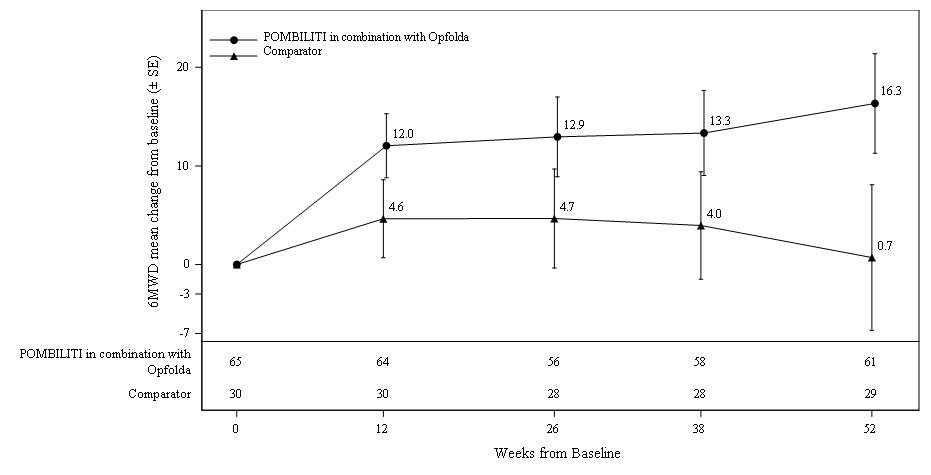
The ERT‑experienced patients treated with POMBILITI in combination with Opfolda showed a numerically favorable change in 6MWD from baseline at Week 52 (Table 6 and Figure 3).
Table 6. Summary of 6MWD in Adults with LOPD by ERT Status at 52 Weeks in Trial 1
| 6MWD: 6-minute walk distance; LOPD: late-onset Pompe disease; ERT: enzyme replacement therapy; SD: standard deviation; Diff.: difference; SE: standard error; CI: confidence interval |
| ∗ POMBILITI in combination with Opfolda is not approved for use in ERT‑naïve patients with LOPD [see Indications and Usage (1)]. The ERT-naïve patient subgroup enrolled too few patients to conclusively interpret the data. For the ERT‑naïve group, the treatment difference was estimated using a 2-sample t-test. One ERT‑naïve subject in the control arm was excluded from this table because their change of 355 meters in 6MWD from baseline at Week 52 was a statistical outlier and not considered clinically plausible. |
| † A U.S.-approved alglucosidase alfa product was not used in this clinical trial. Conclusions cannot be drawn from this clinical trial regarding comparative effectiveness between a U.S.-approved alglucosidase alfa product and POMBILITI in combination with Opfolda for the treatment of adult patients with LOPD weighing ≥40 kg and who are not improving on their current ERT. |
| ‡ For the ERT‑experienced group, the treatment difference of the mean was estimated by nonparametric analysis of covariance which included treatment, gender, baseline 6MWD, age, weight, and height in the model. Nominal p=0.047. Missing data at Week 52 was imputed using last observed values. |
| Efficacy Endpoint | ERT‑experienced | ERT‑naïve* |
| 6MWD | POMBILITI in Combination with Opfolda | A Non-U.S.-Approved Alglucosidase alfa Product† with Placebo | POMBILITI in Combination with Opfolda | A Non-U.S.-Approved Alglucosidase alfa Product† with Placebo |
Baseline
n
Mean (SD)
Median |
n=65
347 (110)
353 |
n=30
335 (114)
344 |
n=20
394 (112)
375 |
n=7
421 (136)
386 |
Change from baseline at Week 52
n
Mean (SD)
Median |
n=61
16 (39)
10 |
n=29
1 (40)
-9 |
n=20
33 (49)
24 |
n=7
38 (29))
34 |
Change to Week 52
Diff. of means (SE)
(95% CI) |
17 (8)
(0.2, 33)‡ |
-5 (20)
(-45, 36) |
Figure 3. Mean Change (± SE) of 6MWD from Baseline to Week 52 in ERT‑experienced Adults with LOPD in Trial 1*
SE: standard error; 6MWD: 6-minute walk distance; ERT: enzyme replacement therapy; LOPD: late-onset Pompe disease
∗ A U.S.-approved alglucosidase alfa product was not used in this clinical trial. Conclusions cannot be drawn from this clinical trial regarding comparative effectiveness between a U.S.-approved alglucosidase alfa product and POMBILITI in combination with Opfolda for the treatment of adult patients with LOPD weighing ≥40 kg and who are not improving on their current ERT.