Carcinogenesis
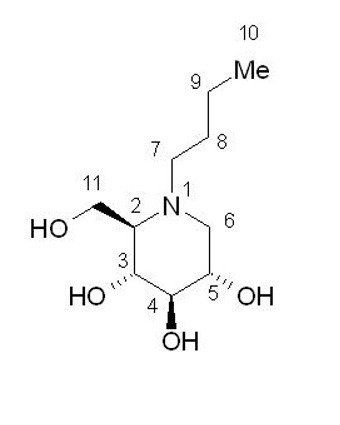
The carcinogenicity of OPFOLDA is based on studies from another miglustat product. Below are findings from the carcinogenicity studies with the other miglustat product.
Two-year carcinogenicity studies have been conducted with miglustat in CD-1 mice at oral doses up to 500 mg/kg/day and in Sprague Dawley rats at oral doses up to 180 mg/kg/day. Oral administration of miglustat for 104 weeks produced mucinous adenocarcinomas of the large intestine at 210, 420, and 500 mg/kg/day (about 3, 5, and 6-fold the MRHD of OPFOLDA 260 mg, respectively, based on body surface area [BSA]) in male mice and at 420 and 500 mg/kg/day (about 5 and 6-fold the MRHD of OPFOLDA 260 mg, respectively, based on BSA) in female mice. The adenocarcinomas were considered rare in CD-1 mice and occurred in the presence of inflammatory and hyperplastic lesions in the large intestine of both males and females. In rats, oral administration of miglustat for 100 weeks produced increased incidences of interstitial cell adenomas of the testis at 30, 60, and 180 mg/kg/day (about 1, 2, and 4-fold the MRHD of OPFOLDA 260 mg, respectively, based on BSA).
Mutagenesis
The mutagenicity of OPFOLDA is based on studies from another miglustat product. Below are findings from the carcinogenicity studies with the other miglustat product.
Miglustat was not mutagenic or clastogenic in a battery of in vitro and in vivo assays including the bacterial reverse mutation (Ames), chromosomal aberration (in human lymphocytes), gene mutation in mammalian cells (Chinese hamster ovary), and mouse micronucleus assays, in studies with another miglustat product.
Impairment of Fertility
In a fertility study in rats, oral miglustat (60 mg/kg) was administered alone, or in combination with intravenous cipaglucosidase alfa-atga (400 mg/kg), to male and female rats every other day. Dosing in males was initiated 28 days prior to cohabitation with untreated females. Dosing in females was initiated 14 days prior to cohabitation with untreated males and continued through GD 7. Additional experimental groups received intravenous cipaglucosidase alfa-atga alone (75, 150, or 400 mg/kg/day) with the same frequency over the same pre-mating interval (males) or pre-mating and pregnancy interval (females).
There was no effect on male or female rat fertility in any experimental group. Treatment of male rats with the combination was associated with increased preimplantation loss that was reversible. Treatment of female rats with the combination, or with miglustat alone, resulted in preimplantation loss; whether this would be reversible if treatment were discontinued prior to cohabitation is unknown. NOAELs were not identified for the combination in either male or female rats. The LOAEL margins for these doses represent 4-fold and 21-fold the MRHD of OPFOLDA and Pombiliti, respectively, based on plasma AUC exposures.
The impact of OPFOLDA on fertility is based, in part, on studies from another miglustat product. Below are findings from the fertility studies with the other miglustat product.
Fertility studies conducted with another miglustat product showed that male rats, given 20 mg/kg/day miglustat (exposure less than that expected for the MRHD of OPFOLDA 260 mg, based on BSA comparisons, mg/m2) by oral gavage, 14 days prior to mating, had decreased spermatogenesis with altered sperm morphology and motility and decreased fertility. Decreased spermatogenesis was reversible following 6 weeks of miglustat withdrawal in this study. A higher dose of 60 mg/kg/day (2 times the MRHD of OPFOLDA, based on BSA comparisons, mg/m2) resulted in seminiferous tubule and testicular atrophy/degeneration. Female rats were given oral miglustat gavage doses of 20, 60, and 180 mg/kg/day beginning 14 days before mating and continuing through gestation in this study. Effects observed at 20 mg/kg/day (systemic exposure less than the human therapeutic systemic exposure, based on BSA comparisons) included decreased corpora lutea, increased post-implantation loss, and decreased live births.