Ranitidine Tablet
FDA Label NDC 71993-314

10 label sections · Submitted to the FDA by Atland Pharmaceuticals, Llc · Indications, Dosage, Usage, and Precautions

Structured Product Label

The following Structured Product Label (SPL) was submitted to the FDA by Atland Pharmaceuticals, Llc for the product Ranitidine (NDC 71993-314). This document serves as the official prescribing information, containing essential scientific data and clinical materials required for healthcare providers and patients.

This specific version of the label includes detailed information regarding description, clinical pharmacology, indications and usage, contraindications, pregnancy:, adverse reactions, overdosage, dosage and administration, and other regulatory disclosures. Use the navigation below to review specific sections of the FDA submission.

Description

Ranitidine Tablets USP are available for oral administration containing 150 mg or 300 mg of ranitidine. The active ingredient in Ranitidine Tablets USP, 150 mg and 300 mg is Ranitidine hydrochloride (HCl), USP, a histamine H 2-receptor antagonist.

Chemically it is N[2-[[[5-[(dimethylamino)methyl]-2-furanyl]methyl]thio]ethyl]-N’-methyl-2-nitro-1,1-ethenediamine, HCl. It has the following structure:

"image Description" (Ranitidine Tabs Structure)
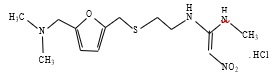
"image Description" (Ranitidine Tabs Structure)

The empirical formula is C 13H 22N 4O 3S.HCl, representing a molecular weight of 350.87.

Ranitidine HCl is white to pale yellow, crystalline, practically odorless powder, sensitive to light and moisture. Melts at about 140°C with decomposition.

Ranitidine is available as 150 mg and 300 mg tablets for oral administration.

Each Ranitidine Tablet USP, 150 mg contains 150 mg ranitidine (equivalent to 168 mg of ranitidine HCl) and the following inactive ingredients microcrystalline cellulose, croscarmellose sodium, magnesium stearate, Opadry ® 200 Orange 203A530006 (Polyvinyl alcohol, talc, titanium dioxide, glycerol monostearate, sodium lauryl sulphate, FD&C yellow 6 and iron oxide yellow), purified water.

Each Ranitidine Tablet USP, 300 mg contains 300 mg ranitidine (equivalent to 336 mg of ranitidine HCl) and the following inactive ingredients microcrystalline cellulose, croscarmellose sodium, magnesium stearate, Opadry ® 200 Yellow 203A520014 (Polyvinyl alcohol, talc, titanium dioxide, glycerol monostearate, sodium lauryl sulphate, FD&C yellow 5 and FD&C Blue 1), purified water.

Contains color additives including FD&C Yellow No.5 (tartrazine)

Meets FDA approved specifications for nitrosamine impurities.

Clinical Pharmacology

Ranitidine Tablets are a competitive, reversible inhibitor of the action of histamine at the histamine H 2-receptors, including receptors on the gastric cells. Ranitidine Tablets do not lower serum Ca ++in hypercalcemic states. Ranitidine Tablets are not an anticholinergic agent.

Indications And Usage

Ranitidine Tablets are indicated in:

  • Short-term treatment of active duodenal ulcer. Most patients heal within 4 weeks. Studies available to date have not assessed the safety of Ranitidine in uncomplicated duodenal ulcer for periods of more than 8 weeks.
  • Maintenance therapy for duodenal ulcer patients at reduced dosage after healing of acute ulcers. No placebo – controlled comparative studies have been carried out for periods longer than 1 year.
  • The treatment of pathological hypersecretory conditions. (e.g., Zollinger-Ellison syndrome and systemic mastocytosis).
  • Short-term treatment of active, benign gastric ulcers. Most patients heal within 6 weeks and the usefulness of further treatment has not been demonstrated. Studies available to date have not assessed the safety of ranitidine in uncomplicated, benign gastric ulcer for periods of more than 6 weeks.
  • Maintenance therapy for gastric ulcer patients at reduced dosage after healing of acute ulcers. Placebo-controlled studies have been carried out for 1 year.
  • Treatment of GERD. Symptomatic relief commonly occurs within 24 hours after starting therapy with Ranitidine Tablets USP, 150 mg twice daily.
  • Treatment of endoscopically diagnosed erosive esophagitis. Symptomatic relief of heartburn commonly occurs within 24 hours of therapy initiation with Ranitidine Tablets USP, 150 mg 4 times daily.
  • Maintenance of healing of erosive esophagitis. Placebo-controlled trials have been carried out for 48 weeks.
  • ​​​​​​​Concomitant antacids should be given as needed for pain relief to patients with active duodenal ulcer; active, benign gastric ulcer; hypersecretory states; GERD; and erosive esophagitis.

Contraindications

Ranitidine Tablets are contraindicated for patients known to have hypersensitivity to the drug or any of the ingredients (see PRECAUTIONS).

Pregnancy:

Teratogenic Effects:Reproduction studies have been performed in rats and rabbits at doses upto 160 times the human dose and have revealed no evidence of impaired fertility or harm to the fetus due to Ranitidine Tablets. There are, however, no adequate and well-controlled studies in pregnant women. Because animal reproduction studies are not always predictive of human response, this drug should be used during pregnancy only if clearly needed.

Adverse Reactions

The following have been reported as events in clinical trials or in the routine management of patients treated with Ranitidine Tablets. The relationship to therapy with Ranitidine Tablets has been unclear in many cases. Headache, sometimes severe, seems to be related to administration of Ranitidine Tablets.

Overdosage

There has been limited experience with overdosage. Reported acute ingestions of up to 18 g orally have been associated with transient adverse effects similar to those encountered in normal clinical experience (see ADVERSE REACTIONS). In addition, abnormalities of gait and hypotension have been reported.

When overdosage occurs, the usual measures to remove unabsorbed material from the gastrointestinal tract, clinical monitoring, and supportive therapy should be employed.

Studies in dogs receiving dosages of Ranitidine, in excess of 225 mg/kg/day have shown muscular tremors, vomiting, and rapid respiration. Single oral doses of 1,000 mg/kg in mice and rats were not lethal. Intravenous LD 50, values in mice and rats were 77 and 83 mg/kg, respectively.

Dosage And Administration

Active Duodenal Ulcer:The current recommended adult oral dosage of Ranitidine Tablets for duodenal ulcer is 150 mg twice daily. An alternative dosage of 300 mg once daily after the evening meal or at bedtime can be used for patients in whom dosing convenience is important. The advantages of one treatment regimen compared with the other in a particular patient population have yet to be demonstrated (see Clinical Trials:Active Duodenal Ulcer). Smaller doses have been shown to be equally effective in inhibiting gastric acid secretion in US studies, and several foreign trials have shown that 100 mg twice daily is as effective as the 150 mg dose.

Antacid should be given as needed for relief of pain (see CLINICAL PHARMACOLOGY: Pharmacokinetics).

How Supplied And Storage

Ranitidine Tablets USP, 150 mg (Ranitidine HCl equivalent to 150 mg of ranitidine) are orange, round shaped tablets debossed with ‘V’ on one side and ‘37’ on the other side.

They are available in following count

  • Bottles of 30 tablets (NDC 71993-314-30)
  • Ranitidine Tablets USP, 300 mg (Ranitidine HCl equivalent to 300 mg of ranitidine) are yellow, oval shaped tablets debossed with ‘V’ on one side and ‘03’ on the other side.

    They are available in following count

    • Bottles of 30 tablets (NDC 71993-315-30)
    • Contains color additives including FD&C Yellow No.5 (tartrazine)

      Storage: Store at 15°C to 30°C (59°F to 86°F) [see USP controlled room temperature] in a dry place. Dispense in the original container.

      Note to the Pharmacist: Inform the patient after first opening, store the tablets in the original bottle for up to 3 months (90 days). If the tablets are not used within 3 months (90 days), discard unused tablets.The discard after date should be noted on the bottle.

      • Replace cap securely after each opening. Keep the bottle tightly closed.
      • Do not remove desiccant from bottle.
      • Protect from light.
      • ​​​​​​​ * MULTISTIX is a registered trademark of Bayer Healthcare LLC.

        Distributed by:
        Atland Pharmaceuticals, LLC
        Sylacauga, AL 35150

        Manufactured by:

        "image Description" (Manuf Comp Logo)

        "image Description" (Manuf Comp Logo)

        ​​​​​​​

        VKT Pharma Private Limited
        Srikakulam District, India-532-409

        ​​​​​​​Issued: 08/2026

Principal Display Panel

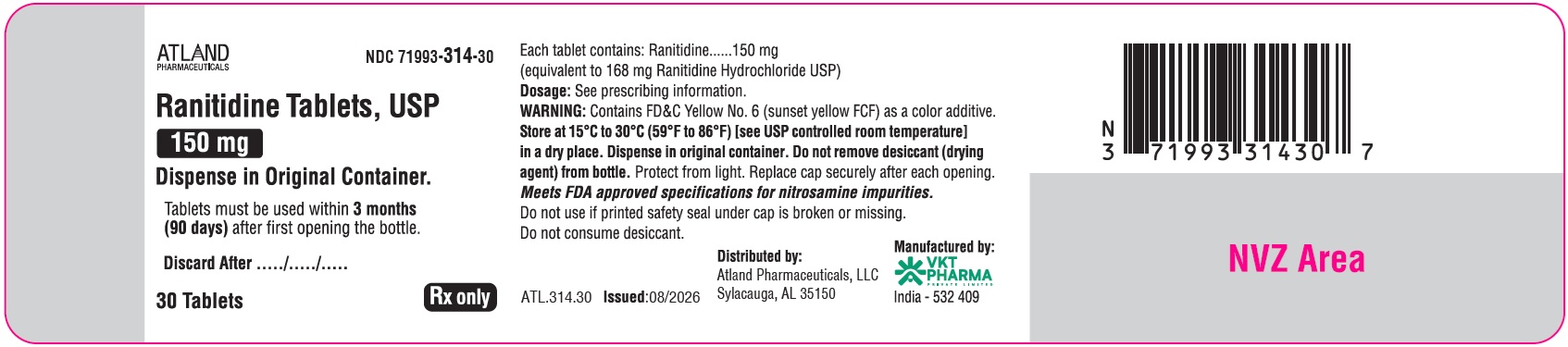
Ranitidine Tablets, USP 150 mg - NDC 71993-314-30 - 30 Tabs Bottle Label

"image Description" (Ranitidine Tabs 150mg 30s Bottle Label)

"image Description" (Ranitidine Tabs 150mg 30s Bottle Label)

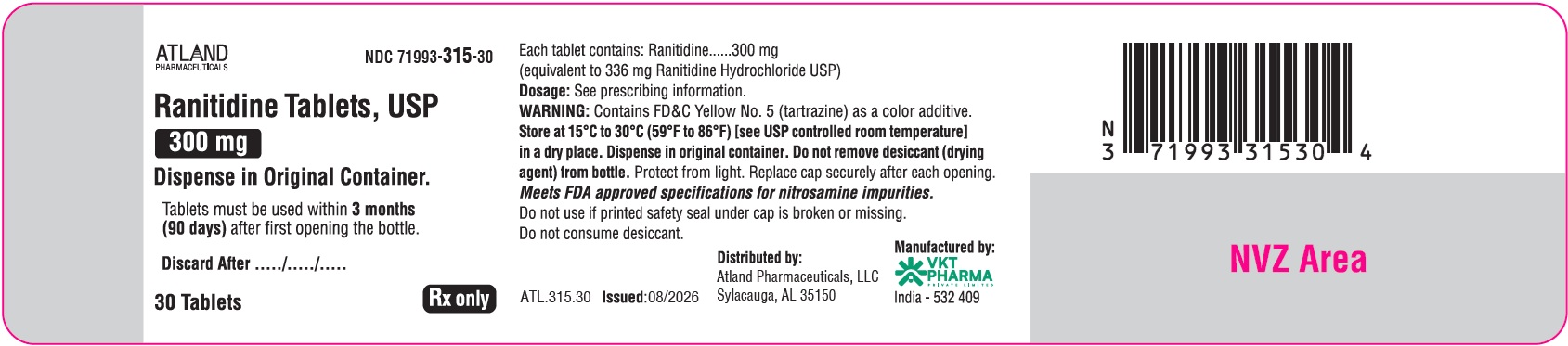
Ranitidine Tablets, USP 300 mg - NDC 71993-315-30 - 30 Tabs Bottle Label

"image Description" (Ranitidine Tabs 300mg 30s Bottle Label)

"image Description" (Ranitidine Tabs 300mg 30s Bottle Label)

​​​​​​

* Please review the disclaimer below.