Tegsedi
Product Images NDC 72126-007

20 FDA label images from Akcea Therapeutics, Inc. · Packaging, Regulatory Labels, and Product Appearance

Product Visual Gallery

This gallery contains 20 technical images submitted to the FDA as part of the official labeling for Tegsedi (NDC 72126-007). Unlike standard consumer photos, these assets often include clinical data figures, molecular chemical structures, and official manufacturer packaging layouts.

As provided by Akcea Therapeutics, Inc., these visuals offer a comprehensive scientific overview of the product's physical and chemical identity, aiding pharmacists and researchers in product verification and study.

FDA Label Image

Chemical Structure (Inotersen 01)
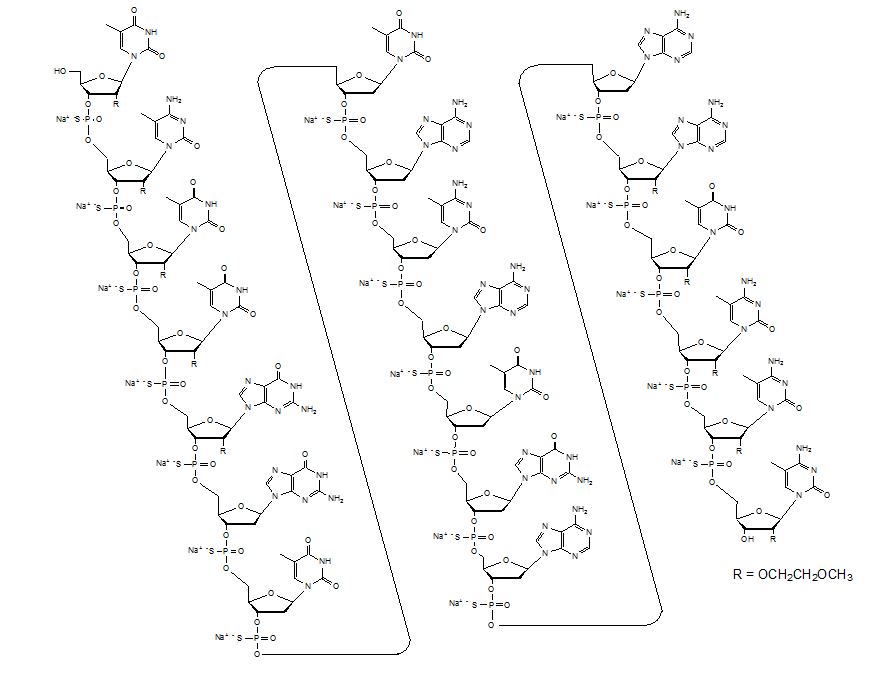
Chemical Structure (Inotersen 01)
Chemical structure of the active ingredient in Tegsedi from Akcea Therapeutics, Inc. The diagram illustrates three oligonucleotide chains with repeating nucleotide units, including sodium phosphate groups and base pair variations. The structure includes an R group defined as OCH2CH2OCH3.*
FDA Label Image

Figure 1: Change From Baseline In Mnis+7 (Inotersen 02)

Figure 1: Change From Baseline In Mnis+7 (Inotersen 02)
A line graph showing the least squares mean change in NIS+7 scores over 70 weeks comparing Tegsedi and placebo groups. Data points at approximately weeks 35 and 70 indicate lower mean scores for Tegsedi compared to placebo, with error bars and statistical annotations present. The number of evaluable patients is listed below the x-axis for both groups at each time point.*
FDA Label Image

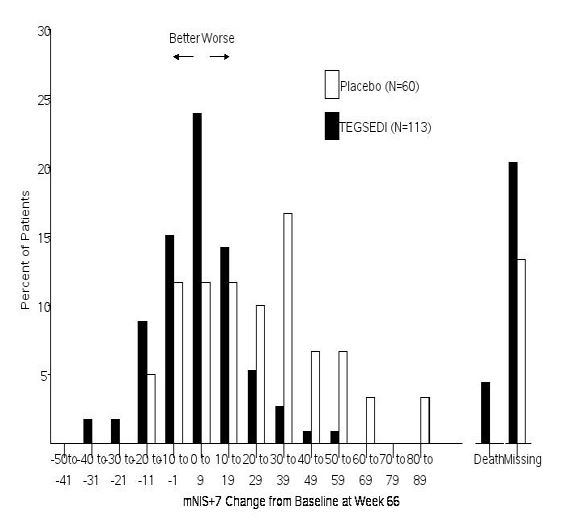
Figure 2: Histogram Of Mnis+7 Change From Baseline At Week 66 (Inotersen 03)

Figure 2: Histogram Of Mnis+7 Change From Baseline At Week 66 (Inotersen 03)
Bar chart comparing the percent of patients experiencing different ranges of mNIS+7 change from baseline at Week 66 between Tegsedi (N=113) and placebo (N=60). The horizontal axis shows change intervals from -50 to 89, indicating better or worse patient outcomes, with additional bars for death and missing data. The vertical axis shows the percent of patients for each category.*
FDA Label Image

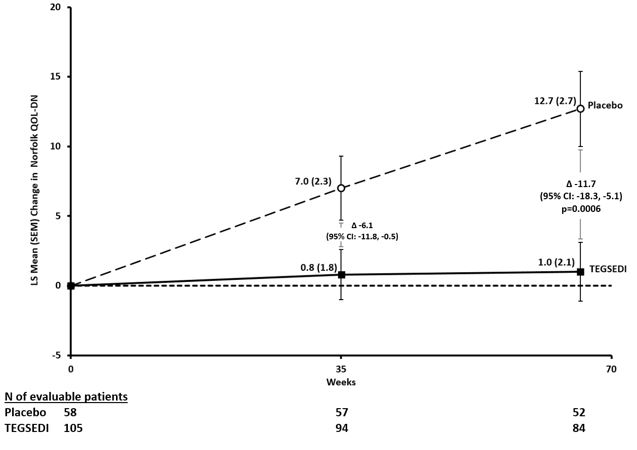
Figure 3: Change From Baseline In Norfolk Qol-dn Score (Inotersen 04)

Figure 3: Change From Baseline In Norfolk Qol-dn Score (Inotersen 04)
A line graph comparing the LS Mean (SEM) Change in Norfolk QOL-DN over 70 weeks between Tegsedi and placebo groups. It shows numerically increasing values for placebo and near-zero changes for Tegsedi at 35 and 70 weeks, including sample sizes at different points.*
FDA Label Image

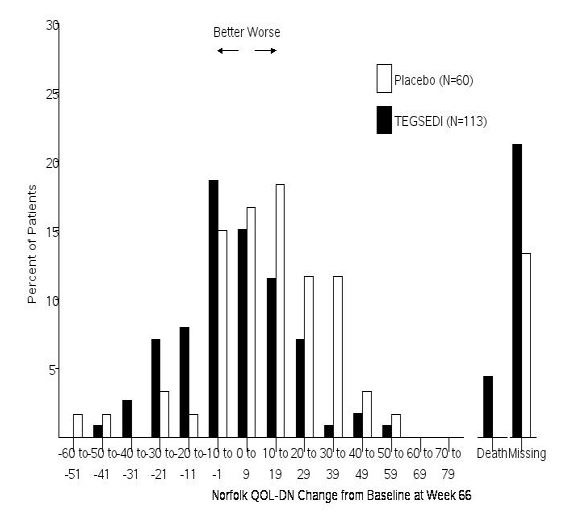
Figure 4: Histogram Of Norfolk Qol-dn Change From Baseline At Week 66 (Inotersen 05)

Figure 4: Histogram Of Norfolk Qol-dn Change From Baseline At Week 66 (Inotersen 05)
A bar chart displaying the percent of patients by Norfolk QOL-DN change from baseline at week 66, comparing Tegsedi (N=113) and placebo (N=60) groups. The horizontal axis represents change categories ranging from -60 to 79 and death/missing, with percentages on the vertical axis. Bars show differences in patient outcomes between treatment and placebo, with an annotation indicating directions for 'Better' and 'Worse'.*
FDA Label Image

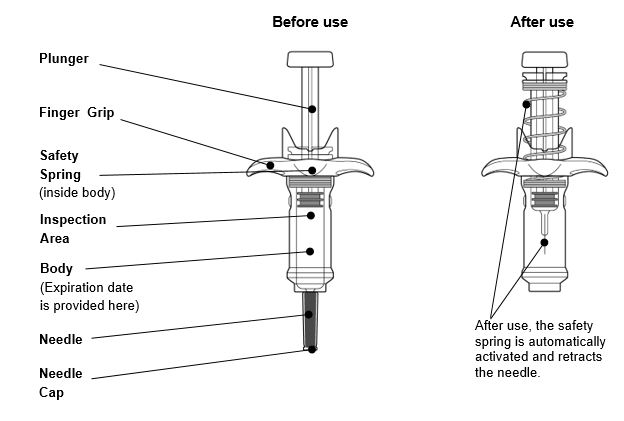
Instructions For Use (Figure 1)

Instructions For Use (Figure 1)
An instructional diagram showing a syringe device for Tegsedi with labeled parts before use, including plunger, finger grip, safety spring, inspection area, body (with expiration date), needle, and needle cap, alongside a depiction after use where the safety spring is activated and retracts the needle automatically.*
FDA Label Image

Instructions For Use (Figure 2)

Instructions For Use (Figure 2)
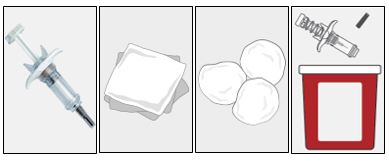
An instructional diagram showing four steps involving a syringe with a needle, a folded cloth or gauze, three cotton balls, and a red sharps disposal container. These images likely represent preparation and disposal steps related to medication administration.*
FDA Label Image

Instructions For Use (Figure 3)

FDA Label Image

Instructions For Use (Figure 4)

Instructions For Use (Figure 4)
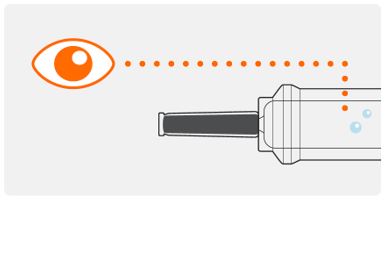
Illustration showing an injection pen with a series of dotted lines connecting to an eye icon, indicating a focus on proper eye observation or caution when using the device. The pen shows liquid inside with a few bubbles visible near the tip.*
FDA Label Image

Instructions For Use (Figure 5)

Instructions For Use (Figure 5)
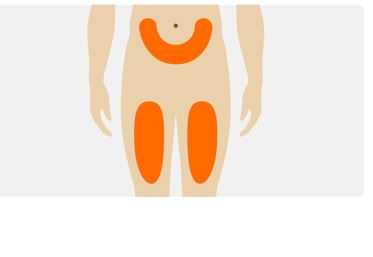
An illustration showing a human torso and upper legs with orange areas marked on the abdomen above the navel and the front of both thighs, indicating specific body regions.*
FDA Label Image

Instructions For Use (Figure 6)

Instructions For Use (Figure 6)
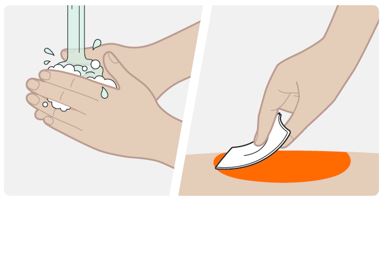
Instructional illustration showing handwashing with soap and water on the left, and wiping an arm injection site with an alcohol pad on the right, demonstrating preparation steps for subcutaneous injection.*
FDA Label Image

Instructions For Use (Figure 7)

Instructions For Use (Figure 7)
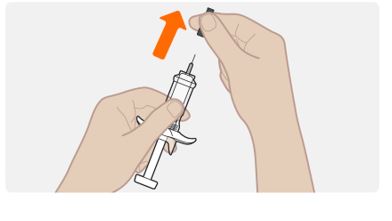
An instructional illustration showing a pair of hands preparing a syringe by removing the cap from the needle. The image depicts the process of safely detaching the needle cover as indicated by an orange upward arrow.*
FDA Label Image

Instructions For Use (Figure 8)

Instructions For Use (Figure 8)
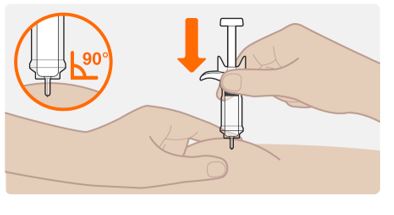
An instructional illustration showing the proper technique for administering an injection with a syringe. It depicts a hand holding the syringe perpendicular (90 degrees) to the skin on the opposite hand, with an arrow indicating the downward insertion motion.*
FDA Label Image

Instructions For Use (Figure 9)

Instructions For Use (Figure 9)
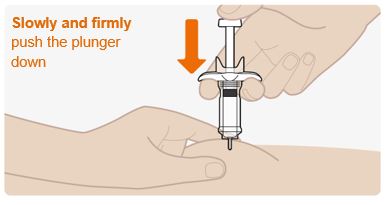
An instructional illustration showing the administration of Tegsedi via injection. The image depicts a hand holding a syringe and a finger receiving the injection, with the instruction to slowly and firmly push the plunger down.*
FDA Label Image

Instructions For Use (Figure 10)

Instructions For Use (Figure 10)
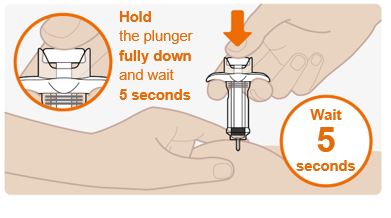
An instructional diagram showing how to use a syringe for Tegsedi. The image instructs to hold the plunger fully down and wait for 5 seconds after injection. It depicts a hand pressing the syringe plunger into the skin and includes a close-up of the syringe tip inside the injection site.*
FDA Label Image

Instructions For Use (Figure 11)

Instructions For Use (Figure 11)
An instructional illustration depicting a hand administering an injection with a syringe. The image shows the thumb being lifted slowly back up as part of the injection process. This likely corresponds to user guidance for the Tegsedi injection device by Akcea Therapeutics, Inc.*
FDA Label Image

Instructions For Use (Figure 12)

Instructions For Use (Figure 12)
An illustration showing the components of an injection kit, including a syringe and a red sharps disposal container with a white lid, depicted separately above the container. The image appears to demonstrate proper placement or handling of the syringe in relation to the disposal container.*
FDA Label Image

Syringe Label (Inotersen 18)

Syringe Label (Inotersen 18)
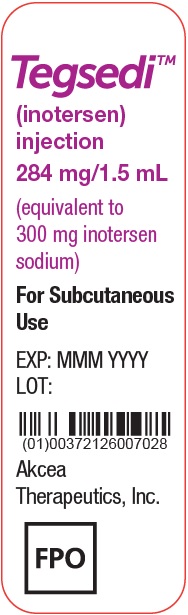
Label for Tegsedi (inotersen) injection, 284 mg per 1.5 mL, equivalent to 300 mg inotersen sodium. The label indicates subcutaneous use, with placeholder text for expiration date and lot number, and includes a barcode. The labeler is Akcea Therapeutics, Inc.*
FDA Label Image

1-count Tray Label (Inotersen 19)

1-count Tray Label (Inotersen 19)
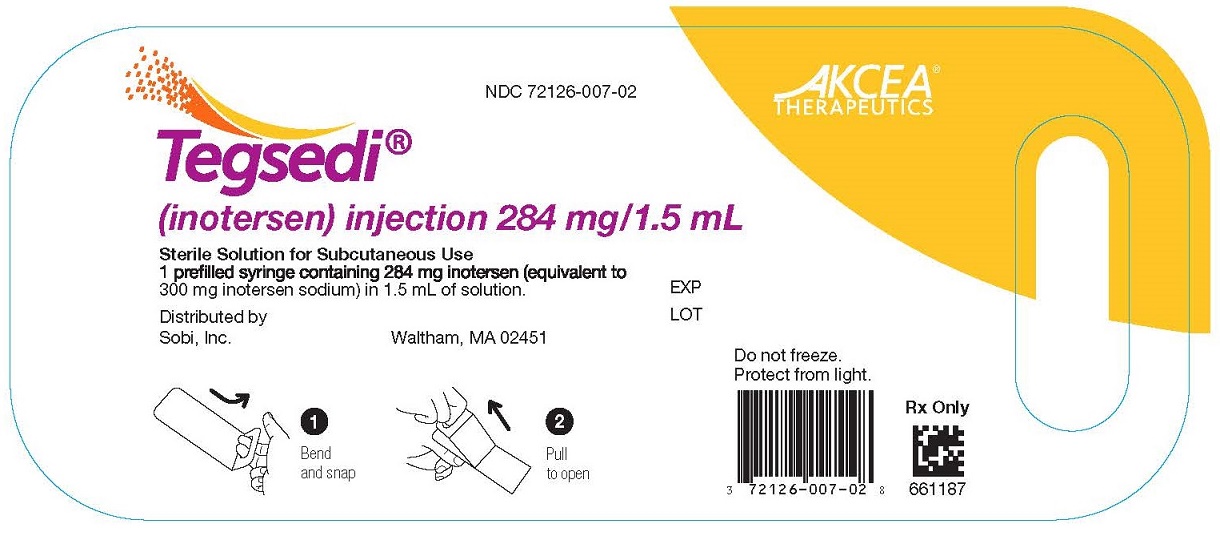
Tegsedi (inotersen) injection 284 mg/1.5 mL prefilled syringe label by Akcea Therapeutics, Inc. The sterile solution is for subcutaneous use, with one prefilled syringe containing 284 mg inotersen in 1.5 mL. The label includes handling instructions with illustrations, storage warnings to avoid freezing and light, and a barcode.*
FDA Label Image

4-count Carton Label (Inotersen 20)

4-count Carton Label (Inotersen 20)
Packaging label for Tegsedi (inotersen) injection 284 mg/1.5 mL by Akcea Therapeutics, Inc. The label indicates the product includes 4 prefilled syringes each containing 284 mg inotersen. The box design features a purple and yellow color scheme with storage and usage instructions, distributor information for Sobi, Inc., and a barcode.*

* About these descriptions: Image descriptions on this page are generated by automated AI analysis of the product label images from the manufacturer's FDA label submission (SPL). They are provided for reference only and may contain errors or omissions. Always rely on the printed label itself and the official FDA labeling, and consult a pharmacist or healthcare professional with any questions about this product.