Testosterone topical solution was evaluated in a multicenter, open label, 120-day trial that enrolled 155 hypogonadal men at 26 clinical research centers. The median age of subjects was 53 years with a range of 19 to 78 years. Of the 144 subjects whose race was recorded, 122 (84.7%) were Caucasian, 13 (9.0%) were Hispanic, 6 (4.2%) were African Americans, 1 (0.7%) was Asian and 2 (1.4%) had race recorded as “Other”.
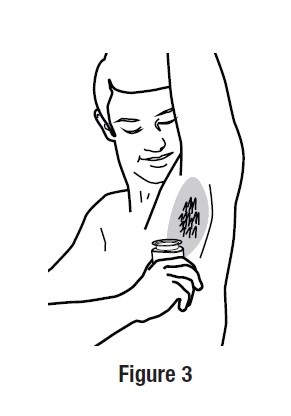
Patients were instructed to apply testosterone topical solution to unclothed, clean, dry, and unbroken skin. The solution was applied to the axillary area. Patients were not instructed to alter their normal grooming routine, e.g., shave under the arm.
During the initial testosterone topical solution treatment period (Days 1 to 15) 143 patients were treated with 60 mg of testosterone daily. On Day 45 of the trial, patients were maintained at the same dose, or were titrated up or down, based on their 24 hour average serum testosterone concentration measured on Day 15. On Day 90 of the trial, patients were maintained at the same dose, or were titrated up or down, based on their 24 hour average serum testosterone concentration measured on Day 60.
On day 120, 75% of responding patients finished the study on the starting dose of 60 mg of testosterone, while 2% had been titrated to 30 mg, 17% had been titrated to 90 mg and 6% had been titrated to the 120 mg dose.
On day 60, 84.8% of subjects had total testosterone concentrations in the normal range. Of those who had sufficient data for analysis on day 120, 84.1%, had their average serum testosterone concentration in the normal range of 300 to 1050 ng/dL.
Table 3 summarizes the proportion of subjects having average testosterone concentrations within the normal range on Days 60 and 120.
Table 3: Proportion of subjects who had an average Serum Total Testosterone in the range 300 to 1050 ng/dL and completed 120 days of treatment (N=138a)
Evaluation Time | Statistics | Value |
Baseline Testosterone | Mean (SD) | 194.6 ng/dL (92.9 ng/dL) |
Day 15 | Normalb | 76.1%c |
95% CI | (69.0%, 83.2%) |
Day 60 | Normalb | 84.8% |
95% CI | (78.8%, 90.8%) |
Day 120 | Normalb | 84.1% |
95% CI | (77.9%, 90.2%) |
a Three patients who withdrew from the study due to adverse reactions are included as treatment failures.
b Normal represents the percentage of patients with average testosterone concentration in the range of 300 to 1050 ng/dL.
c On Day 15, 72.2% of the 90 subjects in the US study population had an average serum testosterone in the range of 300 ng/dL to 1050 ng/dL.
Of the 135 patients who completed the 120 day treatment, 123 patients did so with no deviation from the protocol. By day 120, average serum testosterone concentration was within normal range for 67% of those who titrated down on the 30 mg dose, 89% of those on the 60 mg dose, 86% of those who titrated up to 90 mg and 70% of those who titrated up to the 120 mg dose. Table 4 below summarizes the testosterone concentration data in the patients who completed 120 days.
Table 4: Baseline-unadjusted Arithmetic Mean (±SD) Steady-State Serum Testosterone Concentrations on Days 15, 60 and 120 in Patients Who Completed 120 Days of Treatment
Dose of Testosterone Topical Solution |
| 30 mg | 60 mg | 90 mg | 120 mg | Overall |
Day 15 | [N=0] | [N=135] | [N=0] | [N=0] | [N=135] |
Cavg (ng/dL) | -- | 456 (±226) | -- | -- | 456 (±226) |
Cmax (ng/dL) | -- | 744 (±502) | -- | -- | 744 (±502) |
Day 60 | [N=1] | [N=105] | [N=29] | [N=0] | [N=135] |
Cavg (ng/dL) | 343 (--) | 523 (±207) | 368 (±138) | -- | 488 (±204) |
Cmax (ng/dL) | 491 (--) | 898 (±664) | 646 (±382) | -- | 840 (±620) |
Day 120 | [N=3] | [N=97] | [N=25] | [N=10] | [N=135] |
Cavg (ng/dL) | 493 (±239) | 506 (±175) | 415 (±165) | 390 (±160) | 480 (±177) |
Cmax (ng/dL) | 779 (±416) | 839 (±436) | 664 (±336) | 658 (±353) | 792 (±417) |
Figure 2 summarizes the pharmacokinetic profiles of total testosterone in patients completing 120 days of testosterone topical solution treatment administered as 60 mg of testosterone for the initial 15 days followed by possible titration according to follow-up testosterone measurements.

Figure-2-graph (Figure 2 Graph)
Figure 2: Mean (± SD) Steady-State Serum Testosterone Concentrations on Day 120 (30, 60, 90 or 120 mg testosterone) in Patients Who Completed 120 Days (N=135) of Testosterone Topical Solution Once-Daily Treatment