Absorption
The total absorption of mesalamine from mesalamine delayed-release tablets 2.4 g or 4.8 g given once daily for 14 days to healthy subjects was found to be approximately 21% to 22% of the administered dose.
Gamma-scintigraphy studies have shown that a single dose of mesalamine delayed-release tablets 1.2 g (one tablet) passed intact through the upper gastrointestinal tract of fasted healthy subjects. Scintigraphic images showed a trail of radio-labeled tracer in the colon, suggesting that mesalamine had distributed through this region of the gastrointestinal tract.
In a single-dose study, mesalamine delayed-release tablets 1.2 g, 2.4 g, and 4.8 g were administered in the fasted state to healthy subjects. Plasma concentrations of mesalamine were detectable after 2 hours and reached a maximum by 9 to 12 hours on average for the doses studied. The pharmacokinetic parameters are highly variable among subjects (Table 4). Mesalamine systemic exposure in terms of area under the plasma concentration-time curve (AUC) was slightly more than dose proportional between 1.2 g and 4.8 g mesalamine delayed-release tablets. Maximum plasma concentrations (Cmax) of mesalamine increased approximately dose proportionately between 1.2 g and 2.4 g and sub-proportionately between 2.4 g and 4.8 g of mesalamine delayed-release tablets, with the dose normalized value at 4.8 g representing, on average, 74% of that at 2.4 g based on geometric means.
Table 4: Mean (SD) Pharmacokinetic Parameters for Mesalamine Following Single-Dose Administration of Mesalamine Under Fasting ConditionsParameter* of Mesalamine | Mesalamine 1.2 g (N=47) | Mesalamine 2.4 g (N=48) | Mesalamine 4.8 g (N=48) |
AUC0-t (ng·h/mL) | 9039† (5054) | 20538 (12980) | 41434 (26640) |
AUC0-∞ (ng·h/mL) | 9578‡ (5214) | 21084 (13185) | 44775§ (30302) |
Cmax (ng/mL) | 857 (638) | 1595 (1484) | 2154 (1140) |
Tmax¶ (h) | 9.0# (4.0 to 32.1) | 12.0 (4.0 to 34.1) | 12.0 (4.0 to 34.0) |
Tlag¶ (h) | 2.0# (0 to 8.0) | 2.0 (1.0 to 4.0) | 2.0 (1.0 to 4.0) |
T1/2 (h) (Terminal Phase) | 8.56‡ (6.38) | 7.05Ϸ (5.54) | 7.25§ (8.32) |
*Arithmetic mean of parameter values are presented except for Tmax and Tlag. |
†N=43, ‡N=27, §N=36, ¶Median (min, max), #N=46, ϷN=33 |
Food Effects
Administration of a single dose of mesalamine 4.8 g with a high-fat meal resulted in further delay in absorption, and plasma concentrations of mesalamine were detectable 4 hours following dosing. However, a high-fat meal increased systemic exposure of mesalamine (mean Cmax: increased 91%; mean AUC: increased 16%) compared to results in the fasted state. Mesalamine was administered with food in the controlled clinical trials [see Dosage and Administration (2)].
In a single- and multiple-dose pharmacokinetic study of mesalamine, 2.4 g or 4.8 g was administered once daily with standard meals to 28 healthy subjects per dose group. Plasma concentrations of mesalamine were detectable after 4 hours and were maximal by 8 hours after the single dose. Steady state was achieved generally by 2 days after dosing. Mean AUC at steady state was only modestly greater (1.1- to 1.4fold) than predictable from single dose pharmacokinetics.
Distribution
Mesalamine is approximately 43% bound to plasma proteins at the concentration of 2.5 mcg/mL.
Elimination
Metabolism
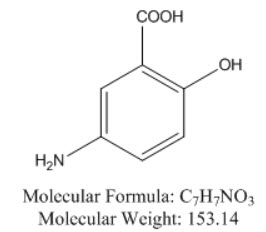
The only major metabolite of mesalamine (5-aminosalicylic acid) is N-acetyl-5-aminosalicylic acid. Its formation is brought about by N-acetyltransferase (NAT) activity in the liver and intestinal mucosa cells, principally by NAT-1.
Excretion
Excretion of mesalamine is mainly via the renal route following metabolism to N-acetyl-5-aminosalicylic acid (acetylation); however, there is also limited excretion of the parent drug in urine. Of the approximately 21% to 22% of the dose absorbed, less than 8% of the dose was excreted unchanged in the urine after 24 hours, compared with greater than 13% for N-acetyl-5-aminosalicylic acid. The mean renal clearance (CLR) in adults ranged from 1.8 L/h to 2.9 L/h following single dose administration and ranged from 5.5 L/h to 6.4 L/h after a multiple dosing for 14 days. The apparent terminal half-lives for mesalamine and its major metabolite after administration of mesalamine 2.4 g and 4.8 g were, on average, 7 to 9 hours and 8 to 12 hours, respectively.
Systemic exposures in adult subjects were inversely correlated with renal function as assessed by estimated creatinine clearance [see Use in Specific Populations (8.6)].
Specific Populations
Geriatric Patients
In a single-dose pharmacokinetic study of mesalamine, 4.8 g was administered in the fasted state to 71 healthy male and female subjects (28 young (18 to 35 years); 28 elderly (65 to 75 years); 15 elderly (>75 years)). Increased age resulted in increased systemic exposure (approximately 2-fold in Cmax) to mesalamine and its metabolite N-acetyl-5-aminosalicylic acid. Increased age resulted in a slower apparent elimination of mesalamine, though there was high between-subject variability.
Table 5: Mean (SD) Pharmacokinetic Parameters for Mesalamine Following Single-Dose Administration of Mesalamine 4.8 g under Fasting Conditions to Young and Elderly Subjects| Parameter of 5-ASA | Young Subjects (18 to 35 years) (N=28) | Elderly Subjects (65 to 75 years) (N=28) | Elderly Subjects (75 years and older) (N=15) |
| AUC0-t (ng·h/mL) | 51570 (23870) | 73001 (42608) | 65820 (25283) |
| AUC0-∞ (ng·h/mL) | 58057* (22429) | 89612† (40596) | 63067‡ (22531) |
| Cmax (ng/mL) | 2243 (1410) | 4999 (4381) | 4832 (4383) |
| tmax§ (h) | 22.0 (5.98 to 48.0) | 12.5 (4.00 to 36.0) | 16.0 (4.00 to 26.0) |
| tlag§ (h) | 2 (1 to 6) | 2 (1 to 4) | 2 (2 to 4) |
| t1/2 (h), terminal phase | 5.68* (2.83) | 9.68† (7.47) | 8.67‡ (5.84) |
| Renal clearance (L/h) | 2.05 (1.33) | 2.04 (1.16) | 2.13 (1.20) |
| Arithmetic mean (SD) data are presented, N = Number of subjects; 5-ASA = 5-aminosalicylic acid *N=15, †N=16, ‡N=13, §Median (min-max) |
Pediatric Patients
In pediatric patients 5 years to 17 years of age diagnosed with ulcerative colitis, systemic exposure of mesalamine, as measured by mean AUCss and Cmax,ss, increased in a dose-proportional manner between 30 and 60 mg/kg/day of mesalamine and increased in a sub-proportional between 60 and 100 mg/kg/day doses. Pharmacokinetic parameters had moderate to high inter-subject variability with CV% ranging from 36% to 52% in pediatric patients.
The overall systemic exposure of mesalamine following oral administration of 4.8 g once daily for 7 days in a limited number of pediatric patients 5 years to 17 years of age (AUC range of 30,556 to 50,388 ng·hr/mL, n=3) was in similar range to that was observed in the healthy adults (AUC of 41,434 ± 26,640 ng·hr/mL, n=48) after single dose administration.
The mean renal clearance (CLR) of mesalamine in pediatric patients (range from approximately 5.0 to 6.5 L/h) seems to be similar to that observed with healthy adult subjects after multiple dose administration.
Drug Interaction Studies
The potential effect of mesalamine (4.8 g given once daily) on the pharmacokinetics of four commonly used antibiotics were evaluated in healthy subjects. The four antibiotics studied and their dosing regimens were as follows: amoxicillin (single 500 mg dose), ciprofloxacin XR (single 500 mg dose), metronidazole (750 mg twice daily for 3.5 days), and sulfamethoxazole/trimethoprim (800 mg/160 mg twice daily for 3.5 days). The change in Cmax and AUC of amoxicillin, ciprofloxacin, and metronidazole when they were co-administered with mesalamine were all 3% or less. There was an increase of 12% in Cmax and an increase of 15% in AUC of sulfamethoxazole when sulfamethoxazole/trimethoprim was coadministered with mesalamine. Coadministration of mesalamine did not result in clinically significant changes in the pharmacokinetics of any of the four antibiotics.