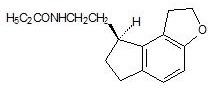
Ramelteon Tablets has a highly variable intersubject pharmacokinetic profile (approximately 100% coefficient of variation in Cmax and AUC). As noted above, CYP1A2 is the major isozyme involved in the metabolism of Ramelteon Tablets; the CYP2C subfamily and CYP3A4 isozymes are also involved to a minor degree.
Effects of Other Drugs on Ramelteon Tablets Metabolism
Fluvoxamine (strong CYP1A2 inhibitor)
When fluvoxamine 100 mg twice daily was administered for three days prior to single-dose coadministration of Ramelteon Tablets 16 mg and fluvoxamine, the AUC0-inf for ramelteon increased approximately 190-fold, and the Cmax increased approximately 70-fold, compared to Ramelteon Tablets administered alone. Ramelteon Tablets should not be used in combination with fluvoxamine. Other less strong CYP1A2 inhibitors have not been adequately studied. Ramelteon Tablets should be administered with caution to patients taking less strong CYP1A2 inhibitors [see Contraindications (4), Drug Interactions (7)].
Rifampin (strong CYP enzyme inducer)
Administration of rifampin 600 mg once daily for 11 days resulted in a mean decrease of approximately 80% (40 to 90%) in total exposure to ramelteon and metabolite M-II, (both AUC0-inf and Cmax) after a single 32 mg dose of Ramelteon Tablets. Efficacy may be reduced when Ramelteon Tablets are used in combination with strong CYP enzyme inducers such as rifampin [see Drug Interactions (7)].
Ketoconazole (strong CYP3A4 inhibitor)
AUC0-inf and Cmax of ramelteon increased by approximately 84% and 36%, respectively, when a single 16 mg dose of Ramelteon Tablets was administered on the fourth day of ketoconazole 200 mg twice daily administration, compared to administration of Ramelteon Tablets alone. Similar increases were seen in M-II pharmacokinetic variables. Ramelteon Tablets should be administered with caution in subjects taking strong CYP3A4 inhibitors such as ketoconazole [see Drug Interactions (7)].
Fluconazole (strong CYP2C9 inhibitor)
The total and peak systemic exposure (AUC0-inf and Cmax) of ramelteon after a single 16 mg dose of Ramelteon Tablets was increased by approximately 150% when administered with fluconazole. Similar increases were also seen in M-II exposure. Ramelteon Tablets should be administered with caution in subjects taking strong CYP2C9 inhibitors such as fluconazole [see Drug Interactions (7)].
Donepezil
Administration of donepezil 10 mg once daily for 26 days resulted in a mean increase of approximately 100% in overall exposure to ramelteon, (AUC0-inf) and a mean increase of approximately 87% in maximum exposure to ramelteon (Cmax) after a single 8 mg dose of Ramelteon Tablets. No change was seen in M-II exposure. Patients should be closely monitored when Ramelteon Tablets is coadministered with donepezil [see Drug Interactions (7)].
Doxepin
Administration of doxepin 10 mg once daily for 23 days resulted in a mean increase of approximately 66% in overall exposure to ramelteon, (AUC0-inf) and a mean increase of approximately 69% in maximum exposure to ramelteon (Cmax ) after a single 8 mg dose of Ramelteon Tablets. No change was seen in M-II exposure. Patients should be closely monitored when Ramelteon Tablets is coadministered with doxepin [see Drug Interactions (7)]. Interaction studies of concomitant administration of Ramelteon Tablets with fluoxetine (CYP2D6 inhibitor), omeprazole (CYP1A2 inducer/CYP2C19 inhibitor), theophylline (CYP1A2 substrate), dextromethorphan (CYP2D6 substrate), sertraline, venlafaxine, escitalopram, gabapentin, and zolpidem did not produce clinically meaningful changes in either peak or total exposures to ramelteon or the M-II metabolite.
Effects of Ramelteon Tablets on Metabolism of Other Drugs
Zolpidem
Administration of ramelteon 8 mg once daily for 11 days resulted in an increase in median Tmax of zolpidem by approximately 20 minutes and exposure to zolpidem (both AUC0-inf and Cmax) was unchanged after a single 10 mg dose of zolpidem. Ordinarily zolpidem should not be given in a patient taking Ramelteon Tablets.
Concomitant administration of Ramelteon Tablets with omeprazole (CYP2C19 substrate), dextromethorphan (CYP2D6 substrate), midazolam (CYP3A4 substrate), theophylline (CYP1A2 substrate), digoxin (p-glycoprotein substrate), warfarin (CYP2C9 [S]/CYP1A2 [R] substrate), venlafaxine, fluvoxamine, donepezil, doxepin, sertraline, escitalopram, and gabapentin did not produce clinically meaningful changes in peak and total exposures to these drugs.
Effect of Alcohol on Ramelteon Tablets
With single-dose, daytime coadministration of Ramelteon Tablets 32 mg and alcohol (0.6 g/kg), there were no clinically meaningful or statistically significant effects on peak or total exposure to Ramelteon Tablets. However, an additive effect was seen on some measures of psychomotor performance (i.e., the Digit Symbol Substitution Test, the Psychomotor Vigilance Task Test, and a Visual Analog Scale of Sedation) at some postdose time points. No additive effect was seen on the Delayed Word Recognition Test. Because alcohol by itself impairs performance, and the intended effect of Ramelteon Tablets is to promote sleep, patients should be cautioned not to consume alcohol when using Ramelteon Tablets.