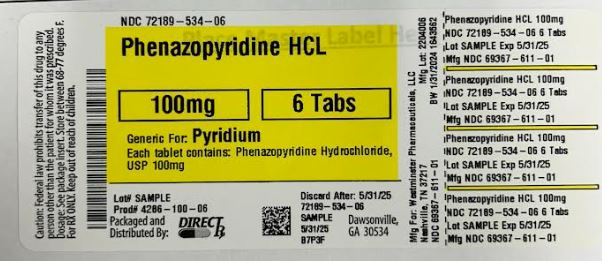
General
The patient should be advised that Phenazopyridine Hydrochloride produces an orange to red color in the urine and feces, and may cause staining. Phenazopyridine Hydrochloride may cause discoloration of body fluids and staining of contact lenses has been reported. A yellowish color of the skin or sclera may indicate accumulation of Phenazopyridine Hydrochloride resulting from impaired renal function and necessitates discontinuance of the drug. It should be noted that a decline in renal function is common in elderly patients. Phenazopyridine Hydrochloride may mask pathological conditions and interfere with laboratory test values using colorimetric, spectrophotometric or fluorometric analysis methods.
Cautious use in patients with G-6-PD deficiency is advised since these patients are susceptible to oxidative hemolysis and may have greater potential to develop hemolytic anemia.
Information for Patients
The patient should be advised to take Phenazopyridine Hydrochloride with or following food or after eating a snack to reduce stomach upset.
The patients should be aware that Phenazopyridine Hydrochloride causes a reddish orange discoloration of the urine and feces, and may stain clothing. Phenazopyridine Hydrochloride may cause discoloration of body fluids and staining of contact lenses has been reported. There have been reports of teeth discoloration when the product has been broken or held in the mouth prior to swallowing.
Patients should be instructed to take Phenazopyridine Hydrochloride for only 2 days if an antibacterial agent is administered concurrently for the treatment of a urinary tract infection.
If symptoms persist beyond those 2 days, the patient should be instructed to contact his or her physician.
Laboratory Tests
Phenazopyridine Hydrochloride may interfere with laboratory test values using colorimetric, photometric or fluorometric analysis methods.
Altered urine laboratory test values may include ketone (sodium nitroprusside) bilirubin (foam test, talc-disk-Fouchet-spot test, Franklin's tablet-Fouchet test, p-nitrobenzene diazonium p-toluene sulfonate reagent), diacetic acid (Gerhardt ferric chloride test), free hydrochloric acid, glucose (glucose oxidase tests), 17-hydroxycorticosteroids (modified Glenn-Nelson), 17-ketosteroids (Holtorff Koch modification of Zimmerman), porphyrins, albumin (discolors bromophenol blue test areas of commercial reagent strips, nitric acid ring test), phenolsulfophthalein, urobilinogen (color interference with Ehrlich's reagent), and urinalysis (spectrophotometric or color-based tests). Phenazopyridine Hydrochloride also imparts an orange-red color to stools which may interfere with color tests.
Drug Interactions
The interaction of Phenazopyridine Hydrochloride with other drugs has not been studied in a systematic manner. However, the medical literature to date suggests that no significant interactions have been reported.
Carcinogenesis, Mutagenesis, Impairment of Fertility
Long-term administration of Phenazopyridine Hydrochloride has been associated with tumors of the large intestine in rats and of the liver in mice. Available epidemiological data are insufficient to evaluate the carcinogenicity of Phenazopyridine Hydrochloride in humans. In vitro studies indicate that Phenazopyridine Hydrochloride in the presence of metabolic activation is mutagenic in bacteria and mutagenic and clastogenic in mammalian cells.
Pregnancy Category B
Reproductive studies with Phenazopyridine Hydrochloride (in combination with sulfacytine) in rats given up to 110 mg/kg/day and in rabbits given up to 39 mg/kg/day during organogenesis revealed no evidence of harm to offspring.
One prospective study in humans demonstrated that Phenazopyridine Hydrochloride traverses the placenta into the fetal compartment. There are no adequate and well-controlled studies in pregnant women. Therefore, Phenazopyridine Hydrochloride should be used in pregnant women only if the benefit clearly outweighs the risk.
Nursing Mothers
It is not known whether Phenazopyridine Hydrochloride or its metabolites are excreted in human milk. Because many drugs are excreted in human milk, a decision should be made to discontinue nursing or to discontinue the drug, taking into account the importance of drug therapy to the mother.
Children
Adequate and well-controlled studies have not been performed in the pediatric population. No pediatric-specific problems have been documented.