Table 1 Adverse Reactions Reported in ≥ 5% of Patients in the Decitabine Group and at a Rate Greater than Supportive Care in Phase 3 MDS Trial
| Decitabine
N = 83 (%)
| Supportive Care
N = 81 (%)
|
Blood and lymphatic system disorders
|
Neutropenia
| 75 (90)
| 58 (72)
|
Thrombocytopenia
| 74 (89)
| 64 (79)
|
Anemia NOS
| 68 (82)
| 60 (74)
|
Febrile neutropenia
| 24 (29)
| 5 (6)
|
Leukopenia NOS
| 23 (28)
| 11 (14)
|
Lymphadenopathy
| 10 (12)
| 6 (7)
|
Thrombocythemia
| 4 (5)
| 1 (1)
|
Cardiac disorders
|
Pulmonary edema NOS
| 5 (6)
| 0 (0)
|
Eye disorders
|
Vision blurred
| 5 (6)
| 0 (0)
|
Gastrointestinal disorders
|
Nausea
| 35 (42)
| 13 (16)
|
Constipation
| 29 (35)
| 11 (14)
|
Diarrhea NOS
| 28 (34)
| 13 (16)
|
Vomiting NOS
| 21 (25)
| 7 (9)
|
Abdominal pain NOS
| 12 (14)
| 5 (6)
|
Oral mucosal petechiae
| 11 (13)
| 4 (5)
|
Stomatitis
| 10 (12)
| 5 (6)
|
Dyspepsia
| 10 (12)
| 1 (1)
|
Ascites
| 8 (10)
| 2 (2)
|
Gingival bleeding
| 7 (8)
| 5 (6)
|
Hemorrhoids
| 7 (8)
| 3 (4)
|
Loose stools
| 6 (7)
| 3 (4)
|
Tongue ulceration
| 6 (7)
| 2 (2)
|
Dysphagia
| 5 (6)
| 2 (2)
|
Oral soft tissue disorder NOS
| 5 (6)
| 1 (1)
|
Lip ulceration
| 4 (5)
| 3 (4)
|
Abdominal distension
| 4 (5)
| 1 (1)
|
Abdominal pain upper
| 4 (5)
| 1 (1)
|
Gastro-esophageal reflux disease
| 4 (5)
| 0 (0)
|
Glossodynia
| 4 (5)
| 0 (0)
|
General disorders and administrative site disorders
|
Pyrexia
| 44 (53)
| 23 (28)
|
Edema peripheral
| 21 (25)
| 13 (16)
|
Rigors
| 18 (22)
| 14 (17)
|
Edema NOS
| 15 (18)
| 5 (6)
|
Pain NOS
| 11 (13)
| 5 (6)
|
Lethargy
| 10 (12)
| 3 (4)
|
Tenderness NOS
| 9 (11)
| 0 (0)
|
Fall
| 7 (8)
| 3 (4)
|
Chest discomfort
| 6 (7)
| 3 (4)
|
Intermittent pyrexia
| 5 (6)
| 3 (4)
|
Malaise
| 4 (5)
| 1 (1)
|
Crepitations NOS
| 4 (5)
| 1 (1)
|
Catheter site erythema
| 4 (5)
| 1 (1)
|
Catheter site pain
| 4 (5)
| 0 (0)
|
Injection site swelling
| 4 (5)
| 0 (0)
|
Hepatobiliary disorders
|
Hyperbilirubinemia
| 12 (14)
| 4 (5)
|
Infections and infestations
|
Pneumonia NOS
| 18 (22)
| 11 (14)
|
Cellulitis
| 10 (12)
| 6 (7)
|
Candidal infection NOS
| 8 (10)
| 1 (1)
|
Catheter related infection
| 7 (8)
| 0 (0)
|
Urinary tract infection NOS
| 6 (7)
| 1 (1)
|
Staphylococcal infection
| 6 (7)
| 0 (0)
|
Oral candidiasis
| 5 (6)
| 2 (2)
|
Sinusitis NOS
| 4 (5)
| 2 (2)
|
Bacteremia
| 4 (5)
| 0 (0)
|
Injury, poisoning and procedural complications
|
Transfusion reaction
| 6 (7)
| 3 (4)
|
Abrasion NOS
| 4 (5)
| 1 (1)
|
Investigations
|
Cardiac murmur NOS
| 13 (16)
| 9 (11)
|
Blood alkaline phosphatase NOS increased
| 9 (11)
| 7 (9)
|
Aspartate aminotransferase increased
| 8 (10)
| 7 (9)
|
Blood urea increased
| 8 (10)
| 1 (1)
|
Blood lactate dehydrogenase increased
| 7 (8)
| 5 (6)
|
Blood albumin decreased
| 6 (7)
| 0 (0)
|
Blood bicarbonate increased
| 5 (6)
| 1 (1)
|
Blood chloride decreased
| 5 (6)
| 1 (1)
|
Protein total decreased
| 4 (5)
| 3 (4)
|
Blood bicarbonate decreased
| 4 (5)
| 1 (1)
|
Blood bilirubin decreased
| 4 (5)
| 1 (1)
|
Metabolism and nutrition disorders
|
Hyperglycemia NOS
| 27 (33)
| 16 (20)
|
Hypoalbuminemia
| 20 (24)
| 14 (17)
|
Hypomagnesemia
| 20 (24)
| 6 (7)
|
Hypokalemia
| 18 (22)
| 10 (12)
|
Hyponatremia
| 16 (19)
| 13 (16)
|
Appetite decreased NOS
| 13 (16)
| 12 (15)
|
Anorexia
| 13 (16)
| 8 (10)
|
Hyperkalemia
| 11 (13)
| 3 (4)
|
Dehydration
| 5 (6)
| 4 (5)
|
Musculoskeletal and connective tissue disorders
|
Arthralgia
| 17 (20)
| 8 (10)
|
Pain in limb
| 16 (19)
| 8 (10)
|
Back pain
| 14 (17)
| 5 (6)
|
Chest wall pain
| 6 (7)
| 1 (1)
|
Musculoskeletal discomfort
| 5 (6)
| 0 (0)
|
Myalgia
| 4 (5)
| 1 (1)
|
Nervous system disorders
|
Headache
| 23 (28)
| 11 (14)
|
Dizziness
| 15 (18)
| 10 (12)
|
Hypoesthesia
| 9 (11)
| 1 (1)
|
Psychiatric disorders
|
Insomnia
| 23 (28)
| 11 (14)
|
Confusional state
| 10 (12)
| 3 (4)
|
Anxiety
| 9 (11)
| 8 (10)
|
Renal and urinary disorders
|
Dysuria
| 5 (6)
| 3 (4)
|
Urinary frequency
| 4 (5)
| 1 (1)
|
Respiratory, thoracic and Mediastinal disorders
|
Cough
| 33 (40)
| 25 (31)
|
Pharyngitis
| 13 (16)
| 6 (7)
|
Crackles lung
| 12 (14)
| 1 (1)
|
Breath sounds decreased
| 8 (10)
| 7 (9)
|
Hypoxia
| 8 (10)
| 4 (5)
|
Rales
| 7 (8)
| 2 (2)
|
Postnasal drip
| 4 (5)
| 2 (2)
|
Skin and subcutaneous tissue disorders
|
Ecchymosis
| 18 (22)
| 12 (15)
|
Rash NOS
| 16 (19)
| 7 (9)
|
Erythema
| 12 (14)
| 5 (6)
|
Skin lesion NOS
| 9 (11)
| 3 (4)
|
Pruritis
| 9 (11)
| 2 (2)
|
Alopecia
| 7 (8)
| 1 (1)
|
Urticaria NOS
| 5 (6)
| 1 (1)
|
Swelling face
| 5 (6)
| 0 (0)
|
Vascular disorders
|
Petechiae
| 32 (39)
| 13 (16)
|
Pallor
| 19 (23)
| 10 (12)
|
Hypotension NOS
| 5 (6)
| 4 (5)
|
Hematoma NOS
| 4 (5)
| 3 (4)
|
In a single-arm MDS study (N=99) decitabine was dosed at 20 mg/m2 intravenous, infused over one hour daily for 5 consecutive days of a 4-week cycle. Table 2 presents all adverse reactions occurring in at least 5% of patients.
Table 2 Adverse Reactions Reported in ≥ 5% of Patients in a Single-arm Study1
| Decitabine
N = 99 (%)
|
Blood and lymphatic system disorders
|
Anemia
| 31 (31%)
|
Febrile neutropenia
| 20 (20%)
|
Leukopenia
| 6 (6% )
|
Neutropenia
| 38 (38% )
|
Pancytopenia
| 5 (5% )
|
Thrombocythemia
| 5 (5% )
|
Thrombocytopenia
| 27 (27%)
|
Cardiac disorders
|
Cardiac failure congestive
| 5 (5% )
|
Tachycardia
| 8 (8% )
|
Ear and labyrinth disorders
|
Ear pain
| 6 (6% )
|
Gastrointestinal disorders
|
Abdominal pain
| 14 (14%)
|
Abdominal pain upper
| 6 (6% )
|
Constipation
| 30 (30%)
|
Diarrhea
| 28 (28%)
|
Dyspepsia
| 10 (10%)
|
Dysphagia
| 5 (5% )
|
Gastro-esophageal reflux disease
| 5 (5% )
|
Nausea
| 40 (40%)
|
Oral pain
| 5 (5% )
|
Stomatitis
| 11 (11%)
|
Toothache
| 6 (6% )
|
Vomiting
| 16 (16%)
|
General disorders and administration site conditions
|
Asthenia
| 15 (15%)
|
Chest pain
| 6 (6% )
|
Chills
| 16 (16%)
|
Fatigue
| 46 (46%)
|
Mucosal inflammation
| 9 (9% )
|
Edema
| 5 (5% )
|
Edema peripheral
| 27 (27%)
|
Pain
| 5 (5% )
|
Pyrexia
| 36 (36%)
|
Infections and infestations
|
Cellulitis
| 9 (9% )
|
Oral candidiasis
| 6 (6% )
|
Pneumonia
| 20 (20%)
|
Sinusitis
| 6 (6% )
|
Staphylococcal bacteremia
| 8 (8% )
|
Tooth abscess
| 5 (5% )
|
Upper respiratory tract infection
| 10 (10%)
|
Urinary tract infection
| 7 (7% )
|
Injury, poisoning and procedural complications
|
Contusion
| 9 (9% )
|
Investigations
|
Blood bilirubin increased
| 6 (6% )
|
Breath sounds abnormal
| 5 (5% )
|
Weight decreased
| 9 (9% )
|
Metabolism and nutrition disorders
|
Anorexia
| 23 (23%)
|
Decreased appetite
| 8 (8% )
|
Dehydration
| 8 (8% )
|
Hyperglycemia
| 6 (6% )
|
Hypokalemia
| 12 (12%)
|
Hypomagnesemia
| 5 (5% )
|
Musculoskeletal and connective tissue disorders
|
Arthralgia
| 17 (17%)
|
Back pain
| 18 (18%)
|
Bone pain
| 6 (6% )
|
Muscle spasms
| 7 (7% )
|
Muscular weakness
| 5 (5% )
|
Musculoskeletal pain
| 5 (5% )
|
Myalgia
| 9 (9% )
|
Pain in extremity
| 18 (18%)
|
Nervous system disorders
|
Dizziness
| 21 (21%)
|
Headache
| 23 (23%)
|
Psychiatric disorders
|
Anxiety
| 9 (9% )
|
Confusional state
| 8 (8% )
|
Depression
| 9 (9% )
|
Insomnia
| 14 (14%)
|
Respiratory, thoracic and mediastinal disorders
|
Cough
| 27 (27%)
|
Dyspnea
| 29 (29%)
|
Epistaxis
| 13 (13%)
|
Pharyngolaryngeal pain
| 8 (8% )
|
Pleural effusion
| 5 (5% )
|
Sinus congestion
| 5 (5% )
|
Skin and subcutaneous tissue disorders
|
Dry skin
| 8 (8% )
|
Ecchymosis
| 9 (9% )
|
Erythema
| 5 (5% )
|
Night sweats
| 5 (5% )
|
Petechiae
| 12 (12%)
|
Pruritus
| 9 (9% )
|
Rash
| 11 (11%)
|
Skin lesion
| 5 (5% )
|
Vascular disorders
|
Hypertension
| 6 (6% )
|
Hypotension
| 11 (11%)
|
1. In this single arm study, investigators reported adverse events based on clinical signs and symptoms rather than predefined laboratory abnormalities. Thus, not all laboratory abnormalities were recorded as adverse events.
No overall difference in safety was detected between patients > 65 years of age and younger patients in these myelodysplasia trials. No significant gender differences in safety or efficacy were detected. Patients with renal or hepatic dysfunction were not studied. Insufficient numbers of non-white patients were available to draw conclusions in these clinical trials.
Serious adverse reactions that occurred in patients receiving decitabine regardless of causality, not previously reported in Tables 1 and 2 include:
- Blood and Lymphatic System Disorders: myelosuppression, splenomegaly.
- Cardiac Disorders: myocardial infarction, cardio-respiratory arrest, cardiomyopathy, atrial fibrillation, supraventricular tachycardia.
- Gastrointestinal Disorders: gingival pain, upper gastrointestinal hemorrhage.
- General Disorders and Administrative Site Conditions: chest pain, catheter site hemorrhage.
- Hepatobiliary Disorders: cholecystitis.
- Infections and Infestations: fungal infection, sepsis, bronchopulmonary aspergillosis, peridiverticular abscess, respiratory tract infection, pseudomonal lung infection, Mycobacterium avium complex infection.
- Injury, Poisoning and Procedural Complications: post procedural pain, post procedural hemorrhage.
- Nervous System Disorders: intracranial hemorrhage.
- Psychiatric Disorders: mental status changes.
- Renal and Urinary Disorders: renal failure, urethral hemorrhage.
- Respiratory, Thoracic and Mediastinal Disorders: hemoptysis, lung infiltration, pulmonary embolism, respiratory arrest, pulmonary mass.
- Allergic Reaction: Hypersensitivity (anaphylactic reaction) to decitabine has been reported in a Phase 2 trial.
Decitabine is soluble in dimethyl sulfoxide; sparingly soluble in water; slightly soluble in ethanol and water (50:50), in methanol and water (50:50), and in methanol.
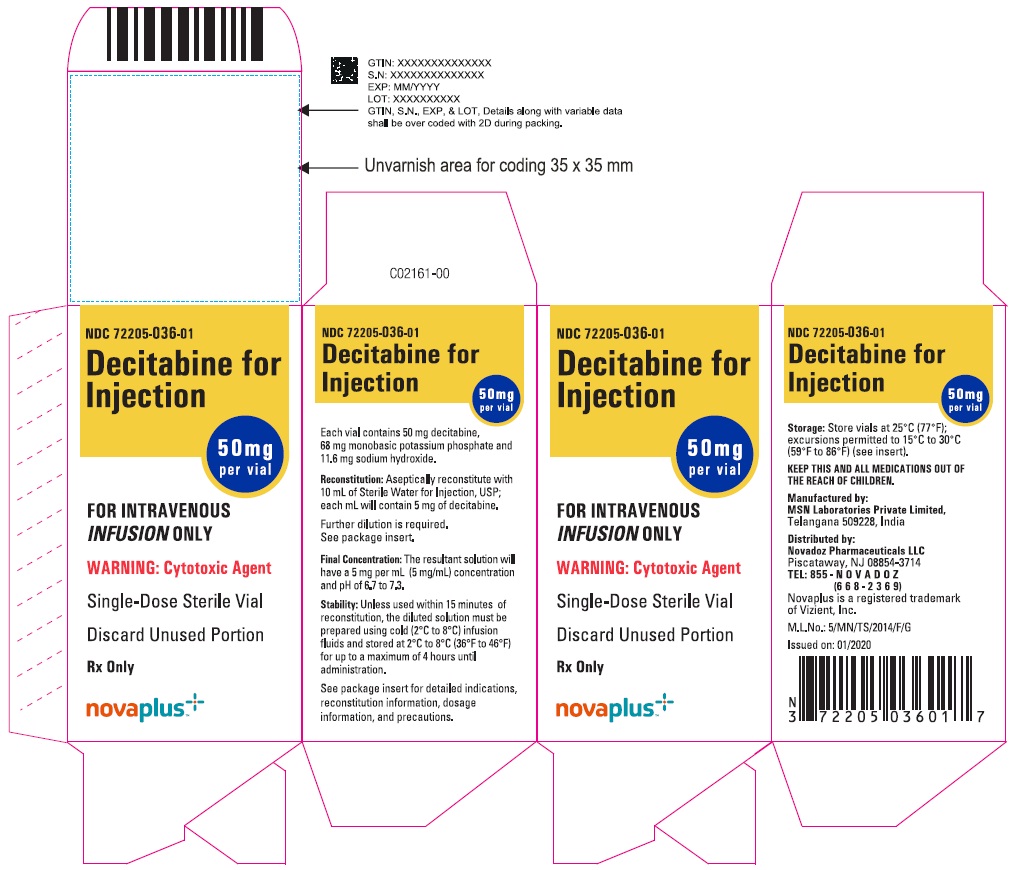
Decitabine for Injection is a sterile white to almost white lyophilized cake or powder supplied in a clear colorless glass vial. Each 20 mL, single dose, glass vial contains 50 mg decitabine, 68 mg monobasic potassium phosphate (potassium dihydrogen phosphate) and 11.6 mg sodium hydroxide.
Table 3 Mean (CV% or 95% CI) Pharmacokinetic Parameters of Decitabine
Dose
| Cmax(ng/mL)
| AUC0-∞
(ng·h/mL)
| T1/2
(h)
| CL
(L/h/m2)
| AUCCumulative***
(ng·h/mL)
|
15 mg/m2 3-hr infusion every 8 hours for 3 days (Option 1)*
| 73.8
(66)
| 163
(62)
| 0.62
(49)
| 125
(53)
| 1332
(1010-1730)
|
20 mg/m2 1-hr infusion daily for 5 days (Option 2)**
| 147
(49)
| 115
(43)
| 0.54
(43)
| 210
(47)
| 570
(470-700)
|
*N=14, **N=11, ***N=35 Cumulative AUC per cycle
The exact route of elimination and metabolic fate of decitabine is not known in humans. One of the pathways of elimination of decitabine appears to be deamination by cytidine deaminase found principally in the liver but also in granulocytes, intestinal epithelium and whole blood.
Specific Populations
Patients with Renal Impairment
There are no data on the use of decitabine in patients with renal impairment; therefore, if decitabine is administered to these patients, monitor them frequently for excessive toxicity.
Patients with Hepatic Impairment
There are no data on the use of decitabine in patients with hepatic impairment; therefore, if decitabine is administered to these patients, monitor them frequently for excessive toxicity.
Table 5 Response Criteria for Phase 3 MDS Trial*
Complete Response (CR)
≥ 8 weeks
| Bone Marrow
| On repeat aspirates:
- <5% myeloblasts
- No dysplastic changes
|
Peripheral Blood
| In all samples during response:
- Hgb >11 g/dL (no transfusions or erythropoietin
- ANC ≥1500/μL (no growth factor)
- Platelets ≥100,000/μL (no thrombopoietic agent)
- No blasts and no dysplasia
|
Partial Response (PR)
≥ 8 weeks
| Bone Marrow
| On repeat aspirates:
- ≥ 50% decrease in blasts over pretreatment values
OR
- Improvement to a less advanced MDS FAB classification
|
Peripheral Blood
| Same as for CR
|
*Cheson BD, Bennett JM, et al. Report of an International Working Group to Standardize Response Criteria for MDS. Blood. 2000; 96:3671-3674.
The overall response rate (CR+PR) in the ITT population was 17% in decitabine-treated patients and 0% in the SC group (p<0.001). (See Table 6)
The overall response rate was 21% (12/56) in decitabine-treated patients considered evaluable for response (i.e., those patients with pathologically confirmed MDS at baseline who received at least 2 cycles of treatment). The median duration of response (range) for patients who responded to decitabine was 288 days (116-388) and median time to response (range) was 93 days (55-272). All but one of the decitabine-treated patients who responded did so by the fourth cycle. Benefit was seen in an additional 13% of decitabine -treated patients who had hematologic improvement, defined as a response less than PR lasting at least 8 weeks, compared to 7% of SC patients. Decitabine treatment did not significantly delay the median time to AML or death versus supportive care.
Table 6 Analysis of Response (ITT)
Parameter
| Decitabine
N=89
| Supportive Care
N=81
|
Overall Response Rate (CR+PR)†
| 15 (17%)**
| 0 (0%)
|
Complete Response (CR)
| 8 (9%)
| 0 (0%)
|
Partial Response (PR)
| 7 (8%)
| 0 (0%)
|
Duration of Response
|
|
|
Median time to (CR+PR) response - Days (range)
| 93 (55-272)
| NA
|
Median Duration of (CR+PR) response - Days (range)
| 288 (116-388)
| NA
|
**p-value <0.001 from two-sided Fisher's Exact Test comparing Decitabine vs. Supportive Care.
†In the statistical analysis plan, a p-value of ≤ 0.024 was required to achieve statistical significance.
All patients with a CR or PR were RBC and platelet transfusion independent in the absence of growth factors.
Responses occurred in patients with an adjudicated baseline diagnosis of AML.
Advise women of childbearing potential to avoid pregnancy and to use effective contraception while receiving decitabine and for 6 months after last dose [See Warnings and Precautions (5.2)].
Advise men not to father a child while receiving treatment with decitabine, and for 3 months after the last dose. Advise men with female partners of childbearing potential to use effective contraception [see Warnings and Precautions (5.2) and Nonclinical Toxicology (13.1)].
Advise patients to avoid breastfeeding while receiving decitabine and for at 1 week after the last dose [see Use in Specific Populations (8.2)]. Advise patients of the risk of myelosuppression and to report any symptoms of infection, anemia, or bleeding to their healthcare provider as soon as possible. Advise patients for the need for laboratory monitoring [see Warnings and Precautions (5.1)].
Manufactured by:
MSN Laboratories Private Limited
Telangana – 509 228,
INDIA
Distributed by:
Novadoz Pharmaceuticals LLC
Piscataway, NJ 08854 -3714
Issued on: 01/2020