Pimavanserin Capsule
Product Images NDC 72205-055

View Photos of Packaging, Regulatory Labels, and Product Appearance

Product Visual Gallery

This gallery contains 7 technical images submitted to the FDA as part of the official labeling for Pimavanserin (NDC 72205-055). Unlike standard consumer photos, these assets often include clinical data figures, molecular chemical structures, and official manufacturer packaging layouts.

As provided by Novadoz Pharmaceuticals Llc, these visuals offer a comprehensive scientific overview of the product's physical and chemical identity, aiding pharmacists and researchers in product verification and study.

FDA Label Image

Pimavanserin-caps-34mg-30s-container-label (Pimavanserin Caps 34mg 30s Container Label)

Pimavanserin-caps-34mg-30s-container-label (Pimavanserin Caps 34mg 30s Container Label)
Label for pimavanserin capsules, 34 mg strength, in a 30-capsule package by Novadoz Pharmaceuticals LLC. The label includes dosage information, storage instructions, manufacturer and distributor details, and a barcode. The label highlights the Rx only status and provides contact information for Novadoz Pharmaceuticals.*
FDA Label Image

Pimavanserin-figure-1 (Pimavanserin Figure 1)

Pimavanserin-figure-1 (Pimavanserin Figure 1)
A pharmacokinetic graph showing fold change and 90% confidence intervals in areas under the curve (AUC) and maximum concentrations (Cmax) for pimavanserin in populations with varying degrees of renal and hepatic impairment. The x-axis represents change relative to reference, ranging from 0.5 to 4, with data points summarizing effects for severe renal impairment, end-stage renal disease (ESRD), and mild to severe hepatic impairment.*
FDA Label Image

Pimavanserin-figure-2 (Pimavanserin Figure 2)

Pimavanserin-figure-2 (Pimavanserin Figure 2)
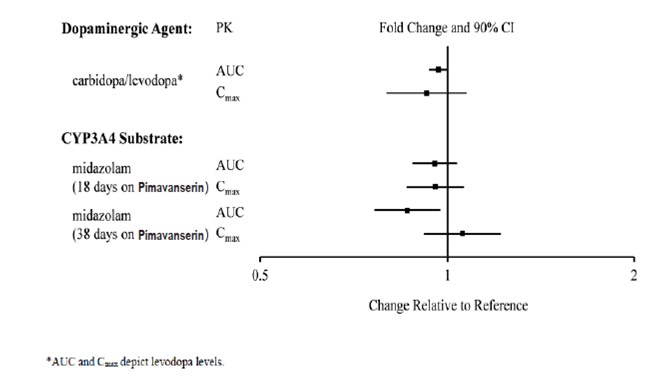
A forest plot showing fold change and 90% confidence intervals for pharmacokinetic parameters (AUC and Cmax) of dopaminergic agent carbidopa/levodopa and CYP3A4 substrate midazolam after 18 and 38 days of pimavanserin use. The x-axis represents change relative to reference from 0.5 to 2, illustrating no significant changes in these parameters.*
FDA Label Image

Pimavanserin-figure-3 (Pimavanserin Figure 3)

Pimavanserin-figure-3 (Pimavanserin Figure 3)
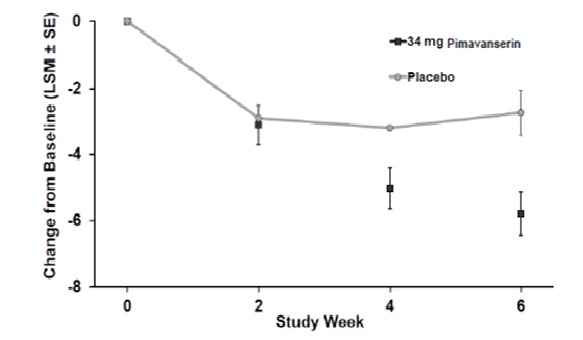
A line graph comparing changes from baseline over study weeks 0, 2, 4, and 6 for 34 mg pimavanserin and placebo groups. The y-axis shows change from baseline (LSM ± SE) with negative values indicating decline, while the x-axis represents study weeks. Pimavanserin shows greater negative change than placebo at weeks 4 and 6.*
FDA Label Image

Pimavanserin-figure-4 (Pimavanserin Figure 4)

Pimavanserin-figure-4 (Pimavanserin Figure 4)
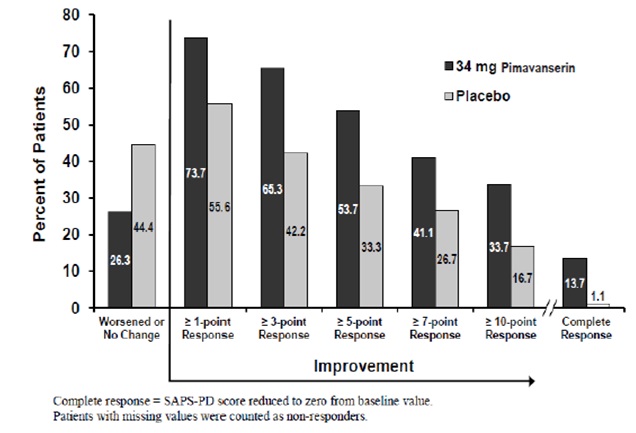
A bar chart comparing clinical improvement between patients receiving 34 mg pimavanserin and placebo. The x-axis shows levels of improvement from 'Worsened or No Change' to 'Complete Response.' The y-axis represents the percent of patients. The chart indicates higher percentages of patients with various degrees of response to pimavanserin compared to placebo, with complete response defined as SAPS-PD score reduced to zero.*
FDA Label Image

Pimavanserin-figure-5 (Pimavanserin Figure 5)

Pimavanserin-figure-5 (Pimavanserin Figure 5)
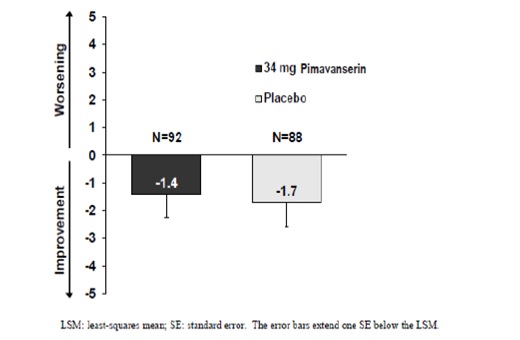
A bar chart comparing the effects of 34 mg pimavanserin versus placebo. The y-axis ranges from worsening to improvement, and two bars represent the mean changes in each group with standard error bars. Sample sizes are N=92 for pimavanserin and N=88 for placebo, showing slight improvement in both groups.*
FDA Label Image

Pimavanserin-structure (Pimavanserin Structure)

Pimavanserin-structure (Pimavanserin Structure)
Chemical structure of the active ingredient pimavanserin as shown in the image, including a duplicated complex molecule and a separate ascorbic acid (vitamin C) structure.*

* About these descriptions: Image descriptions on this page are generated by automated AI analysis of the product label images from the manufacturer's FDA label submission (SPL). They are provided for reference only and may contain errors or omissions. Always rely on the printed label itself and the official FDA labeling, and consult a pharmacist or healthcare professional with any questions about this product.