Initial Combination Therapy with Linagliptin and Metformin
A total of 791 patients with type 2 diabetes mellitus and inadequate glycemic control on diet and exercise participated in the 24-week, randomized, double-blind, portion of this placebo-controlled factorial trial designed to assess the efficacy of linagliptin as initial therapy with metformin. Patients on an antihyperglycemic agent (52%) underwent a drug washout period of 4 weeks’ duration. After the washout period and after completing a 2-week single-blind placebo run-in period, patients with inadequate glycemic control (A1C ≥7% to ≤10.5%) were randomized. Patients with inadequate glycemic control (A1C ≥7.5% to <11%) not on antihyperglycemic agents at trial entry (48%) immediately entered the 2-week single-blind placebo run-in period and then were randomized. Randomization was stratified by baseline A1C (<8.5% vs ≥8.5%) and use of a prior oral antidiabetic drug (none vs monotherapy). Patients were randomized in a 1:2:2:2:2:2 ratio to either placebo or one of 5 active-treatment arms. Approximately equal numbers of patients were randomized to receive initial therapy with 5 mg of linagliptin once daily, 500 mg or 1,000 mg of metformin twice daily, or 2.5 mg of linagliptin twice daily in combination with 500 mg or 1,000 mg of metformin twice daily. Patients who failed to meet specific glycemic goals during the trial were treated with sulfonylurea, thiazolidinedione, or insulin rescue therapy.
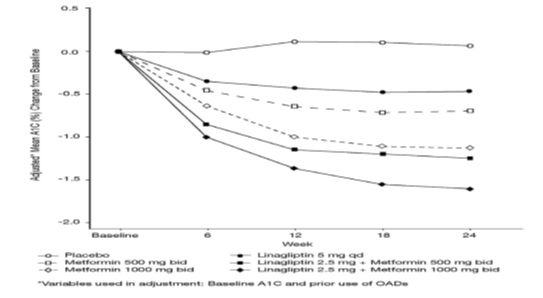
Initial therapy with the combination of linagliptin and metformin provided significant improvements in A1C, and fasting plasma glucose (FPG) compared to placebo, to metformin alone, and to linagliptin alone (Table 7, Figure 1). The adjusted mean treatment difference in A1C from baseline to week 24 (LOCF) was -0.5% (95% CI -0.7, -0.3; p<0.0001) for linagliptin 2.5 mg/metformin 1,000 mg twice daily compared to metformin 1,000 mg twice daily; -1.1% (95% CI -1.4, -0.9; p<0.0001) for linagliptin 2.5 mg/metformin 1,000 mg twice daily compared to linagliptin 5 mg once daily; -0.6% (95% CI -0.8, -0.4; p<0.0001) for linagliptin 2.5 mg/metformin 500 mg twice daily compared to metformin 500 mg twice daily; and -0.8% (95% CI -1, -0.6; p<0.0001) for linagliptin 2.5 mg/metformin 500 mg twice daily compared to linagliptin 5 mg once daily. Lipid effects were generally neutral. No meaningful change in body weight was noted in any of the 6 treatment groups.
Table 7 Glycemic Parameters at Final Visit (24-Week Trial) for Linagliptin and Metformin, Alone and in Combination in Randomized Patients with Type 2 Diabetes Mellitus Inadequately Controlled on Diet and Exercise**
| Placebo
| Linagliptin
5 mg
Once Daily*
| Metformin
500 mg
Twice Daily
| Linagliptin
2.5 mgTwice Daily* + Metformin 500 mg Twice Daily
| Metformin
1,000 mg
Twice Daily
| Linagliptin 2.5 mg
Twice Daily* + Metformin
1,000 mgTwice Daily
|
A1C (%)
|
|
|
|
|
|
|
Number of patients
| n=65
| n=135
| n=141
| n=137
| n=138
| n=140
|
Baseline (mean)
| 8.7
| 8.7
| 8.7
| 8.7
| 8.5
| 8.7
|
Change from baseline (adjusted mean****)
| 0.1
| -0.5
| -0.6
| -1.2
| -1.1
| -1.6
|
Difference from placebo (adjusted mean) (95% CI)
| -
| -0.6 (-0.9, -0.3)
| -0.8 (-1, -0.5)
| -1.3 (-1.6, -1.1)
| -1.2 (-1.5, -0.9)
| -1.7 (-2, -1.4)
|
Patients [n (%)] achieving A1C
<7%***
| 7 (10.8)
| 14 (10.4)
| 26 (18.6)
| 41 (30.1)
| 42 (30.7)
| 74 (53.6)
|
Patients (%) receivingrescue
medication
| 29.2
| 11.1
| 13.5
| 7.3
| 8
| 4.3
|
FPG (mg/dL)
|
|
|
|
|
|
|
Number of patients
| n=61
| n=134
| n=136
| n=135
| n=132
| n=136
|
Baseline (mean)
| 203
| 195
| 191
| 199
| 191
| 196
|
Change from baseline (adjusted mean****)
| 10
| -9
| -16
| -33
| -32
| -49
|
Difference from placebo (adjusted mean) (95% CI)
| -
| -19 (-31, -6)
| -26 (-38, -14)
| -43 (-56, -31)
| -42 (-55, -30)
| -60 (-72, -47)
|
*Total daily dosage of linagliptin is equal to 5 mg
**Full analysis population using last observation on trial
***Metformin 500 mg twice daily, n=140; Linagliptin 2.5 mg twice daily + Metformin 500 mg twice daily, n=136; Metformin 1,000 mg twice daily, n=137; Linagliptin 2.5 mg twice daily + Metformin 1,000 mg twice daily, n=138
****HbA1c: ANCOVA model included treatment and number of prior OADs as class-effects, as well as baseline HbA1c as continuous covariates. FPG: ANCOVA model included treatment and number of prior OADs as class-effects, as well as baseline HbA1c and baseline FPG as continuous covariates.
Figure 1 Adjusted Mean Change from Baseline for A1C (%) over 24 Weeks with Linagliptin and Metformin, Alone and in Combination in Patients with Type 2 Diabetes Mellitus Inadequately Controlled with Diet and Exercise - FAS completers

Lina-met-tabs--figure-1 (Lina Met Tabs Figure 1)
Initial Combination Therapy with Linagliptin and Metformin vs Linagliptin in Treatment-Naïve Patients
A total of 316 patients with type 2 diabetes mellitus diagnosed within the previous 12 months and treatment-naïve (no antidiabetic therapy for 12 weeks prior to randomization) and inadequate glycemic control (A1C ≥8.5% to ≤12%) participated in a 24-week, randomized, double-blind, trial designed to assess the efficacy of linagliptin in combination with metformin vs linagliptin. Patients were randomized (1:1), after a 2-week run-in period, to either linagliptin 5 mg plus metformin (1,500 to 2,000 mg per day, n=159) or linagliptin 5 mg plus placebo, (n=157) administered once daily. Patients in the linagliptin and metformin treatment group were up-titrated to a maximum tolerated dosage of metformin (1,000 to 2,000 mg per day) over a three-week period.
Initial therapy with the combination of linagliptin and metformin provided statistically significant improvements in A1C compared to linagliptin (Table 8). The mean difference between groups in A1C change from baseline was -0.8% with 2-sided 95% confidence interval
(-1.23%, -0.45%).
Table 8 Glycemic Parameters at 24 Weeks in Trial Comparing Linagliptin in Combination with Metformin to Linagliptin in Treatment-Naïve Patients*
| Linagliptin 5 mg + Metformin
| Linagliptin 5 mg + Placebo
|
A1C (%)*
|
|
|
Number of patients
| n=153
| n=150
|
Baseline (mean)
| 9.8
| 9.9
|
Change from baseline (adjusted mean)
| -2.9
| -2
|
Difference from linagliptin (adjusted mean**) (95% CI)
| -0.84† (-1.23, -0.45)
| -
|
Patients [n (%)] achieving A1C <7%*
| 82 (53.6)
| 45 (30)
|
FPG (mg/dL)*
|
|
|
Number of patients
| n=153
| n=150
|
Baseline (mean)
| 196
| 198
|
Change from baseline (adjusted mean)
| -54
| -35
|
Difference from linagliptin (adjusted mean**) (95% CI)
| -18††(-31, -5.5)
| -
|
†p<0.0001 compared to linagliptin, ††p=0.0054 compared to linagliptin
*Full analysis set population
**A1C: MMRM model included treatment, continuous baseline A1C, baseline A1C by visit interaction, visit by treatment interaction, baseline renal impairment by treatment interaction and baseline renal impairment by treatment by visit interaction. FPG: MMRM model included treatment, continuous baseline A1C, continuous baseline FPG, baseline FPG by visit interaction, visit by treatment interaction, baseline renal impairment by treatment interaction and baseline renal impairment by treatment by visit interaction.
The adjusted mean changes for A1C (%) from baseline over time for linagliptin and metformin as compared to linagliptin alone were maintained throughout the 24 week treatment period. Using the completers analysis the respective adjusted means for A1C (%) changes from baseline for linagliptin and metformin as compared to linagliptin alone were -1.9 and -1.3 at week 6, -2.6 and -1.8 at week 12, -2.7 and -1.9 at week 18, and -2.7 and -1.9 at week 24.
Changes in body weight from baseline were not clinically significant in either treatment group.
Add-On Combination Therapy with Metformin
A total of 701 patients with type 2 diabetes mellitus participated in a 24-week, randomized, double-blind, placebo-controlled trial designed to assess the efficacy of linagliptin in combination with metformin. Patients already on metformin (n=491) at a dosage of at least 1,500 mg per day were randomized after completing a 2-week, open-label, placebo run-in period. Patients on metformin and another antihyperglycemic agent (n=207) were randomized after a run-in period of approximately 6 weeks on metformin (at a dosage of at least 1,500 mg per day) in monotherapy. Patients were randomized to the addition of either linagliptin 5 mg or placebo, administered once daily. Patients who failed to meet specific glycemic goals during the studies were treated with glimepiride rescue.
In combination with metformin, linagliptin provided statistically significant improvements in A1C, FPG, and 2-hour PPG compared with placebo (Table 9). Rescue glycemic therapy was used in 7.8% of patients treated with linagliptin 5 mg and in 18.9% of patients treated with placebo. A similar decrease in body weight was observed for both treatment groups.
Table 9 Glycemic Parameters in Placebo-Controlled Trial for Linagliptin in Combination with Metformin*
| Linagliptin 5 mg + Metformin
| Placebo + Metformin
|
A1C (%)
|
|
|
Number of patients
| n=513
| n=175
|
Baseline (mean)
| 8.1
| 8
|
Change from baseline (adjusted mean***)
| -0.5
| 0.15
|
Difference from placebo + metformin (adjusted mean) (95% CI)
| -0.6 (-0.8, -0.5)
| -
|
Patients [n (%)] achieving A1C <7%**
| 127 (26.2)
| 15 (9.2)
|
FPG (mg/dL)
|
|
|
Number of patients
| n=495
| n=159
|
Baseline (mean)
| 169
| 164
|
Change from baseline (adjusted mean***)
| -11
| 11
|
Difference from placebo + metformin (adjusted mean) (95% CI)
| -21 (-27, -15)
| -
|
2-hour PPG (mg/dL)
|
|
|
Number of patients
| n=78
| n=21
|
Baseline (mean)
| 270
| 274
|
Change from baseline (adjusted mean***)
| -49
| 18
|
Difference from placebo + metformin (adjusted mean) (95% CI)
| -67 (-95, -40)
| -
|
* Full analysis population using last observation on trial
**Linagliptin 5 mg + Metformin, n=485; Placebo + Metformin, n=163
***HbA1c: ANCOVA model included treatment and number of prior oral OADs as class-effects, as well as baseline HbA1c as continuous covariates. FPG: ANCOVA model included treatment and number of prior OADs as class-effects, as well as baseline HbA1c and baseline FPG as continuous covariates. PPG: ANCOVA model included treatment and number of prior OADs as class-effects, as well as baseline HbA1c and baseline postprandial glucose after two hours as covariate.
Active-Controlled Trial vs Glimepiride in Combination with Metformin
The efficacy of linagliptin was evaluated in a 104-week, double-blind, glimepiride-controlled non-inferiority trial in type 2 diabetic patients with insufficient glycemic control despite metformin therapy. Patients being treated with metformin only entered a run-in period of 2 weeks’ duration, whereas patients pretreated with metformin and one additional antihyperglycemic agent entered a run-in treatment period of 6 weeks’ duration with metformin monotherapy (dosage of ≥1,500 mg per day) and washout of the other agent. After an additional 2-week placebo run-in period, those with inadequate glycemic control (A1C 6.5% to 10%) were randomized 1:1 to the addition of linagliptin 5 mg once daily or glimepiride. Randomization was stratified by baseline HbA1c (<8.5% vs ≥8.5%), and the previous use of antidiabetic drugs (metformin alone vs metformin plus one other OAD). Patients receiving glimepiride were given an initial dosage of 1 mg/day and then electively titrated over the next 12 weeks to a maximum dosage of 4 mg/day as needed to optimize glycemic control. Thereafter, the glimepiride dosage was to be kept constant, except for down-titration to prevent hypoglycemia.
After 52 weeks and 104 weeks, linagliptin and glimepiride both had reductions from baseline in A1C (52 weeks: -0.4% for linagliptin, -0.6% for glimepiride; 104 weeks: -0.2% for linagliptin,
-0.4% for glimepiride) from a baseline mean of 7.7% (Table 10). The mean difference between groups in A1C change from baseline was 0.2% with 2-sided 97.5% confidence interval (0.1%, 0.3%) for the intent-to-treat population using last observation carried forward. These results were consistent with the completers analysis.
Table 10 Glycemic Parameters at 52 and 104 Weeks in Trial Comparing Linagliptin to Glimepiride as Add-On Therapy in Patients Inadequately Controlled on Metformin**
| Week 52
| Week 104
|
| Linagliptin 5 mg +
Metformin
| Glimepiride + Metformin(mean glimepiride dosage 3 mg)
| Linagliptin 5 mg +
Metformin
| Glimepiride + Metformin(mean glimepiride dosage 3 mg)
|
A1C (%)
|
|
|
|
|
Number of patients
| n=764
| n=755
| n=764
| n=755
|
Baseline (mean)
| 7.7
| 7.7
| 7.7
| 7.7
|
Change from baseline (adjusted mean***)
| -0.4
| -0.6
| -0.2
| -0.4
|
Difference from glimepiride (adjusted mean) (97.5% CI)
|
0.2 (0.1, 0.3)
|
-
|
0.2 (0.1, 0.3)
|
-
|
FPG (mg/dL)
|
|
|
|
|
Number of patients
| n=733
| n=725
| n=733
| n=725
|
Baseline (mean)
| 164
| 166
| 164
| 166
|
Change from baseline (adjusted mean***)
| -8*
| -15
| -2†
| -9
|
*p<0.0001 vs glimepiride; †p=0.0012 vs glimepiride
**Full analysis population using last observation on trial
***HbA1c: ANCOVA model included treatment and number of prior OADs as class-effects, as well as baseline HbA1c as continuous covariates. FPG: ANCOVA model included treatment and number of prior OADs as class-effects, as well as baseline HbA1c and baseline FPG as continuous covariates.
Patients treated with linagliptin had a mean baseline body weight of 86 kg and were observed to have an adjusted mean decrease in body weight of 1.1 kg at 52 weeks and 1.4 kg at 104 weeks. Patients on glimepiride had a mean baseline body weight of 87 kg and were observed to have an adjusted mean increase from baseline in body weight of 1.4 kg at 52 weeks and 1.3 kg at 104 weeks (treatment difference p<0.0001 for both timepoints).
Add-On Combination Therapy with Metformin and a Sulfonylurea
A total of 1,058 patients with type 2 diabetes mellitus participated in a 24-week, randomized, double-blind, placebo-controlled trial designed to assess the efficacy of linagliptin in combination with a sulfonylurea and metformin. The most common sulfonylureas used by patients in the trial were glimepiride (31%), glibenclamide (26%), and gliclazide (26% [not available in the United States]). Patients on a sulfonylurea and metformin were randomized to receive linagliptin 5 mg or placebo, each administered once daily. Patients who failed to meet specific glycemic goals during the trial were treated with pioglitazone rescue. Glycemic end points measured included A1C and FPG.
In combination with a sulfonylurea and metformin, linagliptin provided statistically significant improvements in A1C and FPG compared with placebo (Table 11). In the entire trial population (patients on linagliptin in combination with a sulfonylurea and metformin), a mean reduction from baseline relative to placebo in A1C of -0.6% and in FPG of -13 mg/dL was seen. Rescue therapy was used in 5.4% of patients treated with linagliptin 5 mg and in 13% of patients treated with placebo. Change from baseline in body weight did not differ significantly between the groups.
Table 11 Glycemic Parameters at Final Visit (24-Week Trial) for Linagliptin in Combination with Metformin and Sulfonylurea*
| Linagliptin 5 mg + Metformin + SU
| Placebo + Metformin + SU
|
A1C (%)
|
|
|
Number of patients
| n=778
| n=262
|
Baseline (mean)
| 8.2
| 8.1
|
Change from baseline (adjusted mean***)
| -0.7
| -0.1
|
Difference from placebo (adjusted mean) (95% CI)
| -0.6 (-0.7, -0.5)
| -
|
Patients [n (%)] achieving A1C <7%**
| 217 (29.2)
| 20 (8.1)
|
FPG (mg/dL)
|
|
|
Number of patients
| n=739
| n=248
|
Baseline (mean)
| 159
| 163
|
Change from baseline (adjusted mean***)
| -5
| 8
|
Difference from placebo (adjusted mean) (95% CI)
| -13 (-18, -7)
| -
|
SU=sulfonylurea
*Full analysis population using last observation on trial
**Linagliptin 5 mg + Metformin + SU, n=742; Placebo + Metformin + SU, n=247
***HbA1c: ANCOVA model included treatment as class-effects and baseline HbA1c as continuous covariates. FPG: ANCOVA model included treatment as class-effects, as well as baseline HbA1c and baseline FPG as continuous covariates.