Limitations of Use:
Febuxostat tablets are not recommended for the treatment of asymptomatic hyperuricemia.
Most Common Adverse Reactions
In three randomized, controlled clinical studies (Studies 1, 2 and 3), which were six to 12 months in duration, the following adverse reactions were reported by the treating physician as related to study drug. Table 1 summarizes adverse reactions reported at a rate of at least 1% in febuxostat tablets treatment groups and at least 0.5% greater than placebo.
Table 1: Adverse Reactions Occurring in ≥ 1% of Patients Treated with febuxostat tablets and at Least 0.5% Greater than Seen in Patients Receiving Placebo in Controlled Studies | Placebo | febuxostat tablets | allopurinol
|
|---|
| Adverse Reactions | (N=134) | 40 mg daily
(N=757)
| 80 mg daily
(N=1279)
| (N=1277) |
|---|
| Liver Function Abnormalities | 0.7% | 6.6% | 4.6% | 4.2% |
| Nausea | 0.7% | 1.1% | 1.3% | 0.8% |
| Arthralgia | 0% | 1.1% | 0.7% | 0.7% |
| Rash | 0.7% | 0.5% | 1.6% | 1.6% |
The most common adverse reaction leading to discontinuation from therapy was liver function abnormalities in 1.8% of febuxostat tablets 40 mg, 1.2% of febuxostat tablets 80 mg, and in 0.9% of patients treated with allopurinol.
In addition to the adverse reactions presented in Table 1, dizziness was reported in more than 1% of patients treated with febuxostat tablets although not at a rate more than 0.5% greater than placebo.
In the CARES study, liver function abnormalities and diarrhea were reported in more than 1% of patients treated with febuxostat tablets, although not at a rate more than 0.5% greater than allopurinol.
Less Common Adverse Reactions
In clinical studies the following adverse reactions occurred in less than 1% of patients and in more than one subject treated with doses ranging from 40 mg to 240 mg of febuxostat tablets. This list also includes adverse reactions (less than 1% of patients) associated with organ systems from Warnings and Precautions.
Blood and Lymphatic System Disorders:anemia, idiopathic thrombocytopenic purpura, leukocytosis/leukopenia, neutropenia, pancytopenia, splenomegaly, thrombocytopenia.
Cardiac Disorders:angina pectoris, atrial fibrillation/flutter, cardiac murmur, ECG abnormal, palpitations, sinus bradycardia, tachycardia.
Ear and Labyrinth Disorders:deafness, tinnitus, vertigo.
Eye Disorders:vision blurred.
Gastrointestinal Disorders:abdominal distention, abdominal pain, constipation, dry mouth, dyspepsia, flatulence, frequent stools, gastritis, gastroesophageal reflux disease, gastrointestinal discomfort, gingival pain,hematemesis, hyperchlorhydria, hematochezia, mouth ulceration, pancreatitis, peptic ulcer, vomiting.
General Disorders and Administration Site Conditions:asthenia, chest pain/discomfort, edema, fatigue, feeling abnormal, gait disturbance, influenza-like symptoms, mass, pain, thirst.
Hepatobiliary Disorders:cholelithiasis/cholecystitis, hepatic steatosis, hepatitis, hepatomegaly.
Immune System Disorder:hypersensitivity.
Infections and Infestations:herpes zoster.
Procedural Complications:contusion.
Metabolism and Nutrition Disorders:anorexia, appetite decreased/increased, dehydration, diabetes mellitus, hypercholesterolemia, hyperglycemia, hyperlipidemia, hypertriglyceridemia, hypokalemia, weight decreased/increased.
Musculoskeletal and Connective Tissue Disorders:arthritis, joint stiffness, joint swelling, muscle spasms/twitching/tightness/weakness, musculoskeletal pain/stiffness, myalgia.
Nervous System Disorders:altered taste, balance disorder, cerebrovascular accident, Guillain-Barré syndrome, headache, hemiparesis, hypoesthesia, hyposmia, lacunar infarction, lethargy, mental impairment, migraine, paresthesia, somnolence, transient ischemic attack, tremor.
Psychiatric Disorders:agitation, anxiety, depression, insomnia, irritability, libido decreased, nervousness, panic attack, personality change.
Renal and Urinary Disorders:hematuria, nephrolithiasis, pollakiuria, proteinuria, renal failure, renal insufficiency, urgency, incontinence.
Reproductive System and Breast Changes:breast pain, erectile dysfunction, gynecomastia.
Respiratory, Thoracic and Mediastinal Disorders:bronchitis, cough, dyspnea, epistaxis, nasal dryness, paranasal sinus hypersecretion, pharyngeal edema, respiratory tract congestion, sneezing, throat irritation, upper respiratory tract infection.
Skin and Subcutaneous Tissue Disorders:alopecia
,angio-edema, dermatitis, dermographism, ecchymosis, eczema, hair color changes, hair growth abnormal, hyperhidrosis
,peeling skin, petechiae, photosensitivity, pruritus, purpura, skin discoloration/altered pigmentation, skin lesion, skin odor abnormal, urticaria.
Vascular Disorders:flushing, hot flush, hypertension, hypotension.
Laboratory Parameters:activated partial thromboplastin time prolonged, creatine increased, bicarbonate decreased, sodium increased, EEG abnormal, glucose increased, cholesterol increased, triglycerides increased, amylase increased, potassium increased, TSH increased, platelet count decreased, hematocrit decreased, hemoglobin decreased, MCV increased, RBC decreased, creatinine increased, blood urea increased, BUN/creatinine ratio increased, creatine phosphokinase (CPK) increased, alkaline phosphatase increased, LDH increased, PSA increased, urine output increased/decreased, lymphocyte count decreased, neutrophil count decreased, WBC increased/decreased, coagulation test abnormal, low density lipoprotein (LDL) increased, prothrombin time prolonged, urinary casts, urine positive for white blood cells and protein.
Risk Summary
Limited available data with febuxostat tablets use in pregnant women are insufficient to inform a drug associated risk of adverse developmental outcomes. No adverse developmental effects were observed in embryo-fetal development studies with oral administration of febuxostat to pregnant rats and rabbits during organogenesis at doses that produced maternal exposures up to 40 and 51 times, respectively, the exposure at the maximum recommended human dose (MRHD). No adverse developmental effects were observed in a pre- and postnatal development study with administration of febuxostat to pregnant rats from organogenesis through lactation at an exposure approximately 11 times the MRHD
(see
Data)
.
The estimated background risk of major birth defects and miscarriage for the indicated population is unknown. All pregnancies have a background risk of birth defect, loss, or other adverse outcomes. In the US general population, the estimated background risk of major birth defects and miscarriage in clinically recognized pregnancies is 2 to 4% and 15 to 20%, respectively.
Data
Animal Data
In an embryo-fetal development study in pregnant rats dosed during the period of organogenesis from gestation Days 7 – 17, febuxostat was not teratogenic and did not affect fetal development or survival at exposures up to approximately 40 times the MRHD (on an AUC basis at maternal oral doses up to 48 mg/kg/day). In an embryo-fetal development study in pregnant rabbits dosed during the period of organogenesis from gestation Days 6 – 18, febuxostat was not teratogenic and did not affect fetal development at exposures up to approximately 51 times the MRHD (on an AUC basis at maternal oral doses up to 48 mg/kg/day).
In a pre- and postnatal development study in pregnant female rats dosed orally from gestation Day 7 through lactation Day 20, febuxostat had no effects on delivery or growth and development of offspring at a dose approximately 11 times the MRHD (on an AUC basis at a maternal oral dose of 12 mg/kg/day). However, increased neonatal mortality and a reduction in neonatal body weight gain were observed in the presence of maternal toxicity at a dose approximately 40 times the MRHD (on an AUC basis at a maternal oral dose of 48 mg/kg/day).
Febuxostat crossed the placental barrier following oral administration to pregnant rats and was detected in fetal tissues.
Risk Summary
There are no data on the presence of febuxostat in human milk, the effects on the breastfed infant, or the effects on milk production. Febuxostat is present in rat milk. The developmental and health benefits of breastfeeding should be considered along with the mother's clinical need for febuxostat tablets and any potential adverse effects on the breastfed child from febuxostat tablets or from the underlying maternal condition.
Data
Animal Data
Orally administered febuxostat was detected in the milk of lactating rats at up to approximately 7 times the plasma concentration.
Effect on Uric Acid and Xanthine Concentrations
In healthy patients, febuxostat tablets resulted in a dose dependent decrease in 24-hour mean serum uric acid concentrations and an increase in 24-hour mean serum xanthine concentrations. In addition, there was a decrease in the total daily urinary uric acid excretion. Also, there was an increase in total daily urinary xanthine excretion. Percent reduction in 24-hour mean serum uric acid concentrations was between 40% and 55% at the exposure levels of 40 mg and 80 mg daily doses.
Effect on Cardiac Repolarization
The effect of febuxostat tablets on cardiac repolarization as assessed by the QTc interval was evaluated in normal healthy patients and in patients with gout. Febuxostat tablets in doses up to 300 mg daily (3.75 times the maximum recommended daily dosage), at steady-state, did not demonstrate an effect on the QTc interval.
Absorption
The absorption of radiolabeled febuxostat following oral dose administration was estimated to be at least 49% (based on total radioactivity recovered in urine). Maximum plasma concentrations of febuxostat occurred between 1 and 1.5 hours postdose. After multiple oral 40 mg and 80 mg once daily doses, C
maxis approximately 1.6 ± 0.6 mcg/mL (N=30), and 2.6 ± 1.7 mcg/mL (N=227), respectively. Absolute bioavailability of the febuxostat tablet has not been studied.
Following multiple 80 mg once daily doses with a high fat meal, there was a 49% decrease in C
maxand an 18% decrease in AUC, respectively. However, no clinically significant change in the percent decrease in serum uric acid concentration was observed (58% fed vs 51% fasting). Thus, febuxostat tablets may be taken without regard to food.
Concomitant ingestion of an antacid containing magnesium hydroxide and aluminum hydroxide with an 80 mg single dose of febuxostat tablets has been shown to delay absorption of febuxostat (approximately one hour) and to cause a 31% decrease in C
maxand a 15% decrease in AUC
∞. As AUC rather than C
maxwas related to drug effect, change observed in AUC was not considered clinically significant. Therefore, febuxostat tablets may be taken without regard to antacid use.
Distribution
The mean apparent steady state volume of distribution (V
ss/F) of febuxostat was approximately 50 L (CV ~40%). The plasma protein binding of febuxostat is approximately 99.2% (primarily to albumin), and is constant over the concentration range achieved with 40 mg and 80 mg doses.
Metabolism
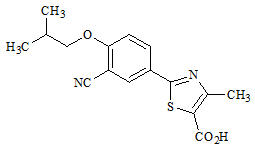
Febuxostat is extensively metabolized by both conjugation via uridine diphosphate glucuronosyltransferase (UGT) enzymes including UGT1A1, UGT1A3, UGT1A9, and UGT2B7 and oxidation via cytochrome P450 (CYP) enzymes including CYP1A2, 2C8 and 2C9 and non-P450 enzymes. The relative contribution of each enzyme isoform in the metabolism of febuxostat is not clear. The oxidation of the isobutyl side chain leads to the formation of four pharmacologically active hydroxy metabolites, all of which occur in plasma of humans at a much lower extent than febuxostat.
In urine and feces, acyl glucuronide metabolites of febuxostat (~35% of the dose), and oxidative metabolites, 67M-1 (~10% of the dose), 67M-2 (~11% of the dose), and 67M-4, a secondary metabolite from 67M-1 (~14% of the dose), appeared to be the major metabolites of febuxostat
in vivo.
Elimination
Febuxostat is eliminated by both hepatic and renal pathways. Following an 80 mg oral dose of
14C-labeled febuxostat, approximately 49% of the dose was recovered in the urine as unchanged febuxostat (3%), the acyl glucuronide of the drug (30%), its known oxidative metabolites and their conjugates (13%), and other unknown metabolites (3%). In addition to the urinary excretion, approximately 45% of the dose was recovered in the feces as the unchanged febuxostat (12%), the acyl glucuronide of the drug (1%), its known oxidative metabolites and their conjugates (25%), and other unknown metabolites (7%).
The apparent mean terminal elimination half-life (t
1/2) of febuxostat was approximately 5 to 8 hours.
Specific Populations
Geriatric Patients
The C
maxand AUC of febuxostat and its metabolites following multiple oral doses of febuxostat tablets in geriatric patients (≥ 65 years) were similar to those in younger patients (18 to 40 years). In addition, the percent decrease in serum uric acid concentration was similar between elderly and younger patients. No dose adjustment is necessary in geriatric patients
[see
Use in Specific Populations (8.5)].
Patients with Renal Impairment
In a dedicated phase I pharmacokinetics study, following multiple 80 mg doses of febuxostat tablets in healthy patients with mild (Cl
cr50 to 80 mL/min), moderate (Cl
cr30 to 49 mL/min) or severe renal impairment (Cl
cr10 to 29 mL/min), the C
maxof febuxostat did not change relative to patients with normal renal function (Cl
crgreater than 80 mL/min). AUC and half-life of febuxostat increased in patients with renal impairment in comparison to patients with normal renal function, but values were similar among three renal impairment groups. Mean febuxostat AUC values were up to 1.8 times higher in patients with renal impairment compared to those with normal renal function. Mean C
maxand AUC values for three active metabolites increased up to two and four-fold, respectively. However, the percent decrease in serum uric acid concentration for patients with renal impairment was comparable to those with normal renal function (58% in normal renal function group and 55% in the severe renal function group).
Based on population pharmacokinetic analysis, following multiple 40 mg or 80 mg doses of febuxostat tablets, the mean oral clearance (CL/F) values of febuxostat in patients with gout and mild (n=334), moderate (n=232) or severe (n=34) renal impairment were decreased by 14%, 34%, and 48%, respectively, compared to patients with normal (n=89) renal function. The corresponding median AUC values of febuxostat at steady-state in patients with renal impairment were increased by 18%, 49%, and 96% after 40 mg dose, and 7%, 45% and 98% after 80 mg dose, respectively, compared to patients with normal renal function.
Febuxostat tablets have not been studied in end stage renal impairment patients who are on dialysis.
Patients with Hepatic Impairment
Following multiple 80 mg doses of febuxostat tablets in patients with mild (Child-Pugh Class A) or moderate (Child-Pugh Class B) hepatic impairment, an average of 20% to 30% increase was observed for both C
maxand AUC
24(total and unbound) in hepatic impairment groups compared to patients with normal hepatic function. In addition, the percent decrease in serum uric acid concentration was comparable between different hepatic groups (62% in healthy group, 49% in mild hepatic impairment group, and 48% in moderate hepatic impairment group). No dose adjustment is necessary in patients with mild or moderate hepatic impairment. No studies have been conducted in patients with severe hepatic impairment (Child-Pugh Class C); caution should be exercised in those patients
[see
Use in Specific Populations (8.7)].
Male and Female Patients
Following multiple oral doses of febuxostat tablets, the C
maxand AUC
24of febuxostat were 30% and 14% higher in females than in males, respectively. However, weight-corrected C
maxand AUC were similar between the genders. In addition, the percent decrease in serum uric acid concentrations was similar between genders. No dose adjustment is necessary based on gender.
Racial Groups
No specific pharmacokinetic study was conducted to investigate the effects of race.
Drug Interaction Studies
Effect of Febuxostat Tablets on Other Drugs
Xanthine Oxidase Substrate Drugs-Azathioprine, Mercaptopurine, and Theophylline
Febuxostat is an XO inhibitor. A drug-drug interaction study evaluating the effect of febuxostat tablets upon the pharmacokinetics of theophylline (an XO substrate) in healthy patients showed that coadministration of febuxostat with theophylline resulted in an approximately 400-fold increase in the amount of 1-methylxanthine, one of the major metabolites of theophylline, excreted in the urine. Since the long-term safety of exposure to 1-methylxanthine in humans is unknown, use with caution when coadministering febuxostat with theophylline.
A drug interaction study of febuxostat tablets and azathioprine has been conducted
[see
Drug Interactions (7)]
. Inhibition of XO by febuxostat tablets caused increased plasma concentrations of 6-mercaptopurine, a metabolite of azathioprine, which may lead to toxicity. Drug interaction studies of febuxostat tablets with other drugs that are metabolized by XO (e.g., mercaptopurine) have not been conducted. Febuxostat tablets are contraindicated in patients being treated with azathioprine or mercaptopurine
[see
Contraindications (4)and
Drug Interactions (7)].
Azathioprine and mercaptopurine undergo metabolism via three major metabolic pathways, one of which is mediated by XO. Concomitant administration of allopurinol [a xanthine oxidase inhibitor] with azathioprine or mercaptopurine has been reported to substantially increase plasma concentrations of these drugs. Because febuxostat tablet is a xanthine oxidase inhibitor, it could inhibit the XO-mediated metabolism of mercaptopurine leading to increased plasma concentrations of mercaptopurine that could result in severe toxicity.
P450 Substrate Drugs
In vitrostudies have shown that febuxostat does not inhibit P450 enzymes CYP1A2, 2C9, 2C19, 2D6, or 3A4 and it also does not induce CYP1A2, 2B6, 2C9, 2C19, or 3A4 at clinically relevant concentrations. As such, pharmacokinetic interactions between febuxostat tablets and drugs metabolized by these CYP enzymes are unlikely.
Effect of Other Drugs on Febuxostat Tablets
Febuxostat is metabolized by conjugation and oxidation via multiple metabolizing enzymes. The relative contribution of each enzyme isoform is not clear. Drug interactions between febuxostat tablets and a drug that inhibits or induces one particular enzyme isoform is in general not expected.
In Vivo Drug Interaction Studies
Theophylline
No dose adjustment is necessary for theophylline when coadministered with febuxostat tablets. Administration of febuxostat tablets (80 mg once daily) with theophylline resulted in an increase of 6% in C
maxand 6.5% in AUC of theophylline. These changes were not considered statistically significant. However, the study also showed an approximately 400-fold increase in the amount of 1-methylxanthine (one of the major theophylline metabolites) excreted in urine as a result of XO inhibition by febuxostat tablets. The safety of long-term exposure to 1-methylxanthine has not been evaluated. This should be taken into consideration when deciding to coadminister febuxostat tablets and theophylline.
Colchicine
No dose adjustment is necessary for either febuxostat tablets or colchicine when the two drugs are coadministered. Administration of febuxostat tablets (40 mg once daily) with colchicine (0.6 mg twice daily) resulted in an increase of 12% in C
maxand 7% in AUC
24of febuxostat. In addition, administration of colchicine (0.6 mg twice daily) with febuxostat tablets (120 mg daily) resulted in a less than 11% change in C
maxor AUC of colchicine for both AM and PM doses. These changes were not considered clinically significant.
Naproxen
No dose adjustment is necessary for febuxostat tablets or naproxen when the two drugs are coadministered. Administration of febuxostat tablets (80 mg once daily) with naproxen (500 mg twice daily) resulted in a 28% increase in C
maxand a 40% increase in AUC of febuxostat. The increases were not considered clinically significant. In addition, there were no significant changes in the C
maxor AUC of naproxen (less than 2%).
Indomethacin
No dose adjustment is necessary for either febuxostat tablets or indomethacin when these two drugs are coadministered. Administration of febuxostat tablets (80 mg once daily) with indomethacin (50 mg twice daily) did not result in any significant changes in C
maxor AUC of febuxostat or indomethacin (less than 7%).
Hydrochlorothiazide
No dose adjustment is necessary for febuxostat tablets when coadministered with hydrochlorothiazide. Administration of febuxostat tablets (80 mg) with hydrochlorothiazide (50 mg) did not result in any clinically significant changes in C
maxor AUC of febuxostat (less than 4%), and serum uric acid concentrations were not substantially affected.
Warfarin
No dose adjustment is necessary for warfarin when coadministered with febuxostat tablets. Administration of febuxostat tablets (80 mg once daily) with warfarin had no effect on the pharmacokinetics of warfarin in healthy patients. INR and Factor VII activity were also not affected by the coadministration of febuxostat tablets.
Desipramine
Coadministration of drugs that are CYP2D6 substrates (such as desipramine) with febuxostat tablets are not expected to require dose adjustment. Febuxostat was shown to be a weak inhibitor of CYP2D6
in vitroand
in vivo. Administration of febuxostat tablets (120 mg once daily) with desipramine (25 mg) resulted in an increase in C
max(16%) and AUC (22%) of desipramine, which was associated with a 17% decrease in the 2-hydroxydesipramine to desipramine metabolic ratio (based on AUC).
Serum Uric Acid Level less than 6 mg/dL at Final Visit
Febuxostat tablets 80 mg were superior to allopurinol in lowering serum uric acid to less than 6 mg/dL at the final visit. Febuxostat tablets 40 mg daily, although not superior to allopurinol, was effective in lowering serum uric acid to less than 6 mg/dL at the final visit
(Table 3).
Table 3: Proportion of Patients with Serum Uric Acid Levels less than 6 mg/dL at Final Visit | | | | | Difference in Proportion
(95% CI)
|
|---|
| Study
| Febuxostat tablets
40 mg daily
| Febuxostat tablets
80 mg daily
| allopurinol | Placebo | Febuxostat tablets
40 mg
vs
allopurinol
| Febuxostat tablets
80 mg
vs
allopurinol
|
|---|
Study 1
(6 months)
(N=2268)
| 45% | 67% | 42% | | 3%
(-2%, 8%)
| 25%
(20%, 30%)
|
Study 2
(6 months)
(N=643)
| | 72% | 39% | 1% | | 33%
(26%, 42%)
|
Study 3
(12 months)
(N=491)
| | 74% | 36% | | | 38%
(30%, 46%)
|
In 76% of febuxostat tablets 80 mg patients, reduction in serum uric acid levels to less than 6 mg/dL was noted by the Week 2 visit. Average serum uric acid levels were maintained at 6 mg/dL or below throughout treatment in 83% of these patients.
In all treatment groups, fewer patients with higher baseline serum urate levels (≥ 10 mg/dL) and/or tophi achieved the goal of lowering serum uric acid to less than 6 mg/dL at the final visit; however, a higher proportion achieved a serum uric acid less than 6 mg/dL with febuxostat tablets 80 mg than with febuxostat tablets 40 mg or allopurinol.
Study 1 evaluated efficacy in patients with mild to moderate renal impairment (i.e., baseline estimated Cl
crless than 90 mL/min). The results in this subgroup of patients are shown in Table 4.
Table 4: Proportion of Patients with Serum Uric Acid Levels less than 6 mg/dL in Patients with Mild or Moderate Renal Impairment at Final Visit | | | Difference in Proportion
(95% CI)
|
|---|
Febuxostat tablets
40 mg daily
(N=479)
| Febuxostat tablets
80 mg daily
(N=503)
| allopurinol
300 mg daily
(N=501)
| Febuxostat tablets
40 mg
vs
allopurinol
| Febuxostat tablets
80 mg
vs
allopurinol
|
|---|
| 50% | 72% | 42% | 7%
(1%, 14%)
| 29%
(23%, 35%)
|
CV Death
Inform patients that gout patients with established CV disease treated with febuxostat tablets had a higher rate of CV death compared to those treated with allopurinol in a CV outcomes study. Inform all patients of the higher rate of CV death with febuxostat tablets compared to allopurinol. Alert all patients (those with and without CV disease) for the development of signs and symptoms of CV events and to seek medical care promptly should they occur
[see
Warnings and Precautions (5.1)]
.
Gout Flares
Inform patients that after initiation of febuxostat tablets an increase in gout flares can occur and that is not reason to stop taking the medication. Instruct patients that it is recommended to initiate and continue gout prophylaxis therapy for six months while taking febuxostat tablets
[see
Warnings and Precautions (5.2)]
.
Hepatic Effects
Inform patients that hepatic effects, including fatal ones, have occurred in patients treated with febuxostat tablets. Instruct them to inform their healthcare provider if they experience liver injury symptoms
[see
Warnings and Precautions (5.3)]
.
Serious Skin Reactions
Inform patients that serious skin and hypersensitivity reactions have occurred in patients treated with febuxostat tablets. Instruct patients to discontinue febuxostat tablets if they develop symptoms of these reactions
[see
Warnings and Precautions (5.4)]
.
Trademarks are the property of their respective owners.
Distributed by:

Logo0001-03 (Logo0001 03)
Plainsboro, NJ 08536
Manufactured by:

Logo0001-01 (Logo0001 01)
No. 1, Northern Industry Road,
Northern Industry Park of Song Shan Lake,
DongGuan, GuangDong, 523808,China
Revised: 03/2026