PERSIST-2 Trial
The safety of VONJO was evaluated in the randomized, controlled PERSIST-2 trial [see Clinical Studies (14)]. In PERSIST-2, key eligibility criteria included adults with intermediate or high-risk primary or secondary (post-polycythemia vera or post-essential thrombocythemia) MF with splenomegaly and a platelet count ≤100 × 109/L. Prior Janus associated kinase (JAK) inhibitor therapy was permitted. Patients received VONJO at 200 mg twice daily (n=106), 400 mg once daily (n=104), or best available therapy (BAT) (n=98). Forty-seven (44%) of the 106 patients treated with VONJO 200 mg twice daily had a baseline platelet count of <50 × 109/L The 400 mg once daily dose could not be established to be safe, so further information on this arm is not provided.
In PERSIST-2, among the 106 patients treated with VONJO 200 mg twice daily, the median baseline hemoglobin was 9.7 g/dL and the median drug exposure was 25 weeks. Fifty-four percent of patients were exposed for 6 months, and 18% were exposed for approximately 12 months. Accounting for dose reductions, the average daily dose (mean relative dose intensity) and median daily dose (median relative dose intensity) were 380 mg (95%) and 400 mg (100%), respectively, for patients receiving VONJO twice daily.
The median age of patients who received VONJO 200 mg twice daily was 67 years (range: 39 to 85 years), 59% were male, 86% were White, 3% were Asian, 2% were Native Hawaiian or Other Pacific Islander, 0% were Black, 9% did not report race, and 87% had an Eastern Cooperative Oncology Group performance status of 0 to 1.
Serious adverse reactions occurred in 47% of patients treated with VONJO 200 mg twice daily and in 31% of patients treated with BAT. The most frequent serious adverse reactions occurring in ≥3% patients receiving VONJO 200 mg twice daily were anemia (8%), thrombocytopenia (6%), pneumonia (6%), cardiac failure (4%), disease progression (3%), pyrexia (3%), and squamous cell carcinoma of skin (3%). Fatal adverse reactions occurred in 8% of patients receiving VONJO 200 mg twice daily and in 9% of patients treated with BAT. The fatal adverse reactions among patients treated with VONJO 200 mg twice daily included events of disease progression (3%), and multiorgan failure, cerebral hemorrhage, meningorrhagia, and acute myeloid leukemia in <1% of patients each, respectively.
Permanent discontinuation due to an adverse reaction occurred in 15% of patients receiving VONJO 200 mg twice daily compared to 12% of patients treated with BAT. The most frequent reasons for permanent discontinuation in ≥2% of patients receiving VONJO 200 mg twice daily included anemia (3%) and thrombocytopenia (2%).
Drug interruptions due to an adverse reaction occurred in 27% of patients who received VONJO 200 mg twice daily compared to 10% of patients treated with BAT. The most frequent reasons for drug interruption in ≥2% of patients receiving VONJO 200 mg twice daily were anemia (5%), thrombocytopenia (4%), diarrhea (3%), nausea (3%), cardiac failure (3%), neutropenia (2%), and pneumonia (2%).
Dosage reductions due to an adverse reaction occurred in 12% of patients who received VONJO 200 mg twice daily compared to 7% of patients treated with BAT. Adverse reactions requiring dosage reduction in ≥2% of patients who received VONJO 200 mg twice daily included thrombocytopenia (2%), neutropenia (2%), conjunctival hemorrhage (2%), and epistaxis (2%).
The most common adverse reactions in ≥20% of patients (N=106) were diarrhea, thrombocytopenia, nausea, anemia, and peripheral edema.
Table 5 summarizes the common adverse reactions in PERSIST-2 during randomized treatment.
Table 5 Adverse Reactions Reported in ≥10% Patients Receiving VONJO 200 mg Twice Daily or Best Available Therapy During Randomized Treatment in PERSIST-2
|
| Adverse Reactions | VONJO (200 mg Twice Daily)
(N=106) | Best Available Therapy
(N=98) |
All Gradesa
% | Grade ≥3
% | All Gradesa
% | Grade ≥3
% |
| Diarrhea
| 48
| 4
| 15
| 0
|
| Thrombocytopenia
| 34
| 32
| 23
| 18
|
| Nausea
| 32
| 1
| 11
| 1
|
| Anemia
| 24
| 22
| 15
| 14
|
| Peripheral edema
| 20
| 1
| 15
| 0
|
| Vomiting
| 19
| 0
| 5
| 1
|
| Dizziness
| 15
| 1
| 5
| 0
|
| Pyrexia
| 15
| 1
| 3
| 0
|
| Epistaxis
| 12
| 5
| 13
| 1
|
| Dyspnea
| 10
| 0
| 9
| 3
|
| Pruritus
| 10
| 2
| 6
| 0
|
| Upper respiratory tract infection
| 10
| 0
| 6
| 0
|
| Cough
| 8
| 2
| 10
| 0
|
Strong and Moderate CYP3A4 inhibitors
VONJO is predominantly metabolized by CYP3A4. In a clinical drug interaction study, a single-dose of VONJO 400 mg was administered following treatment with clarithromycin, a strong CYP3A4 inhibitor. Clarithromycin was administered as 500 mg twice daily for 5 days, which is a submaximal regimen for CYP3A4 inhibition. Compared to VONJO administered alone, the area under the concentration curve (AUC) and maximal concentration (Cmax) of pacritinib increased by 80% and 30%, respectively, upon coadministration with clarithromycin [see Clinical Pharmacology (12.3)]. The increase in exposure to pacritinib may be even higher when tested following a longer treatment with clarithromycin that results in maximal CYP3A4 inhibition. The impact of moderate CYP3A4 inhibitors on the pharmacokinetics of VONJO has not been investigated in clinical studies. Co-administration of VONJO with strong CYP3A4 inhibitors is contraindicated. Avoid concomitant use of VONJO with moderate CYP3A4 inhibitors [see Contraindications (4), Warnings and Precautions (5.4), and Clinical Pharmacology (12.3)].
Strong and Moderate CYP3A4 inducers
In a clinical drug interaction study, a single-dose of VONJO 400 mg was administered following treatment with rifampin, a strong CYP3A4 inducer, at 600 mg once daily for 10 days. Compared to VONJO administered alone, the AUC and Cmax of pacritinib decreased by 87% and 51%, respectively, upon coadministration with rifampin [see Clinical Pharmacology (12.3)]. The impact of moderate CYP3A4 inducers on the pharmacokinetics of VONJO has not been investigated in clinical studies. Co-administration of VONJO with strong CYP3A4 inducers is contraindicated. Avoid concomitant use of VONJO with moderate CYP3A4 inducers [see Contraindications (4), Warnings and Precautions (5.4), and Clinical Pharmacology (12.3)].
CYP1A2 or CYP3A4 substrates
VONJO is an inhibitor of CYP1A2 and CYP3A4 in vitro. Concomitant administration of VONJO with CYP1A2 or CYP3A4 substrates may increase the plasma concentrations of these substrates. Avoid co-administration of VONJO with drugs that are sensitive substrates of CYP1A2 or CYP3A4 [see Clinical Pharmacology (12.3)].
P-gp, BCRP, or OCT1 Substrates
VONJO is an inhibitor of P-glycoprotein (P-gp), breast cancer resistance protein (BCRP), and organic cation transporter 1 (OCT1) in vitro. Concomitant administration of VONJO with P-gp, BCRP, or OCT1 substrates may increase the plasma concentrations of these substrates. Avoid co-administration of VONJO with drugs that are sensitive substrates of P-gp, BCRP, or OCT1 [see Clinical Pharmacology (12.3)].
Risk Summary
There are no available data on VONJO use in pregnant women to evaluate for a drug-associated risk of major birth defects, miscarriage, or adverse maternal or fetal outcomes. In animal reproduction studies, administration of pacritinib to pregnant mice or rabbits at exposures that were considerably lower than those observed at the recommended human dose were associated with maternal toxicity and embryonic and fetal loss (see Data). Advise pregnant women of the potential risk to a fetus. Consider the benefits and risks of VONJO for the mother and possible risks to the fetus when prescribing VONJO to a pregnant woman.
The estimated background risk of major birth defects and miscarriage for the indicated population(s) is unknown. All pregnancies have a background risk of birth defect, loss, or other adverse outcomes. In the U.S. general population, the estimated background risk of major birth defects and miscarriage in clinically recognized pregnancies is 2% to 4% and 15% to 20%, respectively.
Data
Animal Data
Pacritinib was administered orally to pregnant mice at doses of 30, 100, or 250 mg/kg/day from gestation day 6 to gestation day 15. Pacritinib was also administered orally to pregnant rabbits at doses of 15, 30, or 60 mg/kg/day from gestation day 7 until gestation day 20. In both species, pacritinib was associated with maternal toxicity, which resulted in post-implantation loss in mice, abortions in rabbits, and reduced fetal body weights in mice and rabbits at exposures 0.1 times (mice) and 0.3 times (rabbits) the exposure at the recommended human dose (AUC-based). In mice, the high dose was associated with an increased incidence of an external malformation (cleft palate) in the presence of maternal toxicity.
In a pre- and post-natal development study in mice, pregnant animals were dosed with pacritinib from implantation through lactation at 30, 100, or 250 mg/kg/day. Maternal toxicity was noted at 250 mg/kg and associated with increased gestation length and dystocia, lowered mean birth weights and neonatal survival, and transiently delayed startle response, learning, and memory development at weaning.
Risk Summary
There are no data on the presence of pacritinib in either human or animal milk, the effects on the breastfed child, or the effects on milk production. It is not known whether VONJO is excreted in human milk. Because of the potential for serious adverse reactions in the breastfed child, advise patients that breastfeeding is not recommended during treatment with VONJO, and for 2 weeks after the last dose.
Infertility
Males
Pacritinib reduced male mating and fertility indices in BALB/c mice [see Nonclinical Toxicology (13.1)]. Pacritinib may impair male fertility in humans.
Cardiac Electrophysiology
In a 24-week study of 54 patients with MF treated with VONJO 200 mg twice daily, the maximum mean (90% confidence interval) change in QTcF from baseline was 11 (90% CI: 5-17) msec.
Absorption
Pacritinib achieves Cmax within approximately 4 to 5 hours post-dose.
Effect of Food
There was no significant effect of food on the pharmacokinetics of pacritinib following oral administration of VONJO 200 mg with a high-fat meal.
Distribution
The median (range) apparent volume of distribution of pacritinib at steady state is 229 L (156 to 591 L) in patients with MF taking 200 mg twice daily. Plasma protein binding of pacritinib is approximately 98.8%.
Metabolism
Pacritinib is predominantly metabolized by the CYP3A4 isozyme. Pacritinib is the major circulating component and the pharmacologic activity is mainly attributed to the parent molecule. Two major metabolites, M1 and M2, in human whole plasma represent 9.6% and 10.5% of parent drug exposure, respectively.
Elimination
The mean apparent clearance at steady-state (CV%) of pacritinib is 2.09 L/h (33.1%), and mean effective half-life (CV%) is 27.7 hours (17.0%).
Excretion
Following a single oral administration of radiolabeled pacritinib 400 mg in healthy adult subjects, 87% of the radioactivity was recovered in feces, and 6% was recovered in urine. No unchanged drug was excreted in feces and 0.12% of unchanged drug was excreted in urine.
Specific Populations
No clinically significant differences in the pharmacokinetics of pacritinib were observed based on age, sex, body weight, or race.
Patients With Renal Impairment
Pacritinib Cmax and AUC were similar in subjects with eGFR 30 to 89 mL/min, as estimated by the MDRD study equation, compared to subjects with eGFR ≥90 mL/min. The Cmax and AUC increased approximately 30% in subjects with eGFR 15 to 29 mL/min and eGFR <15 mL/min on hemodialysis.
Patients With Hepatic Impairment
The effect of hepatic impairment on the pharmacokinetics of pacritinib was studied in 28 healthy subjects with normal or impaired hepatic function after a single VONJO 400 mg dose. Compared to subjects with normal hepatic function, the geometric mean AUC of pacritinib decreased by 8.5%, 36%, and 45% in subjects with mild [Child-Pugh A], moderate [Child-Pugh B], or severe hepatic impairment [Child-Pugh C], respectively. The geometric mean Cmax to pacritinib decreased by 22%, 47%, and 57% in subjects with mild [Child-Pugh A], moderate [Child-Pugh B], or severe hepatic impairment [Child-Pugh C], respectively, compared to subjects with normal hepatic function.
Drug Interactions
Effects of Other Drugs on the Pharmacokinetics of VONJO
The effect of co-administered drugs on the exposure of pacritinib is shown in Table 6.
Table 6 Change in Pharmacokinetics of Pacritinib Following Administration of a Single 400 mg Dose VONJO in the Presence of Co-administered Drugs
|
|
| Co-administered Drug
| Regimen of Co-administered Drug
| Ratio (90% CI)1 |
| Cmax | AUC
|
| Clarithromycin (strong CYP3A4 inhibitor)
| 500 mg every 12 hours for 5 days
| 1.30
(1.22, 1.39)
| 1.80
(1.67, 1.94)
|
| Rifampin (strong CYP3A4 inducer)
| 600 mg once daily for 10 days
| 0.49
(0.43, 0.55)
| 0.13
(0.11, 0.15)
|
In Vitro Studies
Cytochrome P450 (CYP) Enzymes: Pacritinib is a time-dependent inhibitor of CYP1A2 and CYP3A4, and a reversible inhibitor of CYP3A4 and CYP2C19 (Ki ≤10 μM). Pacritinib shows less direct inhibition towards CYP1A2, CYP2B6, CYP2C8, CYP2C9, and CYP2D6 (Ki >10 μM). Pacritinib is an inducer of CYP1A2 and CYP3A4.
Transporter Systems: Pacritinib is not a substrate of BCRP, MRP2, OAT1, OAT3, OATP1B1, OATP1B3, OCT1, OCT2, or P-gp. Pacritinib is an inhibitor of BCRP, OCT1, OCT2, and P-gp. Pacritinib is not an inhibitor of BSEP, MRP2, OAT1, or OAT3.
PERSIST-2
The efficacy of VONJO in the treatment of patients with intermediate or high-risk primary or secondary (post-polycythemia vera or post-essential thrombocythemia) MF was established in the PERSIST-2 trial.
PERSIST-2 enrolled patients with intermediate or high-risk primary or secondary (post-polycythemia vera or post-essential thrombocythemia) MF with splenomegaly and a platelet count ≤100 × 109/L. Both JAK2 naïve patients and patients with prior JAK2 inhibitor therapy were included. Patients were randomized 1:1:1 to receive VONJO 400 mg once daily, VONJO 200 mg twice daily, or best available therapy (BAT). BAT agents could be used alone, in combinations, sequentially, and intermittently, as clinically indicated by standards of care. BAT included any physician-selected treatment for MF and may have included ruxolitinib, hydroxyurea, glucocorticoids, erythropoietic agents, immunomodulatory agents, mercaptopurine, danazol, interferons, cytarabine, melphalan. BAT also included no treatment (“watch and wait”) or symptom-directed treatment without MF-specific treatment.
In this trial, 311 patients were randomized to receive VONJO 400 mg once daily (n=104), VONJO 200 mg twice daily (n=107), or BAT (n=100). The VONJO dose of 400 mg once daily was not established as safe and is not an approved dosage regimen.
The demographic characteristics of the efficacy population were median age of 68 years (range 32 to 91), 55% male, 86% Caucasian, and 14% non-Caucasian. The VONJO and BAT treatment arms were well balanced with respect to age, gender, race, ethnicity, body mass index, and geographic region. Sixty-eight percent of patients had primary MF, 20% had post-polycythemia vera MF, and 12% had post-essential thrombocythemia MF. Forty-six percent and 51% of patients in the VONJO and BAT treatment arms, respectively, had received prior ruxolitinib therapy. The median baseline hemoglobin level was 9.5 g/dL and 23% of patients were red blood cell (RBC) transfusion dependent at study entry. The median baseline platelet count was 55 × 109/L; 45% of patients had a platelet count <50 × 109/L. Patients had a baseline median spleen length of 14 cm assessed by magnetic resonance imaging (MRI) or computerized axial tomography (CAT).
Efficacy was established in patients who received VONJO 200 mg twice daily and had a platelet count <50 x 109 (N=31).
The most common agents used in the BAT treatment arm in patients with baseline platelet counts <50 × 109/L (N=32) were ruxolitinib (39%), watchful waiting (32%), and hydroxyurea (26%).
Spleen Volume Reduction
The efficacy of VONJO in the treatment of patients with primary or secondary MF was established based upon the proportion of patients in the efficacy population receiving VONJO 200 mg twice daily or BAT achieving ≥35% spleen volume reduction from baseline to Week 24 as measured by magnetic resonance imaging or computed tomography. Efficacy results for spleen volume reduction in patients with a platelet count <50 × 109/L are presented in Table 7.
Table 7 Percentage of Patients Achieving ≥35% Reduction in Spleen Volume From Baseline to Week 24 in the Phase 3 Study, PERSIST-2 (Efficacy Population)
| Patient Population | VONJO
200mg Twice Daily
N=31 | Best Available Therapy
N=32 |
Baseline Platelets
<50 × 109/L
| 9 (29.0%)
| 1 (3.1%)
|
| 95% Confidence Interval (CI)
| 14.2, 48.0
| 0.1, 16.2
|
| Difference (VONJO-BAT) 95% CI
| 25.9 (4.3,44.5)
|
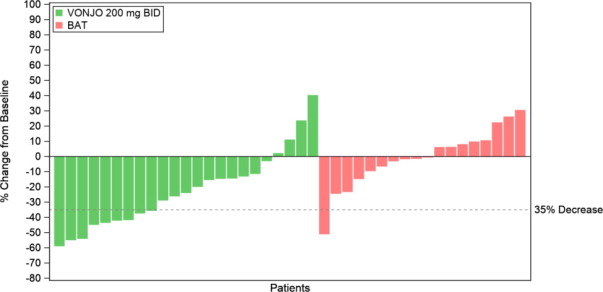
A waterfall plot of the percentage of change in spleen volume from baseline to Week 24 is presented in Figure 1 for the PERSIST-2 patients with baseline platelet counts <50 × 109/L. The median reduction in spleen volume for patients with a platelet count <50 × 109/L was 27.3% for patients in the VONJO 200 mg twice daily group compared to 0.9% in the BAT group.
Figure 1 Waterfall Plot of Median Percent Change From Baseline in Spleen Volume at Week 24 in Patients With <50 × 109/L Platelet Counts in PERSIST-2a
aDropout rates in VONJO and BAT arms were 26% and 44%, respectively.
Current therapy with another kinase inhibitor
Advise patients who are currently taking a kinase inhibitor that they must taper or discontinue their current kinase inhibitor therapy according to the package insert for that drug prior to starting VONJO.
Hemorrhage
Advise patients that VONJO can cause hemorrhage and instruct them to consult their healthcare provider right away if bleeding occurs. Advise patients about how to recognize bleeding and of the urgent need to report any unusual bleeding to their physician. Patients should urgently seek emergency medical attention for any bleeding that cannot be stopped [see Warnings and Precautions (5.1)].
Diarrhea
Advise patients that VONJO can cause diarrhea. Advise patients to stay hydrated while taking VONJO and to inform their physician if they experience diarrhea. Instruct patients to initiate anti-diarrheal medications (e.g., loperamide) if diarrhea occurs. Advise patients to urgently seek emergency medical attention if diarrhea becomes severe [see Warnings and Precautions (5.5.21)].
Thrombocytopenia
Advise patients that VONJO can cause thrombocytopenia, and of the need to monitor complete blood counts before and during treatment [see Warnings and Precautions (5.3)].
Prolonged QT Interval
Advise patients to consult their healthcare provider immediately if they feel faint, lose consciousness, or have signs or symptoms suggestive of arrhythmia. Advise patients with a history of hypokalemia of the importance of monitoring their electrolytes [see Warnings and Precautions (5.4)].
Major Adverse Cardiac Events (MACE)
Advise patients that events of major adverse cardiac events (MACE) including myocardial infarction, stroke, and cardiovascular death, have been reported in clinical studies with another JAK-inhibitor used to treat rheumatoid arthritis, a condition for which VONJO is not indicated. Advise patients, especially current or past smokers or patients with other cardiovascular risk factors, to be alert for the development of signs and symptoms of cardiovascular events [see Warnings and Precautions (5.5)].
Thrombosis
Advise patients that events of deep vein thrombosis and pulmonary embolism have been reported in clinical studies with another JAK-inhibitor used to treat rheumatoid arthritis, a condition for which VONJO is not indicated. Advise patients to tell their healthcare provider if they develop any signs or symptoms of a DVT or PE [see Warnings and Precautions (5.6)].
Secondary Malignancies
Advise patients, especially current or past smokers and patients with a known secondary malignancy (other than a successfully treated NMSC), that lymphoma and other malignancies (excluding NMSC) have been reported in clinical studies with another JAK-inhibitor used to treat rheumatoid arthritis, a condition for which VONJO is not indicated [see Warnings and Precautions (5.7)].
Infections
Advise patients that treatment with another JAK-inhibitor has increased the risk of serious infections in patients with myeloproliferative neoplasms and that serious bacterial, mycobacterial, fungal and viral infections may occur in patients treated with VONJO. Inform patients of the signs and symptoms of infection and to report any such signs and symptoms promptly [see Warnings and Precautions (5.8)].
Nausea and Vomiting
Advise patients that nausea and vomiting may occur during treatment with VONJO. Instruct them on how to manage nausea and vomiting and to immediately inform their healthcare provider if nausea/vomiting become severe.
Drug–Drug Interactions
Advise patients to inform their healthcare providers of all medications they are taking, including prescription and over-the-counter medications, vitamins, herbal products, and dietary supplements [see Drug Interactions (7)].
Dosing
Advise patients to take VONJO twice a day, with or without food or drink. VONJO should be taken at similar times each day. Instruct patients to swallow the VONJO capsules whole and not to open, break, or chew the capsules [see Dosage and Administration (2.1)].
Instruct patients that if they miss a dose of VONJO, to skip the dose and take the next dose when it is due and return to the normal schedule [see Dosage and Administration (2.1)]. Warn patients not to take 2 doses to make up for the missed dose.
Instruct patients to discontinue VONJO 7 days prior to any surgery or invasive procedures (such as cardiac catheterization, coronary stenting or varicose vein ablation) due to the risk of bleeding and to only restart VONJO on the instruction of their healthcare provider.
Patients should not change or stop taking VONJO without first consulting their physician.
Lactation
Advise patients to avoid breastfeeding while taking VONJO and for 2 weeks after the final dose [see Use in Specific Populations (8.2)].
Manufactured and marketed by:
CTI BioPharma Corp.
3101 Western Ave #800
Seattle, WA 98121
VONJO is a trademark of CTI BioPharma Corp. All rights reserved.
©2022 All rights reserved.