Gemcitabine
Product Images NDC 72485-223

View Photos of Packaging, Regulatory Labels, and Product Appearance

Product Visual Gallery

This gallery contains 7 technical images submitted to the FDA as part of the official labeling for Gemcitabine (NDC 72485-223). Unlike standard consumer photos, these assets often include clinical data figures, molecular chemical structures, and official manufacturer packaging layouts.

As provided by Armas Pharmaceuticals Inc., these visuals offer a comprehensive scientific overview of the product's physical and chemical identity, aiding pharmacists and researchers in product verification and study.

FDA Label Image

Structural Formula (Image01)

FDA Label Image

Figure 1 (Image02)

Figure 1 (Image02)
This is a description of the median progression-free survivals for two different treatments: Gemcitabine/Carboplatin at 8.6 months versus Carboplatin alone at 5.8 months. The log rank p-value for the difference between these treatments is reported as 0.0038. The corresponding probability of progression-free survival curves for each treatment is shown graphically.*
FDA Label Image

Figure 2 (Image03)

Figure 2 (Image03)
This text provides information on Median Time to Documented Disease Progression for two different treatments, Gemcitabine/Paclitaxel and Paclitaxel. It shows that Gemcitabine/Paclitaxel had a statistically significant longer progression-free time compared to Paclitaxel, with a logrank p-value of <0.0001. The graph shows the probability of progression-free survival over time for each treatment group, with Gemcitabine/Paclitaxel having a higher probability of being progression-free over time.*
FDA Label Image

Figure 3 (Image04)

Figure 3 (Image04)
This is a table displaying the median survival and 1-year survival rates for patients with two different treatments. The first treatment (Gemcitabine/Cisplatin) has a median survival of 9.0 months and a 1-year survival rate of 39%, while the second treatment (Cisplatin) has a median survival of 7.6 months and a 1-year survival rate of 28%. The table also includes a graph showing the survival probability over time for each treatment, as well as the test statistics and p-values for the Logrank and Wilcoxon tests comparing the two treatments. The data is based on a total of 522 patients (260 in the Gemcitabine/Cisplatin group and 262 in the Cisplatin group) and the survival time is measured in months.*
FDA Label Image

Figure 4 (Image05)

Figure 4 (Image05)
This appears to be a graph or chart showing the "Fraction Surviving" over "Survival Time (months)" for a treatment called "Gemcitabine." Without additional context or data, it is difficult to provide further analysis.*
FDA Label Image

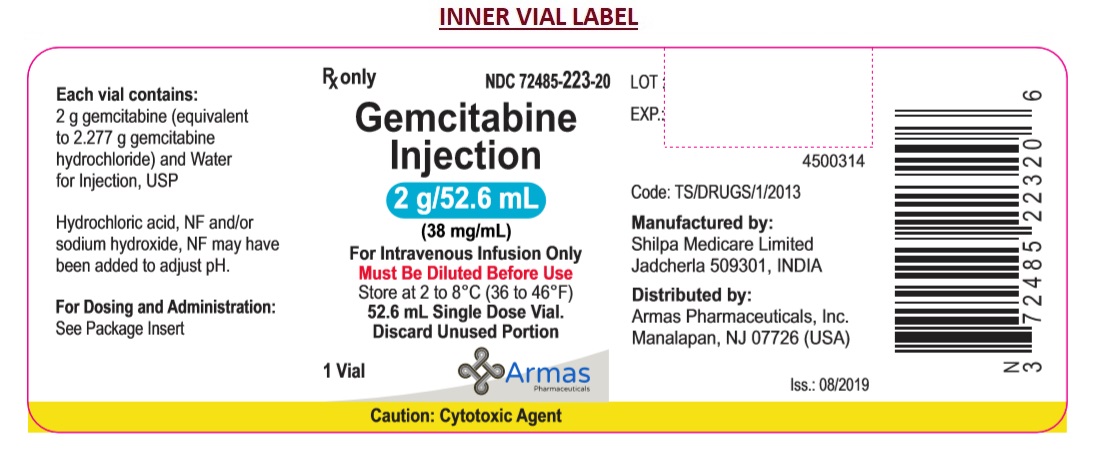
Vial (Image8)

Vial (Image8)
This is a description of a vial of Gemcitabine Injection, for intravenous infusion only. The vial contains 2g of gemcitabine (equivalent to 10 2.277g of gemcitabine hydrochloride) and water for injection, with hydrochloric acid and/or sodium hydroxide added to adjust pH. The label provides information regarding dosing and administration and storage instructions. The product is packaged in a 52.6 mL single-dose vial and is manufactured by Shilpa Medicare Limited in India and distributed by Armas Pharmaceuticals in the USA. The label also warns that it is a cytotoxic agent. The text seems to be complete and legible.*
FDA Label Image

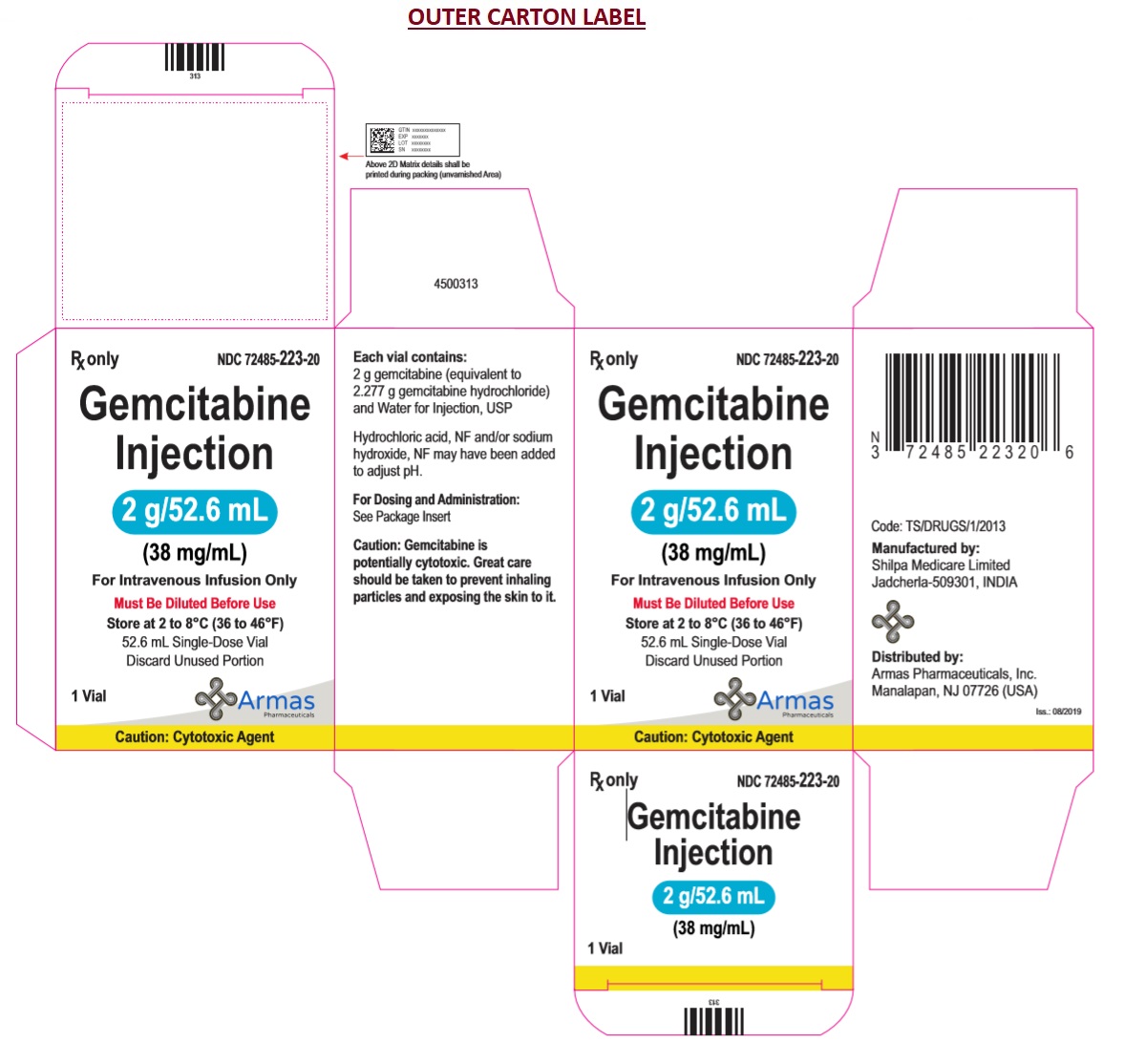
Carton (Image9)

Carton (Image9)
This is the outer carton label for Gemcitabine, a cytotoxic agent produced by Ronly. Each vial of 52.6 mL contains 2g of gemcitabine hydrochloride and water for injection, USP. Before dosing and administration, the package insert and code TSDRUGS2013 should be consulted as well as the warning on the label. The drug should be prevented from inhalation to avoid exposure to potentially harmful particles, and it should only be used for intravenous infusion once diluted. Gemcitabine should be stored between 2 to 8 degrees Celsius and the unused portion discarded. The product is distributed by Amas Pharmaceuticals, Inc. The remaining text contains duplicate information.*

* These product label images have been analyzed using experimental machine learning. Please verify findings with the primary label text.