Other
For Intramuscular or Intravenous Use
To reduce the development of drug-resistant bacteria and maintain the effectiveness of ampicillin and sulbactam and other antibacterial drugs, ampicillin and sulbactam should be used only to treat infections that are proven or strongly suspected to be caused by bacteria.
General: Immediately after completion of a 15-minute intravenous infusion of ampicillin and sulbactam, peak serum concentrations of ampicillin and sulbactam are attained. Ampicillin serum levels are similar to those produced by the administration of equivalent amounts of ampicillin alone. Peak ampicillin serum levels ranging from 109 to 150 mcg/mL are attained after administration of 2,000 mg of ampicillin plus 1,000 mg sulbactam and 40 to 71 mcg/mL after administration of 1,000 mg ampicillin plus 500 mg sulbactam. The corresponding mean peak serum levels for sulbactam range from 48 to 88 mcg/mL and 21 to 40 mcg/mL, respectively. After an intramuscular injection of 1,000 mg ampicillin plus 500 mg sulbactam, peak ampicillin serum levels ranging from 8 to 37 mcg/mL and peak sulbactam serum levels ranging from 6 to 24 mcg/mL are attained.
The mean serum half-life of both drugs is approximately 1 hour in healthy volunteers.
Approximately 75 to 85% of both ampicillin and sulbactam are excreted unchanged in the urine during the first 8 hours after administration of ampicillin and sulbactam to individuals with normal renal function. Somewhat higher and more prolonged serum levels of ampicillin and sulbactam can be achieved with the concurrent administration of probenecid.
In patients with impaired renal function the elimination kinetics of ampicillin and sulbactam are similarly affected, hence the ratio of one to the other will remain constant whatever the renal function. The dose of ampicillin and sulbactam in such patients should be administered less frequently in accordance with the usual practice for ampicillin (see DOSAGE and ADMINISTRATION section).
Ampicillin has been found to be approximately 28% reversibly bound to human serum protein and sulbactam approximately 38% reversibly bound.
The following average levels of ampicillin and sulbactam were measured in the tissues and fluids listed:
TABLE 1
Concentration of Ampicillin and Sulbactam in Various Body Tissues and Fluids
| Fluid or Tissue | Dose (grams) Ampicillin/Sulbactam | Concentration (mcg/mL or mcg/g) Ampicillin/Sulbactam |
|---|---|---|
Peritoneal Fluid | 0.5/0.5 IV | 7/14 |
Blister Fluid (Cantharides) | 0.5/0.5 IV | 8/20 |
Tissue Fluid | 1/0.5 IV | 8/4 |
Intestinal Mucosa | 0.5/0.5 IV | 11/18 |
Appendix | 2/1 IV | 3/40 |
Penetration of both ampicillin and sulbactam into cerebrospinal fluid in the presence of inflamed meninges has been demonstrated after IV administration of ampicillin and sulbactam.
The pharmacokinetics of ampicillin and sulbactam in pediatric patients receiving ampicillin and sulbactam are similar to those observed in adults. Immediately after a 15-minute infusion of 50 to 75 mg ampicillin and sulbactam/kg body weight, peak serum and plasma concentrations of 82 to 446 mcg ampicillin/mL and 44 to 203 mcg sulbactam/mL were obtained. Mean half-life values were approximately 1 hour.
Clinitest™ is a registered trademark of Miles, Inc.
Clinistix™ is a registered trademark of Bayer Corporation.
Testape™ is a registered trademark of Eli Lilly Company.
Rx only
Manufactured by:
STERISCIENCE SPECIALTIES PRIVATE LIMITED
Beta Lactam Division, Bangalore India
Distributed By:
Armas Pharmaceuticals, Inc.
Freehold, NJ 07728 (USA)
December 2022
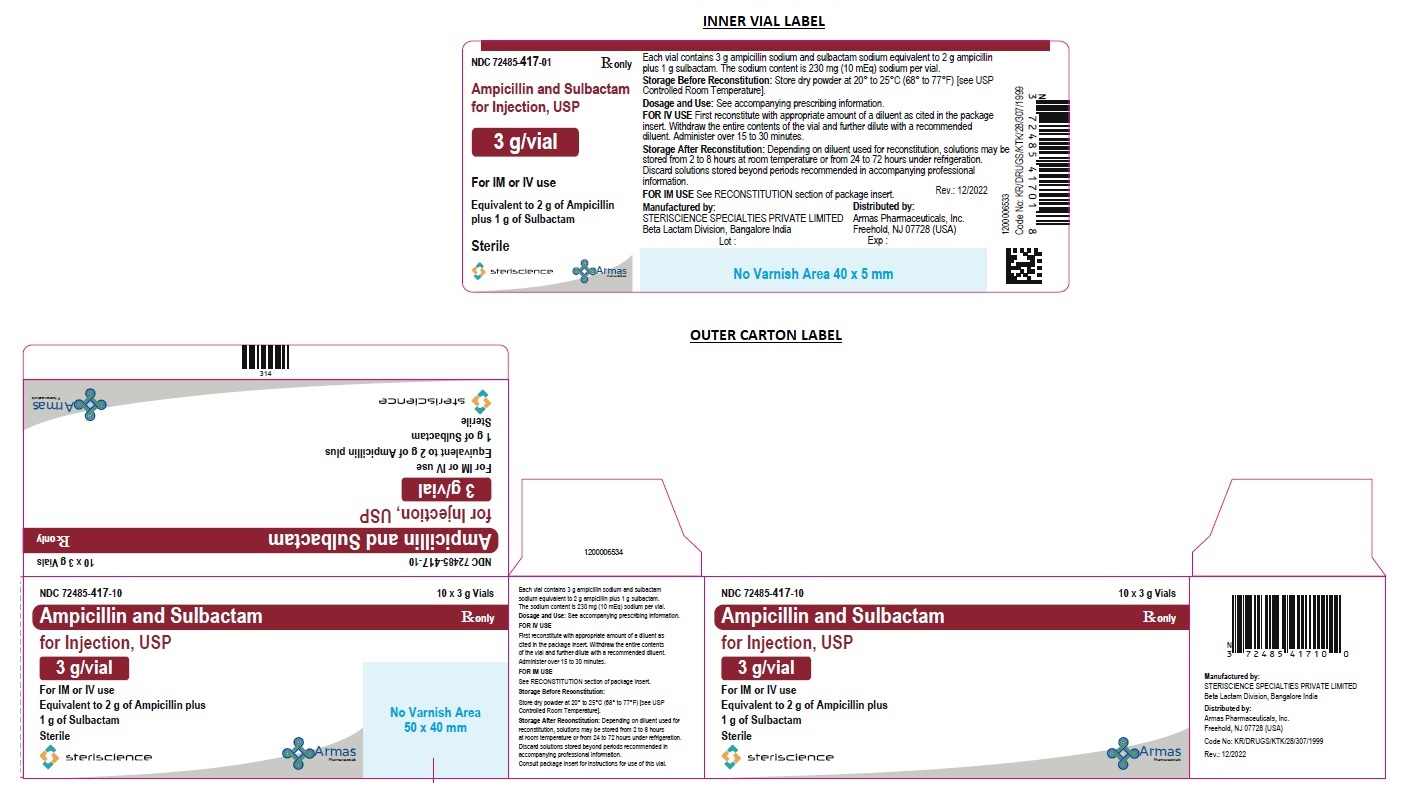
Storage After Reconstitution: Depending on diluent used for reconstitution, solutions may be stored from 2 to 8 hours
at room temperature or from 24 to 72 hours under refrigeration. Discard solutions stored beyond periods recommended in
accompanying professional information.
Consult package insert for instructions for use of this vial.
Code No: KR/DRUGS/KTK/28/307/1999
Rev.: 12/2022