Elamipretide exposure increases proportionally over a dose range of 2 to 80 mg following daily subcutaneous injections with minimal accumulation.
Absorption
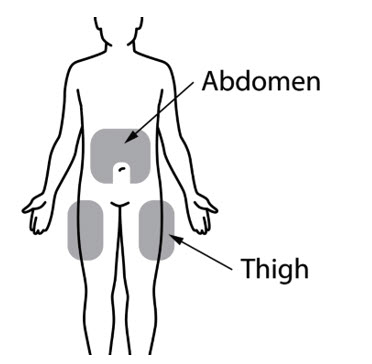
Maximum elamipretide concentrations were reached between 0.5 to 1 hour after subcutaneous administration. The absolute bioavailability following subcutaneous administration is approximately 92%. FORZINITY exposure is comparable after subcutaneous injection to the thigh or to the abdomen.
Distribution
Elamipretide is distributed throughout total body water with an approximate volume of distribution of 0.5 L/kg. There is low binding to plasma proteins (approximately 39%).
Elimination
Metabolism
Elamipretide is metabolized via sequential C-terminal degradation to the M1 tripeptide and M2 dipeptide metabolites, which do not have pharmacological activity.
Excretion
Elamipretide and its metabolites M1 and M2 are excreted in the urine. At 48 hours post-dose, approximately 100% of the FORZINITY dose was recovered in the urine as either elamipretide, M1, or M2 in patients with normal renal function.
Specific Populations
Patients with Renal Impairment
Elamipretide exposure (AUC) increased by 39% in subjects with creatinine clearance 60 to 89 mL/min, 75% in subjects with creatinine clearance 30 to 59 mL/min, and 125% in subjects with creatinine clearance less than 30 mL/min not on dialysis. Renal impairment was categorized based on 24-hour measured urinary creatinine clearance. There was minimal accumulation of elamipretide with daily dosing, regardless of the severity of renal impairment. There was a significant increase in exposure of the M1 and M2 metabolites, up to 280% and 640%, respectively, in subjects with severe renal impairment not on dialysis (creatinine clearance less than 30 mL/min).
While the effect of renal impairment on elamipretide pharmacokinetics was characterized using 24-hour measured urinary creatinine clearance, analyses conducted with estimated glomerular filtration (CKD-EPI equation) support the recommendations for use in this specific population
[see
Dosage and Administration (2.2)and
Use in Specific Populations (8.6)]
.
Patients with Hepatic Impairment
No hepatic metabolism was observed for elamipretide
in vitro.Hepatic impairment is not expected to alter the pharmacokinetics (PK) of elamipretide.
Drug Interaction Studies
In Vitro Studies
CYP enzymes: Elamipretide does not inhibit CYP1A, CYP2D6, CYP2E1, CYP2B6, CYP2C8, CYP2C9, CYP2C19, or CYP3A. Elamipretide does not induce metabolism by CYP1A2, CYP2B6, or CYP3A4.
Drug transporters: Elamipretide does not inhibit the activity of OCT2, BCRP, OAT1, OAT3, OATP1B1, OATP1B3, P-gp, or MATE2-K. Elamipretide is an inhibitor of MATE1 (IC
503.53 μM).
In Vivo Clinical Studies
Aspirin: administration of elamipretide (0.1 mg/kg/hour for 4 hours via intravenous infusion) starting 4 hours after a single dose of 650 mg aspirin did not affect the PK of aspirin and its metabolite, salicylic acid. There was no impact on the antiplatelet activity of aspirin when co-administered with elamipretide.
Clopidogrel: administration of elamipretide (0.1 mg/kg/hour for 4 hours via intravenous infusion) starting 4 hours after a single dose of 300 mg clopidogrel did not significantly affect the PK of clopidogrel. There was no impact on the anti-thrombotic activity of clopidogrel when co-administered with elamipretide.
Unfractionated heparin: administration of elamipretide (0.25 mg/kg/hour for 4 hours via intravenous infusion) had no significant impact on activated partial thromboplastin time (aPTT) and anti-factor Xa activity of unfractionated heparin, when co-administered 7 hours after starting the unfractionated heparin infusion.