Because clinical trials are conducted under widely varying conditions, adverse reaction rates observed cannot be directly compared to rates in other clinical trials and may not reflect the rates observed in practice.
Adult Population
A total of 1020 adult patients have received acetaminophen in clinical trials, including 37.3% (n=380) who received 5 or more doses, and 17% (n=173) who received more than 10 doses. Most patients were treated with acetaminophen 1000 mg every 6 hours. A total of 13.1% (n=134) received acetaminophen 650 mg every 4 hours.
All adverse reactions that occurred in adult patients treated with either acetaminophen or placebo in repeated dose, placebo-controlled clinical trials at an incidence ≥3% and at a greater frequency than placebo are listed in Table 4. The most common adverse events in adult patients treated with acetaminophen (incidence ≥5% and greater than placebo) were nausea, vomiting, headache, and insomnia.
Table 4. Treatment-Emergent Adverse Reactions Occurring in ≥3% of Acetaminophen-treated Adult Patients and at a Greater Frequency than Placebo in Placebo-Controlled, Repeated Dose Studies | System Organ Class – Preferred Term | Acetaminophen
(N=402)
n (%) | Placebo
(N=379)
n (%) |
|---|
Gastrointestinal Disorders
Nausea
Vomiting | 138 (34)
62 (15) | 119 (31)
42 (11) |
General Disorders and Administration Site Conditions
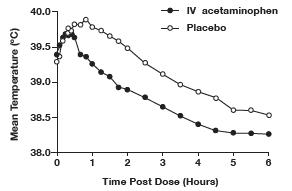
Pyrexia Pyrexia adverse reaction frequency data is included in order to alert healthcare practitioners that the antipyretic effects of acetaminophen may mask fever. | 22 (5) | 52 (14) |
Nervous System Disorders
Headache | 39 (10) | 33 (9) |
Psychiatric Disorders
Insomnia | 30 (7) | 21 (5) |
Other Adverse Reactions Observed During Clinical Studies of Acetaminophen in Adults
The following additional treatment-emergent adverse reactions were reported by adult subjects treated with acetaminophen in all clinical trials (n=1020) that occurred with an incidence of at least 1% and at a frequency greater than placebo (n=525).
Blood and Lymphatic System Disorders
Anemia.
General Disorders and Administration Site Conditions
Fatigue, infusion site pain, edema peripheral.
Investigations
Aspartate aminotransferase increased, breath sounds abnormal.
Metabolism and Nutrition Disorders
Hypokalemia.
Musculoskeletal and Connective Tissue Disorders
Muscle spasms, trismus.
Psychiatric Disorders
Anxiety.
Respiratory, Thoracic and Mediastinal Disorders
Dyspnea.
Vascular Disorders
Hypertension, hypotension.
Pediatric Population
A total of 483 pediatric patients (72 neonates, 167 infants, 171 children, and 73 adolescents) have received acetaminophen in active-controlled (n=250) and open-label clinical trials (n=225), including 43.9% (n=212) who received 5 or more doses and 31.2% (n=153) who received more than 10 doses. Pediatric patients received acetaminophen doses up to 15 mg/kg on an every 4 hours, every 6 hours, or every 8 hours schedule. The maximum exposure was 7.7, 6.4, 6.8, and 7.1 days in neonates, infants, children, and adolescents, respectively.
The most common adverse events (incidence ≥5%) in pediatric patients treated with acetaminophen were nausea, vomiting, constipation, and pruritus.