Potassium Phosphates Injection, Solution, Concentrate
FDA Label NDC 72572-232

Full FDA labeling including Indications, Dosage, Usage, and Precautions

Structured Product Label

The following Structured Product Label (SPL) was submitted to the FDA by Civica, Inc. for the product Potassium Phosphates (NDC 72572-232). This document serves as the official prescribing information, containing essential scientific data and clinical materials required for healthcare providers and patients.

This specific version of the label includes detailed information regarding 1 indications and usage, other, 2.2 dosage for administration in intravenous fluids to correct hypophosphatemia, 2.3 preparation and administration in parenteral nutrition, 2.4 dosage for administration in parenteral nutrition, 3 dosage forms and strengths, 4 contraindications, 5.1 serious cardiac adverse reactions with undiluted, bolus or rapid intravenous administration, and other regulatory disclosures. Use the navigation below to review specific sections of the FDA submission.

1 Indications And Usage

Potassium Phosphates Injection is indicated as a source of phosphorus:

  • in intravenous fluids to correct hypophosphatemia in adults and pediatric patients when oral or enteral replacement is not possible, insufficient or contraindicated.
  • for parenteral nutrition in adults and pediatric patients when oral or enteral nutrition is not possible, insufficient or contraindicated.

Other

Preparation

  • Potassium Phosphates Injection is for intravenous infusion into a central or peripheral vein only after dilution.
  • Using aseptic technique, withdraw the required amount from the vial and add to 0.9% Sodium Chloride Injection, USP (normal saline) or 5% Dextrose Injection, USP (D5W). For adults and pediatric patients 12 years of age and older a total volume of 100 mL or 250 mL is recommended. For pediatric patients less than 12 years of age, use the smallest recommended volume, considering daily fluid requirements and the maximum concentration for peripheral and central administration shown in Table 1.
  • The concentration of the diluted solution should take into consideration the age of the patient, the amounts of phosphorus and potassium in the dose, and is dependent upon whether administration will be through a peripheral or central venous catheter. The recommended maximum concentrations are shown in Table 1:
  • Table 1: Maximum Recommended Concentration of Potassium Phosphates Injection by Age and Route of Administration (Peripheral vs. Central)

    Patient Population

    Peripheral Venous Catheter

    Central Venous Catheter

    Adults and Pediatric Patients 12 Years of Age and Older

    phosphorus 6.8 mmol/100 mL (potassium 10 mEq/100 mL)

    phosphorus 18 mmol/100 mL (potassium 26.4 mEq/100 mL)

    Pediatric Patients Less than 12 Years of Age

    phosphorus 0.27 mmol/10 mL (potassium 0.4 mEq/10 mL)

    phosphorus 0.55 mmol/10 mL (potassium 0.8 mEq/10 mL)

    • Visually inspect the solution for particulate matter and discoloration before and after dilution and prior to administration. Do not administer unless solution is clear, and seal on the vial is intact.
    • Administration

      • Check serum potassium and calcium concentrations prior to administration. Normalize the calcium before administering Potassium Phosphates Injection [see Contraindications (4), Warnings and Precautions (5.3, 5.4)].
      • Potassium Phosphates Injection is only for administration to a patient with a serum potassium concentration less than 4 mEq/dL [see Warnings and Precautions (5.3)]. If the potassium concentration is 4 mEq/dL or more, use an alternative source of phosphorus.
      • Do not infuse with calcium-containing intravenous fluids [see Warnings and Precautions (5.4)].
      • The rate of administration may be dependent on the patient and the specific institution policy [see Dosage and Administration (2.2)].
      • Storage and Stability

        • Single-Dose Vial (15 mL)
          • oFor single use only. Discard used vial, including any unused contents.
          • After dilution, the solution is stable for a maximum of 4 hours at room temperature 20°C to 25°C (68°F to 77°F) or 14 days under refrigeration at 2°C to 8°C (36°F to 46°F).
          • Initial or Single Dose

            The phosphorus doses in Table 2 are general recommendations for an initial or single dose and are intended for most patients. Based upon clinical requirements, some patients may require a lower or higher dose. The maximum initial or single dose of phosphorus is 45 mmol (potassium 66 mEq) [see Warnings and Precautions (5.1)].

            In patients with moderate renal impairment (eGFR ≥30 mL/min/1.73 m2 to <60 mL/min/1.73 m2), start at the low end of the dose range [see Use in Specific Populations (8.6)].

            Monitor serum phosphorus, potassium, calcium and magnesium serum concentrations.

            Table 2: Recommended Initial or Single Dose of Potassium Phosphates Injection in Intravenous Fluids to Correct Hypophosphatemia in Adults and Pediatric Patients
            a Serum phosphorus reported using 2.5 mg/dL as the lower end of the reference range for healthy adults and pediatric patients 12 months of age and older. Serum phosphorus reported using 4 mg/dL as the lower end of the reference range for preterm and term infants less than 12 months of age. Serum phosphorus concentrations may vary depending on the assay used and the laboratory reference range.
            b Weight is in terms of actual body weight. Limited information is available regarding dosing of patients significantly above ideal body weight; consider using an adjusted body weight for these patients.
            c up to a maximum of phosphorus 45 mmol (potassium 66 mEq) as a single dose.

            Serum Phosphorus Concentrationa

            Phosphorus Dosageb,c

            Corresponding Potassium Content

            1.8 mg/dL to lower end of the reference rangea

            0.16 mmol/kg to 0.31 mmol/kg

            potassium

            0.23 mEq/kg to 0.46 mEq/kg

            1 mg/dL to 1.7 mg/dL

            0.32 mmol/kg to 0.43 mmol/kg

            potassium

            0.47 mEq/kg to 0.63 mEq/kg

            Less than 1 mg/dL

            0.44 mmol/kg to 0.64 mmol/kgc

            potassium

            0.64 mEq/kg to 0.94 mEq/kg

            Concentration and Intravenous Infusion Rate

            • The concentration of the diluted solution [see Table 1, Dosage and Administration (2.1)] and the infusion rate is dependent upon whether administration will be through a peripheral or central venous catheter. The maximum recommended infusion rates are shown in Table 3 for adults and pediatric patients 12 years of age and older.
            • Table 3: Maximum Recommended Infusion Rate of Potassium Phosphates Injection for Adults and Pediatric Patients 12 Years of Age and Older

              Route of Administration

              Maximum Infusion Rate

              Peripheral Venous Catheter

              phosphorus 6.8 mmol/hour (potassium 10 mEq/hour)

              Central Venous Catheter

              phosphorus 15 mmol/hour (potassium 22 mEq/hour)

              Continuous electrocardiographic (ECG) monitoring and infusion through a central venous catheter is recommended for infusion rates higher than:

              • Potassium 10 mEq/hour for adults and pediatric patients weighing 20 kg or greater
              • Potassium 0.5 mEq/kg/hour for pediatric patients weighing less than 20 kg
              • Repeated Dosing

                Additional dose(s) following the initial dose may be needed in some patients. Prior to administration of additional doses, assess the patient clinically, obtain serum phosphorus, calcium and potassium concentrations and adjust the dose accordingly.

                Storage

                • Protect the parenteral nutrition solution from light during storage.
                • Stability

                  • Single-Dose Vial (15 mL)
                    • oFor single use only. Discard used vial, including any unused contents.
                    • oUse parenteral nutrition solution containing Potassium Phosphates Injection promptly after mixing. Any storage of the admixture should be under refrigeration from 2°C to 8°C (36°F to 46°F) and limited to a brief period of time, no longer than 24 hours. After removal from refrigeration, bring to room temperature and use promptly and complete the infusion within 24 hours. Discard any remaining admixture.
                    • Monitoring

                      Monitor serum phosphorus, potassium, calcium and magnesium concentrations and adjust the dosage accordingly.

                      Risk Summary

                      Administration of the recommended dose of Potassium Phosphates Injection is not expected to cause major birth defects, miscarriage, or adverse maternal or fetal outcomes. Animal reproduction studies have not been conducted with Potassium Phosphates Injection.

                      The estimated background risk of major birth defects and miscarriage for the indicated population is unknown. All pregnancies have a background risk of birth defect, loss, or other adverse outcomes. In the U.S. general population, the estimated background risk of major birth defects and miscarriage in clinically recognized pregnancies is 2 to 4% and 15 to 20%, respectively.

                      Clinical Considerations

                      Disease-associated Maternal and/or Embryo-Fetal Risk

                      Phosphorus is an essential mineral element. Parenteral supplementation with potassium phosphates should be considered if a pregnant woman's requirements cannot be fulfilled by oral or enteral intake.

                      Risk Summary

                      Phosphorus and potassium are present in human milk. Administration of the recommended dose of Potassium Phosphates Injection is not expected to cause harm to a breastfed infant. There is no information on the effects of potassium phosphates on milk production. The development and health benefits of breastfeeding should be considered along with the mother's clinical need for Potassium Phosphates Injection and any potential adverse effects on the breastfed child from Potassium Phosphates Injection or from underlying maternal condition.

                      Hyperphosphatemia

                      Administration of excessive doses of intravenous potassium phosphates in intravenous fluids as a single dose ranging from approximately 50 to 270 mmol phosphorus and/or at rapid infusion rates (over 1 to 3 hours) has resulted in death, cardiac arrest, cardiac arrhythmia (including QT prolongation), hyperkalemia, hyperphosphatemia, seizures, and tetany.

                      Hyperphosphatemia is particularly a risk in patients with renal failure. Hyperphosphatemia leads in turn to hypocalcemia, which may be severe, and to ectopic calcification, particularly in patients with initial hypercalcemia. Tissue calcification may cause hypotension and organ damage and result in acute renal failure.

                      Hyperkalemia

                      Excessive administration of phosphates given as potassium salts may also cause hyperkalemia. Manifestations of hyperkalemia include:

                      • Disturbances in cardiac conduction and arrhythmias, including bradycardia, heart block, asystole, ventricular tachycardia, ventricular fibrillation
                      • Hypotension
                      • Muscle weakness including paresthesia, muscular and respiratory paralysis
                      • Management

                        In the event of overdosage, discontinue infusions containing potassium phosphates immediately and institute general supportive measures, including ECG monitoring, laboratory monitoring, and correction of serum electrolyte concentrations, especially potassium, phosphorus, calcium, and magnesium.

                        Distribution

                        Approximately 85% of serum phosphates is free and ultra-filterable and 15% is protein-bound.

                        Elimination

                        Intravenously infused phosphates not taken up by the tissues are excreted almost entirely in the urine. Serum phosphorus is believed to be filterable by the renal glomeruli and the major portion of filtered phosphorus (greater than 80%) is actively reabsorbed by the tubules.

2.2 Dosage For Administration In Intravenous Fluids To Correct Hypophosphatemia

Potassium Phosphates Injection provides phosphorus 3 mmol/mL (potassium 4.4 mEq/mL).

The dosage is dependent upon the individual needs of the patient, and the contribution of phosphorus and potassium from other sources.

2.3 Preparation And Administration In Parenteral Nutrition

  • Potassium Phosphates Injection is for intravenous infusion into a peripheral or central vein only after dilution and admixing.
  • Potassium Phosphates Injection is to be prepared only in a suitable work area such as a laminar flow hood (or an equivalent clean air compounding area). The key factor in the preparation is careful aseptic technique to avoid inadvertent touch contamination during mixing of solutions and addition of other nutrients.
  • Transfer the required amount of Potassium Phosphates Injection to the parenteral nutrition solution following the admixture of amino acids, dextrose, electrolytes solutions, and prior to lipids (if added).
  • Because additives may be incompatible, evaluate all additions to the parenteral nutrition container for compatibility and stability of the resulting preparation.
  • Calcium and phosphate ratios must be considered. Excess addition of calcium and phosphate, especially in the form of mineral salts, may result in the formation of calcium-phosphate precipitates [see Warnings and Precautions (5.2)]. Calcium-phosphate stability in parenteral nutrition solutions is dependent upon the pH of the solution, temperature, and relative concentration of each ion. Discard if any precipitates are observed.
  • Inspect the final parenteral solution containing Potassium Phosphates Injection to ensure that:
    • oprecipitates have not formed during mixing or addition of additives and inspect again before administration.
    • othe emulsion has not separated, if lipids have been added. Separation of the emulsion can be visibly identified by a yellowish streaking or the accumulation of yellowish droplets in the admixed emulsion.
    • The final parenteral nutrition solution is for intravenous infusion into a peripheral or central vein. The choice of a peripheral or central venous route should depend on the osmolarity of the final infusate. Solutions with osmolarity of 900 mOsmol/L or greater must be infused through a central catheter [see Warnings and Precautions (5.7)].

2.4 Dosage For Administration In Parenteral Nutrition

Potassium Phosphates Injection provides phosphorus 3 mmol/mL (potassium 4.4 mEq/mL).

The recommended daily dosage in parenteral nutrition is shown in Table 4. Individualize the dosage based upon the patient's clinical condition, nutritional requirements, and the contribution of oral or enteral phosphorus and potassium intake. The amount of phosphorus that can be added to parenteral nutrition may be limited by the amount of calcium that is also added to the solution.

Table 4: Recommended Daily Dosage of Potassium Phosphates Injection for Parenteral Nutrition for Adults and Pediatric Patients
a In patients with moderate renal impairment (eGFR ≥30 mL/min/1.73 m2 to <60 mL/min/1.73 m2), start at the low end of the dosage range

Patient Population

Generally Recommended Phosphorus Daily Dosage

(Potassium Content)

Preterm and Term Infants Less than 12 Months

2 mmol/kg/day

(potassium 2.9 mEq/kg/day)

Pediatric Patients 1 year to Less Than 12 years

1 mmol/kg/day; up to 40 mmol/day

(potassium 1.5 mEq/kg/day; up to 58.7 mEq/day)

Adults and Pediatric Patients 12 Years of Age and Older

20 mmol/day to 40 mmol/daya

(potassium 29.3 mEq/day to 58.7 mEq/day)

3 Dosage Forms And Strengths

Potassium Phosphates Injection, USP is a clear and colorless solution supplied as:

  • phosphorus 45 mmol/15 mL (3 mmol/mL) and potassium 66 mEq/15 mL (4.4 mEq/mL) in a single-dose vial.

4 Contraindications

Potassium Phosphates Injection is contraindicated in patients with:

  • hyperkalemia [see Warning and Precautions (5.3)]
  • severe renal impairment (eGFR less than 30 mL/min/1.73m2) or end stage renal disease [see Warning and Precautions (5.3)]
  • hyperphosphatemia [see Warning and Precautions (5.4)]
  • hypercalcemia or significant hypocalcemia [see Warning and Precautions (5.4)]

5.1 Serious Cardiac Adverse Reactions With Undiluted, Bolus Or Rapid Intravenous Administration

Intravenous administration of potassium phosphates to correct hypophosphatemia in single doses of phosphorus 50 mmol and greater and/or at rapid infusion rates (over 1 to 3 hours) in intravenous fluids has resulted in death, cardiac arrest, cardiac arrhythmia (including QT prolongation), hyperkalemia, hyperphosphatemia, and seizures [see Overdosage (10)]. In addition, inappropriate intravenous administration of undiluted or insufficiently diluted potassium phosphates as a rapid “IV push” has resulted in cardiac arrest, cardiac arrhythmias, hypotension, and death.

Potassium Phosphates Injection is for intravenous infusion only after dilution or admixing. The maximum initial or single dose of Potassium Phosphates Injection in intravenous fluids to correct hypophosphatemia is phosphorus 45 mmol (potassium 66 mEq). The recommended infusion rate for administration through a peripheral venous catheter is approximately phosphorus 6.8 mmol/hour (potassium 10 mEq/hour). Continuous electrocardiographic (ECG) monitoring is recommended for higher infusion rates [see Dosage and Administration (2.1, 2.2)].

5.2 Pulmonary Embolism Due To Pulmonary Vascular Precipitates

Pulmonary vascular emboli and pulmonary distress related to precipitates in the pulmonary vasculature have been described in patients receiving admixed products containing calcium and phosphate or parenteral nutrition. The cause of precipitate formation has not been determined in all cases; however, in some fatal cases, pulmonary emboli occurred as a result of calcium phosphate precipitates. Precipitation has occurred following passage through an in-line filter; in vivo precipitate formation may also have occurred. If signs of pulmonary distress occur, stop the parenteral nutrition infusion and initiate a medical evaluation. In addition to inspection of the solution [see Dosage and Administration (2.3)], the infusion set and catheter should also periodically be checked for precipitates.

5.3 Hyperkalemia

Potassium Phosphates Injection may increase the risk of hyperkalemia, including life-threatening cardiac events, especially when administered in excessive doses, undiluted or by rapid intravenous infusion [see Warnings and Precautions (5.1)]. Patients with severe renal impairment and end stage renal disease are at increased risk of developing life-threatening hyperkalemia, when administered intravenous potassium [see Contraindications (4)]. Other patients at increased risk of hyperkalemia include those with severe adrenal insufficiency or treated concurrently with other drugs that cause or increase the risk of hyperkalemia [see Drug Interactions (7.1)]. Patients with cardiac disease may be more susceptible to the effects of hyperkalemia.

Consider the amount of potassium from all sources when determining the dose of Potassium Phosphates Injection and do not exceed the maximum age- appropriate recommended daily amount of potassium. In patients with moderate renal impairment (eGFR ≥30 mL/min/1.73 m2 to <60 mL/min/1.73 m2), start at the low end of the dose range and monitor serum potassium, phosphorus, calcium, and magnesium concentrations [see Dosage and Administration (2.2, 2.4), Use in Specific Populations (8.6)].

When administering Potassium Phosphates Injection in intravenous fluids to correct hypophosphatemia, check the serum potassium concentration prior to administration. If the potassium concentration is 4 mEq/dL or more, do not administer Potassium Phosphates Injection and use an alternative source of phosphorus [see Dosage and Administration (2.1)].

The maximum initial or single dose of Potassium Phosphates Injection in intravenous fluids to correct hypophosphatemia is phosphorus 45 mmol (potassium 66 mEq). The recommended infusion rate of potassium through a peripheral venous catheter is 10 mEq/hour. Continuous electrocardiographic (ECG) monitoring is recommended for higher infusion rates of potassium [see Dosage and Administration (2.2)].

5.4 Hyperphosphatemia And Hypocalcemia

Hyperphosphatemia can occur with intravenous administration of potassium phosphates, especially in patients with renal impairment. Hyperphosphatemia can cause the formation of insoluble calcium phosphorus products with consequent hypocalcemia, neurological irritability with tetany, nephrocalcinosis with acute kidney injury and more rarely, cardiac irritability with arrhythmias.

Obtain serum calcium concentrations prior to administration and normalize the calcium before administering Potassium Phosphates Injection. Potassium Phosphates Injection is contraindicated in patients with hyperphosphatemia and/or hypercalcemia [see Contraindications (4)].

Monitor serum phosphorus and calcium concentrations during treatment with Potassium Phosphates Injection [see Dosage and Administration (2.2, 2.4)].

5.5 Aluminum Toxicity

Potassium Phosphates Injection contains aluminum that may be toxic.

Aluminum may reach toxic levels with prolonged parenteral administration in patients with renal impairment. Preterm infants are particularly at risk for aluminum toxicity because their kidneys are immature, and they require large amounts of calcium and phosphate containing solutions, which also contain aluminum.

Patients with renal impairment, including preterm infants, who receive greater than 4 to 5 mcg/kg/day of parenteral aluminum can accumulate aluminum at levels associated with central nervous system and bone toxicity. Tissue loading may occur at even lower rates of administration.

Exposure to aluminum from Potassium Phosphates Injection is no more than 0.6 mcg/kg/day when patients are administered the recommended dosage [see Dosage and Administration (2.4), Description (11)].

When prescribing Potassium Phosphates Injection for use in parenteral nutrition solutions containing other small volume parenteral products, the total daily patient exposure to aluminum from the admixture should be considered and maintained at no more than 5 mcg/kg/day [see Use in Specific Populations (8.4)].

5.6 Hypomagnesemia

Intravenous infusion of phosphate has been reported to cause a decrease in serum magnesium (and calcium) concentrations when administered to patients with hypercalcemia and diabetic ketoacidosis. Monitor serum magnesium concentrations during treatment.

5.7 Vein Damage And Thrombosis

Potassium Phosphates Injection must be diluted and administered in intravenous fluids or used as an admixture in parenteral nutrition. It is not for direct intravenous infusion. The infusion of hypertonic solutions into a peripheral vein may result in vein irritation, vein damage, and/or thrombosis. The primary complication of peripheral administration is venous thrombophlebitis, which manifests as pain, erythema, tenderness or a palpable cord. Remove the catheter as soon as possible and initiate appropriate medical treatment if thrombophlebitis develops.

When administered peripherally in intravenous fluids to correct hypophosphatemia, a generally recommended maximum concentration is phosphorus 6.8 mmol/100 mL (potassium 10 mEq/100 mL) [see Dosage and Administration (2.1)]

Parenteral nutrition solutions with an osmolarity of 900 mOsmol/L or greater must be infused through a central catheter [see Dosage and Administration (2.3)].

5.8 Laboratory Monitoring

Monitor serum phosphorus, potassium, calcium and magnesium concentrations during treatment [see Dosage and Administration (2.2, 2.4)].

6 Adverse Reactions

The following clinically significant adverse reactions are described elsewhere in the labeling:

  • Aluminum Toxicity [see Warnings and Precautions (5.5)]
  • Hypomagnesemia [see Warnings and Precautions (5.6)]
  • Vein Damage and Thrombosis [see Warnings and Precautions (5.7)]
  • The following adverse reactions in Table 5 have been reported in clinical studies or postmarketing reports in patients receiving intravenously administered potassium phosphates. Because some of these reactions were reported voluntarily from a population of uncertain size, it is not always possible to reliably estimate their frequency or establish a causal relationship to drug exposure.

    Table 5: Adverse Reactions Reported in Clinical Studies or Postmarketing Reports with Intravenous Potassium Phosphates

    System Organ Class

    Adverse Reactions

    Metabolism and Nutrition Disorders

    pulmonary embolism due to pulmonary vascular precipitates [see Warnings and Precautions (5.2)], hyperkalemia [see Warnings and Precautions (5.3)], hyperphosphatemia [see Warnings and Precautions (5.4)], hypocalcemia [see Warnings and Precautions (5.5)], hypovolemia, and osmotic diuresis

    Cardiac Disorders

    hypotension, arrhythmia, heart block, cardiac arrest, bradycardia, chest pain, ECG changes [see Warnings and Precautions (5.1)], and edema

    Respiratory, Thoracic, and Mediastinal Disorders

    dyspnea [see Warnings and Precautions (5.2)]

    Renal and Urinary Disorders

    acute phosphate nephropathy (i.e., nephrocalcinosis with acute kidney injury), decreased urine output, and transition to chronic kidney disease [see Warnings and Precautions (5.4)]

    Gastrointestinal Disorders

    diarrhea, stomach pain

    Musculoskeletal and Connective Tissue Disorders

    weakness

    Nervous System Disorders

    confusion, lethargy, paralysis, paresthesia

7.1 Other Products That Increase Serum Potassium

Administration of Potassium Phosphates Injection to patients treated concurrently or recently with products that increase serum potassium (e.g., potassium- sparing diuretics, ACE inhibitors, angiotensin II receptor antagonists, digoxin, or the immunosuppressants tacrolimus and cyclosporine) increases the risk of severe and potentially fatal hyperkalemia, in particular in the presence of other risk factors for hyperkalemia [see Warnings and Precautions (5.3)]. Avoid use of Potassium Phosphates Injection in patients receiving such products. If use cannot be avoided, closely monitor serum potassium concentrations [see Dosage and Administration (2.2, 2.4)].

8.4 Pediatric Use

Safety and effectiveness of Potassium Phosphates Injection have been established in pediatric patients as a source of phosphorus:

  • in intravenous fluids to correct hypophosphatemia when oral or enteral replacement is not possible, insufficient, or contraindicated.
  • for parenteral nutrition when oral or enteral nutrition is not possible, insufficient, or contraindicated.
  • Because of immature renal function, preterm infants receiving prolonged parenteral nutrition treatment with Potassium Phosphates Injection may be at higher risk of aluminum toxicity. [see Warnings and Precautions (5.5)].

8.5 Geriatric Use

In general, dose selection of Potassium Phosphates Injection for an elderly patient should be cautious, starting at the low end of the dosing range because of the greater frequency of decreased hepatic, renal, or cardiac function, and of concomitant disease or other drug therapy. It may be useful to monitor renal function during treatment [see Use in Specific Populations (8.6)].

8.6 Renal Impairment

Potassium and phosphorus are known to be substantially excreted by the kidney and the risk of adverse reactions to Potassium Phosphates Injection may be greater in patients with impaired renal function [see Warnings and Precautions (5.3, 5.4, 5.5)].

Potassium Phosphates Injection is contraindicated due to the risk of hyperkalemia in patients with severe renal impairment (eGFR less than 30 mL/min/1.73 m2) or end stage renal disease [see Contraindications (4)].

In patients with moderate renal impairment (eGFR ≥ 30 mL/min/1.73 m2 to < 60 mL/min/1.73 m2), start at the low end of the dosage range and monitor serum potassium, phosphorus, calcium, and magnesium concentrations [see Dosage and Administration (2.2, 2.4)].

11 Description

Potassium Phosphates Injection, USP, a phosphorus replacement product containing phosphorus 3 mmol/mL and potassium 4.4 mEq/mL. It is a sterile, non-pyrogenic, concentrated solution containing a mixture of monobasic potassium phosphate and dibasic potassium phosphate in water for injection. It is supplied as a 15 mL single-dose vial.

Monobasic Potassium Phosphate is chemically designated KH2PO4, molecular weight 136.09, white, odorless crystals or granules freely soluble in water.

Dibasic Potassium Phosphate is chemically designated K2HPO4, molecular weight 174.18, colorless or white granular salt freely soluble in water.

Each mL contains 224 mg of monobasic potassium phosphate and 236 mg of dibasic potassium phosphate.

Each mL contains 3 mmol phosphorus (equivalent to 93 mg phosphorus) and 4.4 mEq potassium (equivalent to 170 mg of potassium). Note: 1 mmol of phosphorus is equal to 1 mmol phosphate. The pH is 6.0 to 7.0.

This product contains no more than 900 mcg/L of aluminum [see Warnings and Precautions (5.5)].

The osmolarity is 7.4 mOsmol/mL (calc).

The solution is administered after dilution or admixing by the intravenous route.

12.1 Mechanism Of Action

Phosphorus in the form of organic and inorganic phosphate has a variety of biochemical functions in all organs and tissues, including critical roles in nucleic acid structure, energy storage and transfer, cell signaling, cell membrane composition and structure, acid-base balance, mineral homeostasis and bone mineralization.

16 How Supplied/Storage And Handling

Potassium Phosphates Injection, USP is a clear and colorless solution supplied as phosphorus 3 mmol/mL and potassium 4.4 mEq/mL as shown:

Product Code

Unit of Sale

Strength

Each

CV860539

NDC 72572-232-25

Tray containing 25 units

Phosphorus 45 mmol/15 mL and

Potassium 66 mEq/15 mL

NDC 72572-232-01

15 mL single dose, plastic vial

Store at 20°C to 25°C (68°F to 77°F) [see USP Controlled Room Temperature].

For storage of admixed solution [see Dosage and Administration (2.1, 2.3)]

17 Patient Counseling Information

Inform patients, caregivers or home healthcare providers of the following risks of Potassium Phosphates Injection:

  • Serious Cardiac Adverse Reactions with Undiluted, Bolus or Rapid Intravenous Administration [see Warnings and Precautions (5.1)]
  • Pulmonary Embolism due to Pulmonary Vascular Precipitates [see Warnings and Precautions (5.2)]
  • Hyperkalemia [see Warnings and Precautions (5.3)]
  • Hyperphosphatemia and Hypocalcemia [see Warnings and Precautions (5.4)]
  • Aluminum toxicity [see Warnings and Precautions (5.5)]
  • Hypomagnesemia [see Warnings and Precautions (5.6)]
  • Vein Damage and Thrombosis [see Warnings and Precautions (5.7)]
  • Distributed by:
    Civica, Inc.
    Lehi, Utah 84048

    U.S. Patent 12,539,283

    Potas-img-01.jpg (Potas Img 01)

    Potas-img-01.jpg (Potas Img 01)

    451873

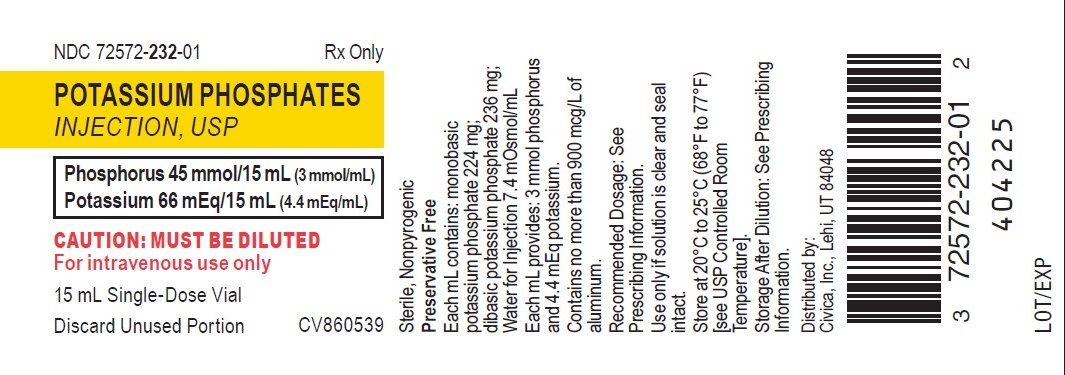
Package Label - Principal Display – Potassium Phosphates Inj, Usp 15 Ml Vial Label

NDC 72572-232-01               Rx Only

POTASSIUM

PHOSPHATES

INJECTION, USP

Phosphorus 45 mmol/15 mL (3 mmol/mL)

Potassium 66 mEq/15 mL (4.4 mEq/mL)

CAUTION: MUST BE DILUTED

For intravenous use only

15 mL Single-Dose Vial

Discard Unused Portion             CV860539

Potas-label-01.jpg (Potas Label 01)

Potas-label-01.jpg (Potas Label 01)

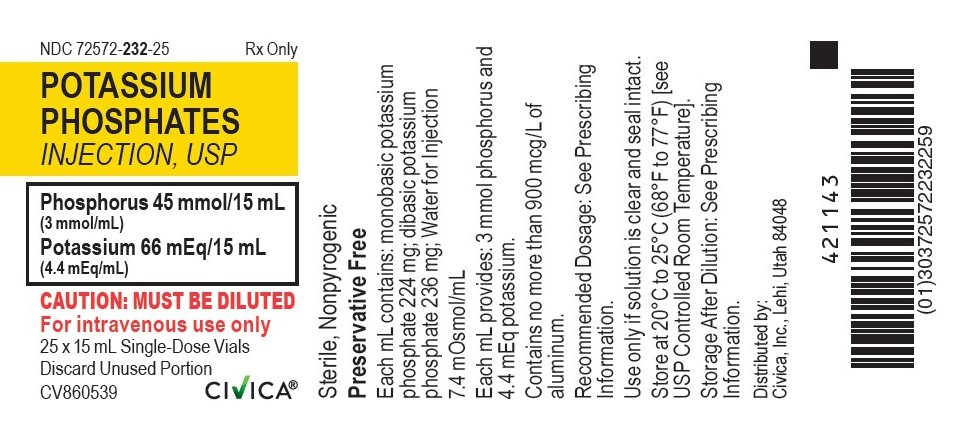
Package Label - Principal Display – Potassium Phosphates Inj, Usp 15 Ml Tray Label

NDC 72572-232-25        Rx Only

POTASSIUM

PHOSPHATES

INJECTION, USP

Phosphorus 45 mmol/15 mL

(3 mmol/mL)

Potassium 66 mEq/15 mL

(4.4 mEq/mL)

CAUTION: MUST BE DILUTED

For intravenous use only

25 x 15 mL

Single-Dose Vials

Discard Unused Portion

CV860539

Potas-label-02.jpg (Potas Label 02)

Potas-label-02.jpg (Potas Label 02)

* Please review the disclaimer below.