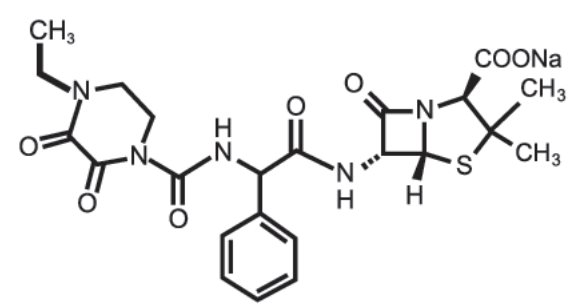
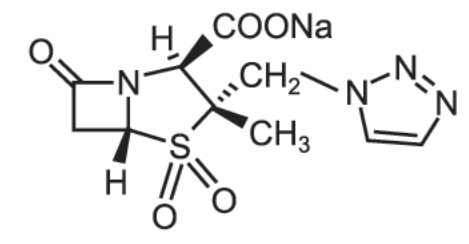
The mean and coefficients of variation (CV%) for the pharmacokinetic parameters of piperacillin and tazobactam after multiple intravenous doses are summarized in Table 8.
Table 8: Mean (CV%) Piperacillin and Tazobactam PK Parameters
Piperacillin |
| Piperacillin and Tazobactam Dose
a | C
max(mcg/mL)
| AUC
b(mcg•h/mL)
| CL(mL/min) | V(L) | T
1/2(h)
| CL
R(mL/min)
|
2.25 g | 134 | 131 [14] | 257 | 17.4 | 0.79 | -- |
3.375 g | 242 | 242 [10] | 207 | 15.1 | 0.84 | 140 |
4.5 g | 298 | 322 [16] | 210 | 15.4 | 0.84 | -- |
Tazobactam |
| Piperacillin and Tazobactam Dose
a | C
max(mcg/mL)
| AUC
b(mcg•h/mL)
| CL(mL/min) | V(L) | T
1/2(h)
| CL
R(mL/min)
|
2.25 g | 15 | 16.0 [21] | 258 | 17.0 | 0.77 | -- |
3.375 g | 24 | 25.0 [8] | 251 | 14.8 | 0.68 | 166 |
4.5 g | 34 | 39.8 [15] | 206 | 14.7 | 0.82 | -- |
aPiperacillin and tazobactam were given in combination, infused over 30 minutes.
bNumbers in []parentheses are coefficients of variation [CV%].
C
max: maximum observed concentration, AUC: Area under the curve, CL=clearance, CL
R= Renal clearance
V=volume of distribution, T
1/2= elimination half-life
Peak plasma concentrations of piperacillin and tazobactam are attained immediately after completion of an intravenous infusion of piperacillin and tazobactam for injection. Piperacillin plasma concentrations, following a 30-minute infusion of piperacillin and tazobactam for injection, were similar to those attained when equivalent doses of piperacillin were administered alone. Steady-state plasma concentrations of piperacillin and tazobactam were similar to those attained after the first dose due to the short half-lives of piperacillin and tazobactam.
Distribution
Both piperacillin and tazobactam are approximately 30% bound to plasma proteins. The protein binding of either piperacillin or tazobactam is unaffected by the presence of the other compound. Protein binding of the tazobactam metabolite is negligible.
Piperacillin and tazobactam are widely distributed into tissues and body fluids including intestinal mucosa, gallbladder, lung, female reproductive tissues (uterus, ovary, and fallopian tube), interstitial fluid, and bile. Mean tissue concentrations are generally 50% to 100% of those in plasma. Distribution of piperacillin and tazobactam into cerebrospinal fluid is low in subjects with non-inflamed meninges, as with other penicillins (see Table 9).
Table 9: Piperacillin and Tazobactam Concentrations in Selected Tissues and Fluids after Single 4 g/0.5 g 30-min IV Infusion of Piperacillin and Tazobactam for Injection
| Tissue or Fluid | N
a | Sampling period
b
(h)
| Mean PIP Concentration Range (mg/L) | Tissue:Plasma Range | Tazo Concentration Range (mg/L) | Tazo Tissue:Plasma Range |
| Skin | 35 | 0.5 to 4.5 | 34.8 to 94.2 | 0.60 to 1.1 | 4.0 to 7.7 | 0.49 to 0.93 |
| Fatty Tissue | 37 | 0.5 to 4.5 | 4.0 to 10.1 | 0.097 to 0.115 | 0.7 to 1.5 | 0.10 to 0.13 |
| Muscle | 36 | 0.5 to 4.5 | 9.4 to 23.3 | 0.29 to 0.18 | 1.4 to 2.7 | 0.18 to 0.30 |
| Proximal Intestinal Mucosa | 7 | 1.5 to 2.5 | 31.4 | 0.55 | 10.3 | 1.15 |
| Distal Intestinal Mucosa | 7 | 1.5 to 2.5 | 31.2 | 0.59 | 14.5 | 2.1 |
| Appendix | 22 | 0.5 to 2.5 | 26.5 to 64.1 | 0.43 to 0.53 | 9.1 to 18.6 | 0.80 to 1.35 |
| aEach subject provided a single sample.
bTime from the start of the infusion
|
Metabolism
Piperacillin is metabolized to a minor microbiologically active desethyl metabolite. Tazobactam is metabolized to a single metabolite that lacks pharmacological and antibacterial activities.
Excretion
Following single or multiple piperacillin and tazobactam for injection doses to healthy subjects, the plasma half-life of piperacillin and of tazobactam ranged from 0.7 to 1.2 hours and was unaffected by dose or duration of infusion.
Both piperacillin and tazobactam are eliminated via the kidney by glomerular filtration and tubular secretion. Piperacillin is excreted rapidly as unchanged drug with 68% of the administered dose excreted in the urine. Tazobactam and its metabolite are eliminated primarily by renal excretion with 80% of the administered dose excreted as unchanged drug and the remainder as the single metabolite. Piperacillin, tazobactam and desethyl piperacillin are also secreted into the bile.
Specific Populations
Renal Impairment
After the administration of single doses of piperacillin and tazobactam to subjects with renal impairment, the half-life of piperacillin and of tazobactam increases with decreasing creatinine clearance. At creatinine clearance below 20 mL/min, the increase in half-life is twofold for piperacillin and fourfold for tazobactam compared to subjects with normal renal function. Dosage adjustments for piperacillin and tazobactam for injection are recommended when creatinine clearance is below 40 mL/min in patients receiving the usual recommended daily dose of piperacillin and tazobactam for injection.
See
Dosage and Administration (2)for specific recommendations for the treatment of patients with renal‑impairment.
Hemodialysis removes 30% to 40% of a piperacillin and tazobactam dose with an additional 5% of the tazobactam dose removed as the tazobactam metabolite. Peritoneal dialysis removes approximately 6% and 21% of the piperacillin and tazobactam doses, respectively, with up to 16% of the tazobactam dose removed as the tazobactam metabolite. For dosage recommendations for patients undergoing hemodialysis
[see Dosage and Administration (2)].
Hepatic Impairment
The half-life of piperacillin and of tazobactam increases by approximately 25% and 18%, respectively, in patients with hepatic cirrhosis compared to healthy subjects. However, this difference does not warrant dosage adjustment of piperacillin and tazobactam for injection due to hepatic cirrhosis.
Pediatrics
Piperacillin and tazobactam pharmacokinetics were studied in pediatric patients 2 months of age and older. The clearance of both compounds is slower in the younger patients compared to older children and adults.
In a population PK analysis, estimated clearance for 9 month-old to 12 year-old patients was comparable to adults, with a population mean (SE) value of 5.64 (0.34) mL/min/kg. The piperacillin clearance estimate is 80% of this value for pediatric patients 2 - 9 months old. In patients younger than 2 months of age, clearance of piperacillin is slower compared to older children; however, it is not adequately characterized for dosing recommendations. The population mean (SE) for piperacillin volume of distribution is 0.243 (0.011) L/kg and is independent of age.
Geriatrics
The impact of age on the pharmacokinetics of piperacillin and tazobactam was evaluated in healthy male subjects, aged 18 - 35 years (n=6) and aged 65 to 80 years (n=12). Mean half-life for piperacillin and tazobactam was 32% and 55% higher, respectively, in the elderly compared to the younger subjects. This difference may be due to age-related changes in creatinine clearance.
Race
The effect of race on piperacillin and tazobactam was evaluated in healthy male volunteers. No difference in piperacillin or tazobactam pharmacokinetics was observed between Asian (n=9) and Caucasian (n=9) healthy volunteers who received single 4/0.5 g doses.
Drug Interactions
The potential for pharmacokinetic drug interactions between piperacillin and tazobactam for injection and aminoglycosides, probenecid, vancomycin, heparin, vecuronium, and methotrexate has been evaluated
[see Drug Interactions (7)].