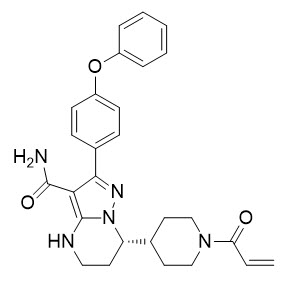
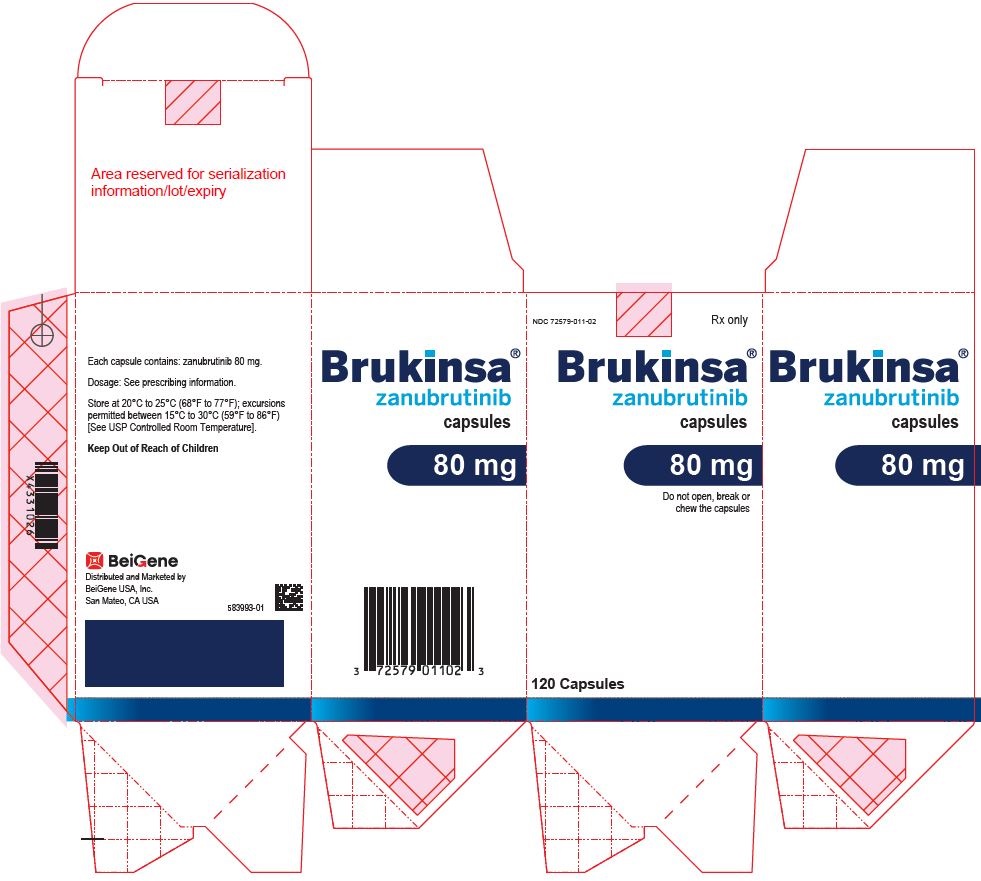
Mantle Cell Lymphoma (MCL)
The safety of BRUKINSA was evaluated in 118 patients with MCL who received at least one prior therapy in two single-arm clinical trials, BGB-3111-206 [NCT03206970] and BGB-3111-AU-003 [NCT02343120] [see Clinical Studies (14.1)]. The median age of patients who received BRUKINSA in studies BGB-3111-206 and BGB-3111-AU-003 was 62 years (range: 34 to 86), 75% were male, 75% were Asian, 21% were White, and 94% had an ECOG performance status of 0 to 1. Patients had a median of 2 prior lines of therapy (range: 1 to 4). The BGB-3111-206 trial required a platelet count ≥ 75 × 109/L and an absolute neutrophil count ≥ 1 × 10⁹/L independent of growth factor support, hepatic enzymes ≤ 2.5 × upper limit of normal, total bilirubin ≤ 1.5 × ULN. The BGB-3111-AU-003 trial required a platelet count ≥ 50 × 109/L and an absolute neutrophil count ≥ 1 × 10⁹/L independent of growth factor support, hepatic enzymes ≤ 3 × upper limit of normal, total bilirubin ≤ 1.5 × ULN. Both trials required a CLcr ≥ 30 mL/min. Both trials excluded patients with prior allogeneic hematopoietic stem cell transplant, exposure to a BTK inhibitor, known infection with HIV, and serologic evidence of active hepatitis B or hepatitis C infection and patients requiring strong CYP3A inhibitors or strong CYP3A inducers. Patients received BRUKINSA 160 mg twice daily or 320 mg once daily. Among patients receiving BRUKINSA, 79% were exposed for 6 months or longer and 68% were exposed for greater than one year.
Fatal events within 30 days of the last dose of BRUKINSA occurred in 8 (7%) of 118 patients with MCL. Fatal cases included pneumonia in 2 patients and cerebral hemorrhage in one patient.
Serious adverse reactions were reported in 36 patients (31%). The most frequent serious adverse reactions that occurred were pneumonia (11%), and hemorrhage (5%).
Of the 118 patients with MCL treated with BRUKINSA, 8 (7%) patients discontinued treatment due to adverse reactions in the trials. The most frequent adverse reaction leading to treatment discontinuation was pneumonia (3.4%). One (0.8%) patient experienced an adverse reaction leading to dose reduction (hepatitis B).
Table 3 summarizes the adverse reactions in BGB-3111-206 and BGB-3111-AU-003.
Table 3: Adverse Reactions (≥ 10%) in Patients Receiving BRUKINSA in BGB-3111-206 and BGB-3111-AU-003 Trials| Body System | Adverse Reaction | Percent of Patients (N=118) |
|---|
All Grades
% | Grade 3 or Higher % |
|---|
| Blood and lymphatic system disorders | Neutropenia and Neutrophil count decreased | 38 | 15 |
| Thrombocytopenia and Platelet count decreased | 27 | 5 |
| Leukopenia and White blood count decreased | 25 | 5 |
| Anemia and Hemoglobin decreased | 14 | 8 |
| Infections and infestations | Upper respiratory tract infection Upper respiratory tract infection includes upper respiratory tract infection, upper respiratory tract infection viral | 39 | 0 |
| Pneumonia Pneumonia includes pneumonia, pneumonia fungal, pneumonia cryptococcal, pneumonia streptococcal, atypical pneumonia, lung infection, lower respiratory tract infection, lower respiratory tract infection bacterial, lower respiratory tract infection viral | 15 | 10 |
| Urinary tract infection | 11 | 0.8 |
| Skin and subcutaneous tissue disorders | Rash Rash includes all related terms containing rash | 36 | 0 |
| Bruising Bruising includes all related terms containing bruise, bruising, contusion, ecchymosis | 14 | 0 |
| Gastrointestinal disorders | Diarrhea | 23 | 0.8 |
| Constipation | 13 | 0 |
| Vascular disorders | Hypertension | 12 | 3.4 |
| Hemorrhage Hemorrhage includes all related terms containing hemorrhage, hematoma | 11 | 3.4 |
| Musculoskeletal and connective tissue disorders | Musculoskeletal pain Musculoskeletal pain includes musculoskeletal pain, musculoskeletal discomfort, myalgia, back pain, arthralgia, arthritis | 14 | 3.4 |
| Metabolism and nutrition disorders | Hypokalemia | 14 | 1.7 |
| Respiratory, thoracic and mediastinal disorders | Cough | 12 | 0 |
Other clinically significant adverse reactions that occurred in < 10% of patients with mantle cell lymphoma include major hemorrhage (defined as ≥ Grade 3 hemorrhage or CNS hemorrhage of any grade) (5%), hyperuricemia (6%) and headache (4.2%).
Table 4: Selected Laboratory AbnormalitiesBased on laboratory measurements.
(> 20%) in Patients with MCL in Studies BGB-3111-206 and BGB-3111-AU-003| Laboratory Parameter | Percent of Patients (N=118) |
|---|
| All Grades (%) | Grade 3 or 4 (%) |
|---|
| Neutrophils decreased | 45 | 20 |
| Platelets decreased | 40 | 7 |
| Hemoglobin decreased | 27 | 6 |
| Lymphocytosis Asymptomatic lymphocytosis is a known effect of BTK inhibition. | 41 | 16 |
| Chemistry abnormalities | | |
| Blood uric acid increased | 29 | 2.6 |
| ALT increased | 28 | 0.9 |
| Bilirubin increased | 24 | 0.9 |
Risk Summary
Based on findings in animals, BRUKINSA can cause fetal harm when administered to pregnant women. There are no available data on BRUKINSA use in pregnant women to evaluate for a drug-associated risk of major birth defects, miscarriage or adverse maternal or fetal outcomes. In animal reproduction studies, oral administration of zanubrutinib to pregnant rats during the period of organogenesis was associated with fetal heart malformation at approximately 5-fold human exposures (see Data). Women should be advised to avoid pregnancy while taking BRUKINSA. If BRUKINSA is used during pregnancy, or if the patient becomes pregnant while taking BRUKINSA, the patient should be apprised of the potential hazard to the fetus.
The estimated background risk of major birth defects and miscarriage for the indicated population is unknown. All pregnancies have a background risk of birth defect, loss, or other adverse outcomes. In the U.S. general population, the estimated background risk of major birth defects and miscarriage in clinically recognized pregnancies is 2% to 4% and 15% to 20%, respectively.
Data
Animal Data
Embryo-fetal development toxicity studies were conducted in both rats and rabbits. Zanubrutinib was administered orally to pregnant rats during the period of organogenesis at doses of 30, 75, and 150 mg/kg/day. Malformations in the heart (2- or 3-chambered hearts) were noted at all dose levels in the absence of maternal toxicity. The dose of 30 mg/kg/day is approximately 5 times the exposure (AUC) in patients receiving the recommended dose of 160 mg twice daily.
Administration of zanubrutinib to pregnant rabbits during the period of organogenesis at 30, 70, and 150 mg/kg/day resulted in post-implantation loss at the highest dose. The dose of 150 mg/kg is approximately 32 times the exposure (AUC) in patients at the recommended dose and was associated with maternal toxicity.
In a pre- and post-natal developmental toxicity study, zanubrutinib was administered orally to rats at doses of 30, 75, and 150 mg/kg/day from implantation through weaning. The offspring from the middle and high dose groups had decreased body weights preweaning, and all dose groups had adverse ocular findings (e.g. cataract, protruding eye). The dose of 30 mg/kg/day is approximately 5 times the AUC in patients receiving the recommended dose.
Risk Summary
There are no data on the presence of zanubrutinib or its metabolites in human milk, the effects on the breastfed child, or the effects on milk production. Because of the potential for serious adverse reactions from BRUKINSA in a breastfed child, advise lactating women not to breastfeed during treatment with BRUKINSA and for at least two weeks following the last dose.
Pregnancy Testing
Pregnancy testing is recommended for females of reproductive potential prior to initiating BRUKINSA therapy.
Contraception
Females
BRUKINSA can cause embryo-fetal harm when administered to pregnant women [see Use in Specific Populations (8.1)]. Advise female patients of reproductive potential to use effective contraception during treatment with BRUKINSA and for at least 1 week following the last dose of BRUKINSA. If this drug is used during pregnancy, or if the patient becomes pregnant while taking this drug, the patient should be informed of the potential hazard to a fetus.
Males
Advise men to avoid fathering a child while receiving BRUKINSA and for at least 1 week following the last dose of BRUKINSA.
BTK Occupancy in PBMCs and Lymph Nodes
The median steady-state BTK occupancy in peripheral blood mononuclear cells was maintained at 100% over 24 hours at a total daily dose of 320 mg in patients with B-cell malignancies. The median steady-state BTK occupancy in lymph nodes was 94% to 100% following the approved recommended dosage.
Cardiac Electrophysiology
At the approved recommended doses (160 mg twice daily or 320 mg once daily), there were no clinically relevant effects on the QTc interval. The effect of BRUKINSA on the QTc interval above the therapeutic exposure has not been evaluated.
Absorption
The median tmax of zanubrutinib is 2 hours.
Effect of Food
No clinically significant differences in zanubrutinib AUC or Cmax were observed following administration of a high-fat meal (approximately 1,000 calories with 50% of total caloric content from fat) in healthy subjects.
Distribution
The geometric mean (%CV) apparent steady-state volume of distribution of zanubrutinib is 881 (95%) L. The plasma protein binding of zanubrutinib is approximately 94% and the blood-to-plasma ratio is 0.7 to 0.8.
Elimination
The mean half-life (t½) of zanubrutinib is approximately 2 to 4 hours following a single oral zanubrutinib dose of 160 mg or 320 mg. The geometric mean (%CV) apparent oral clearance (CL/F) of zanubrutinib is 182 (37%) L/h.
Metabolism
Zanubrutinib is primarily metabolized by cytochrome P450(CYP)3A.
Excretion
Following a single radiolabeled zanubrutinib dose of 320 mg to healthy subjects, approximately 87% of the dose was recovered in feces (38% unchanged) and 8% in urine (less than 1% unchanged).
Specific Populations
No clinically significant differences in the pharmacokinetics of zanubrutinib were observed based on age (19 to 90 years), sex, race (Asian, Caucasian, and Other), body weight (36 to 140 kg), or mild or moderate renal impairment (creatinine clearance [CLcr] ≥ 30 mL/min as estimated by Cockcroft-Gault). The effect of severe renal impairment (CLcr < 30 mL/min) and dialysis on zanubrutinib pharmacokinetics is unknown.
Hepatic Impairment
The total AUC of zanubrutinib increased by 11% in subjects with mild hepatic impairment (Child-Pugh class A), by 21% in subjects with moderate hepatic impairment (Child-Pugh class B), and by 60% in subjects with severe hepatic impairment (Child-Pugh class C) relative to subjects with normal liver function. The unbound AUC of zanubrutinib increased by 23% in subjects with mild hepatic impairment (Child-Pugh class A), by 43% in subjects with moderate hepatic impairment (Child-Pugh class B), and by 194% in subjects with severe hepatic impairment (Child-Pugh class C) relative to subjects with normal liver function.
Drug Interaction Studies
Clinical Studies and Model-Informed Approaches
CYP3A Inhibitors: Co-administration of multiple doses of CYP3A inhibitors increases zanubrutinib Cmax and AUC (Table 6).
Table 6: Observed or Predicted Increase in Zanubrutinib Exposure After Co-Administration of CYP3A Inhibitors| Co-administered CYP3A Inhibitor | Increase in Zanubrutinib Cmax | Increase in Zanubrutinib AUC |
|---|
| Observed |
| Itraconazole (200 mg once daily) | 157% | 278% |
| Predicted |
| Clarithromycin (250 mg twice daily) | 175% | 183% |
| Diltiazem (60 mg three times daily) | 151% | 157% |
| Erythromycin (500 mg four times daily) | 284% | 317% |
| Fluconazole (200 mg once daily) | 179% | 177% |
| Fluconazole (400 mg once daily) | 270% | 284% |
CYP3A Inducers: Co-administration of multiple doses of rifampin (strong CYP3A inducer) decreased the zanubrutinib Cmax by 92% and AUC by 93%.
Co-administration of multiple doses of efavirenz (moderate CYP3A inducer) is predicted to decrease zanubrutinib Cmax by 58% and AUC by 60%.
CYP3A Substrates: Co-administration of multiple doses of zanubrutinib decreased midazolam (CYP3A substrate) Cmax by 30% and AUC by 47%.
CYP2C19 Substrates: Co-administration of multiple doses of zanubrutinib decreased omeprazole (CYP2C19 substrate) Cmax by 20% and AUC by 36%.
Other CYP Substrates: No clinically significant differences were observed with warfarin (CYP2C9 substrate) pharmacokinetics or predicted with rosiglitazone (CYP2C8 substrate) pharmacokinetics when co-administered with zanubrutinib.
Transporter Systems: Co-administration of multiple doses of zanubrutinib increased digoxin (P-gp substrate) Cmax by 34% and AUC by 11%. No clinically significant differences in the pharmacokinetics of rosuvastatin (BCRP substrate) were observed when co-administered with zanubrutinib.
Gastric Acid Reducing Agents: No clinically significant differences in zanubrutinib pharmacokinetics were observed when co-administered with gastric acid reducing agents (proton pump inhibitors, H2-receptor antagonists).
In Vitro Studies
CYP Enzymes: Zanubrutinib is an inducer of CYP2B6.
Transporter Systems: Zanubrutinib is likely to be a substrate of P-gp. Zanubrutinib is not a substrate or inhibitor of OAT1, OAT3, OCT2, OATP1B1, or OATP1B3.
How Supplied
| Package Size | Content | NDC Number |
|---|
| 120-count | Bottle with a child-resistant cap containing 120 capsules | 72579-011-02 |
| 80 mg, white to off-white opaque capsule, marked with "ZANU 80" in black ink |
Hemorrhage
Inform patients to report signs or symptoms of severe bleeding. Inform patients that BRUKINSA may need to be interrupted for major surgeries or procedures [see Warnings and Precautions (5.1)].
Infections
Inform patients to report signs or symptoms suggestive of infection [see Warnings and Precautions (5.2)].
Cytopenias
Inform patients that they will need periodic blood tests to check blood counts during treatment with BRUKINSA [see Warnings and Precautions (5.3)].
Second Primary Malignancies
Inform patients that other malignancies have been reported in patients who have been treated with BRUKINSA, including skin cancer. Advise patients to use sun protection [see Warnings and Precautions (5.4)].
Cardiac Arrhythmias
Counsel patients to report any signs of palpitations, lightheadedness, dizziness, fainting, shortness of breath, and chest discomfort [see Warnings and Precautions (5.5)].
Embryo-Fetal Toxicity
Advise women of the potential hazard to a fetus and to avoid becoming pregnant during treatment and for at least 1 week after the last dose of BRUKINSA [see Warnings and Precautions (5.6)].
Advise males with female sexual partners of reproductive potential to use effective contraception during BRUKINSA treatment and for at least 1 week after the last dose of BRUKINSA [see Use in Specific Populations (8.3)].
Lactation
Advise females not to breastfeed during treatment with BRUKINSA and for at least 2 weeks after the last dose [see Use in Specific Populations (8.2)].
Administration Instructions
BRUKINSA may be taken with or without food. Advise patients that BRUKINSA capsules should be swallowed whole with a glass of water, without being opened, broken, or chewed [see Dosage and Administration (2.1)].
Missed Dose
Advise patients that if they miss a dose of BRUKINSA, they may still take it as soon as possible on the same day with a return to the normal schedule the following day [see Dosage and Administration (2.1)].
Drug Interactions
Advise patients to inform their healthcare providers of all concomitant medications, including over-the-counter medications, vitamins, and herbal products [see Drug Interactions (7)].
Distributed and Marketed by:
BeiGene USA, Inc.
San Mateo, CA 94403
BRUKINSA™ is a trademark owned by BeiGene, Ltd.
© BeiGene, Ltd. 2019