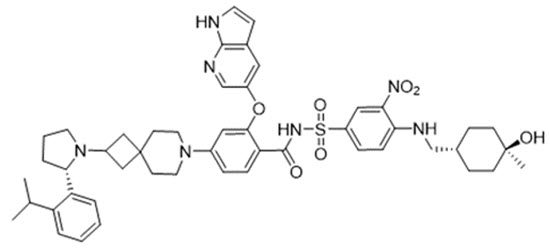
Sonrotoclax pharmacokinetics were determined following a single dose or at steady state at the approved recommended dosage of 320 mg once daily and are presented as mean (CV%), unless otherwise specified.
Sonrotoclax area under the plasma drug concentration-time curve (AUC0-24 h) is 3395 (55%) ng∙h/mL and maximum plasma concentration (Cmax) is 353 (49%) ng/mL, following 320 mg once daily with a low-fat meal. Sonrotoclax Cmax and AUC0-tau increase in a less than dose proportional manner over the dosage range of 320 mg to 640 mg (1 to 2 times the highest approved recommended dosage). Limited systemic accumulation of sonrotoclax was observed following repeated administration.
Absorption
The median Tmax of sonrotoclax is 4 hours (ranged from 1 to 8 hours) following 320 mg once daily dosing.
Effect of Food
Sonrotoclax AUC and Cmax increased by approximately 1.5-fold following administration with a low-fat meal (approximately 333-500 kilocalories, 25% fat calories). Sonrotoclax AUC increased by 2-fold and Cmax by 2.4-fold following administration with a high-fat meal (1000 kilocalories, 50% fat).
Distribution
The geometric mean apparent volume of distribution of sonrotoclax is 482 (38%) L. Sonrotoclax plasma protein binding is 99% across a concentration range of 1 to 10 µM. The blood-to-plasma ratio is 0.6 to 0.7.
Elimination
The mean terminal elimination half-life (t½) of sonrotoclax ranges from 4 to 6 hours. The geometric mean apparent oral clearance (CL/F) of sonrotoclax is 94 (62%) L/h.
Metabolism
Sonrotoclax is primarily metabolized by CYP3A and to a lesser extent by CYP2C8 in vitro.
Excretion
After a single radiolabeled sonrotoclax dose of 20 mg to healthy subjects, approximately 86% of the dose was recovered in feces (19.5% unchanged) and 0.28% in urine (0.04% unchanged).
Specific Populations
No clinically meaningful differences in the pharmacokinetics of sonrotoclax were observed based on race, age (27-91 years), sex, weight (37-165 kg), mild to moderate renal impairment (eGFR ≥30 mL/min) or mild to moderate hepatic impairment (bilirubin ≤3 × upper limit of normal (ULN) and any aspartate aminotransferase (AST)). The effect of severe renal impairment (eGFR <30 mL/min) or severe hepatic impairment (total bilirubin >3 × ULN with any AST) on sonrotoclax pharmacokinetics is unknown.
Drug Interactions Studies
Clinical Studies and Model-Informed Approaches
Strong CYP3A inhibitors:
Sonrotoclax AUC increased 11-fold and Cmax increased 4-fold following concomitant administration of itraconazole (strong CYP3A inhibitor and P-gp inhibitor).
Sonrotoclax AUC increased 13-fold and Cmax increased 7-fold following concomitant administration of posaconazole (strong CYP3A inhibitor).
Strong CYP3A inducers: Sonrotoclax AUC decreased to 35% and Cmax to 58% following concomitant use of phenytoin (strong CYP3A inducer).
Other drugs: No clinically significant differences in sonrotoclax pharmacokinetics were observed following concomitant administration with gastric acid reducing agents (proton pump inhibitors, H2-receptor antagonists).
In Vitro Studies
CYP450 Enzymes: Sonrotoclax is not an inhibitor of CYP1A2, CYP2B6, CYP2C8, CYP2C9, CYP2C19, and CYP2D6. Sonrotoclax inhibits CYP3A in vitro, but this is not anticipated to have a clinically meaningful impact. Sonrotoclax is not an inducer of CYP1A2, CYP2B6, or CYP3A4.
Transporters: Sonrotoclax is a substrate of P-gp and BCRP but not OATP1B1 or OATP1B3. Sonrotoclax does not inhibit P-gp, BCRP OATP1B1, OATP1B3, OAT1, OAT3, OCT1, OCT2, MATE1, or MATE2-K.