Discard the diluted solution after 4 hours at room temperature or after 20 hours under refrigeration.
Do not freeze the diluted solution.
- Administer diluted solution by intravenous infusion through an intravenous line with a sterile, nonpyrogenic, low-protein binding 0.2 micron or 0.22 micron in-line or add-on filter.
- The initial infusion should be delivered over 60 minutes. If tolerated, all subsequent infusions may be administered over 30 minutes.
- Do not coadminister other drugs through the same infusion line.
- Do not administer TEVIMBRA as an intravenous push or single bolus injection.
- The intravenous line must be flushed at the end of infusion.
Immune-Mediated Pneumonitis
TEVIMBRA can cause immune-mediated pneumonitis, which can be fatal. In patients treated with other PD-1/PD-L1 blocking antibodies, the incidence of pneumonitis is higher in patients who have received prior thoracic radiation.
Immune-mediated pneumonitis occurred in 3.8% (75/1972) of patients receiving TEVIMBRA, including fatal (0.2%), Grade 4 (0.3%), Grade 3 (1.4%), and Grade 2 (1.7%) adverse reactions. Pneumonitis led to permanent discontinuation of TEVIMBRA in 35 (1.8%) patients and withholding of TEVIMBRA in 27 (1.4%) patients.
Systemic corticosteroids were required in all patients with pneumonitis. Immune-mediated pneumonitis resolved in 47% of the 75 patients. Of the 27 patients in whom TEVIMBRA was withheld for pneumonitis, 18 reinitiated TEVIMBRA after symptom improvement; of these, 3 (17%) patients had recurrence of pneumonitis.
Immune-Mediated Colitis
TEVIMBRA can cause immune-mediated colitis, which can be fatal. Cytomegalovirus (CMV) infection/reactivation has been reported in patients with corticosteroid-refractory immune-mediated colitis treated with PD-1/PD-L1 blocking antibodies. In cases of corticosteroid-refractory colitis, consider repeating infectious workup to exclude alternative etiologies.
Immune-mediated colitis occurred in 0.9% (17/1972) of patients receiving TEVIMBRA, including Grade 3 (0.4%), and Grade 2 (0.5%) adverse reactions. Colitis led to permanent discontinuation of TEVIMBRA in 2 (0.1%) patients and withholding of TEVIMBRA in 10 (0.5%) patients. All 17 patients received systemic corticosteroids. Twelve (71%) of the 17 patients received high-dose systemic corticosteroids. Two (12%) of the 17 patients received immunosuppressive treatment. Immune-mediated colitis resolved in 88% of the 17 patients. Of the 10 patients in whom TEVIMBRA was withheld for colitis, 8 reinitiated TEVIMBRA after symptom improvement; of these, 1 (13%) patient had recurrence of colitis.
Immune-Mediated Hepatitis
TEVIMBRA can cause immune-mediated hepatitis, which can be fatal.
Immune-mediated hepatitis occurred in 1.7% (34/1972) of patients receiving TEVIMBRA, including fatal (0.1%), Grade 4 (0.1%), Grade 3 (1%), and Grade 2 (0.6%) adverse reactions. Immune-mediated hepatitis led to permanent discontinuation in 9 (0.5%) patients and withholding of TEVIMBRA in 20 (1%) patients. All patients received systemic corticosteroids. Twenty-nine (85%) of the 34 patients received high-dose systemic corticosteroids. One patient (2.9%) of the 34 patients received immunosuppressive treatment. Immune-mediated hepatitis resolved in 59% of the 34 patients. Of the 20 patients in whom TEVIMBRA was withheld for hepatitis, 12 reinitiated TEVIMBRA after symptom improvement; of these, 2 (17%) patients had recurrence of hepatitis.
Immune-Mediated Endocrinopathies
Adrenal Insufficiency
TEVIMBRA can cause immune-mediated adrenal insufficiency. For Grade 2 or higher adrenal insufficiency, initiate symptomatic treatment, including hormone replacement as clinically indicated. Withhold TEVIMBRA depending on severity [see Dosage and Administration (2.2)].
Immune-mediated adrenal insufficiency occurred in 0.3% (6/1972) of patients receiving TEVIMBRA, including Grade 4 (0.1%), Grade 3 (0.1%), and Grade 2 (0.2%) adverse reactions. Adrenal insufficiency did not lead to permanent discontinuation of TEVIMBRA. TEVIMBRA was withheld in 5 out of the 6 patients. All 6 patients received systemic corticosteroids. Two (33%) of the 6 patients received high-dose systemic corticosteroids. Adrenal insufficiency resolved in 17% of the 6 patients.
Hypophysitis
TEVIMBRA can cause immune-mediated hypophysitis. Hypophysitis can present with acute symptoms associated with mass effect such as headache, photophobia, or visual field defects. Hypophysitis can cause hypopituitarism. Initiate hormone replacement as clinically indicated. Withhold or permanently discontinue TEVIMBRA depending on severity [see Dosage and Administration (2.2)].
Hypophysitis/hypopituitarism occurred in 0.1% (1/1972) of patients receiving TEVIMBRA, including a Grade 2 (0.1%) adverse reaction. No TEVIMBRA treatment discontinuation or withholding was required.
Thyroid Disorders
TEVIMBRA can cause immune-mediated thyroid disorders. Thyroiditis can present with or without endocrinopathy. Hypothyroidism can follow hyperthyroidism. Initiate hormone replacement for hypothyroidism or institute medical management of hyperthyroidism as clinically indicated. Withhold or permanently discontinue TEVIMBRA depending on severity [see Dosage and Administration (2.2)].
Thyroiditis: Immune-mediated thyroiditis occurred in 0.4% (7/1972) of patients receiving TEVIMBRA, including Grade 2 (0.3%) adverse reactions. Thyroiditis did not lead to permanent discontinuation of TEVIMBRA. TEVIMBRA was withheld in 1 (0.1%) patient. One (14%) of the 7 patients received systemic corticosteroids. Thyroiditis resolved in 29% of the 7 patients.
Hyperthyroidism: Immune-mediated hyperthyroidism occurred in 0.6% (12/1972) of patients receiving TEVIMBRA, including Grade 3 (0.1%), and Grade 2 (0.5%) adverse reactions. Hyperthyroidism led to the permanent discontinuation of TEVIMBRA in 1 (0.1%) patient and withholding of TEVIMBRA in 1 (0.1%) patient. One (8%) of the 12 patients received systemic corticosteroids. Hyperthyroidism resolved in 92% of the 12 patients.
Hypothyroidism: Immune-mediated hypothyroidism occurred in 7% (132/1972) of patients receiving TEVIMBRA, including Grade 4 (0.1%) and Grade 2 (5%) adverse reactions. TEVIMBRA was not permanently discontinued in any patient, while treatment was withheld in 6 (0.3%) patients. Two (1.5%) of the 132 patients received systemic corticosteroids. All 132 patients received hormone replacement therapy. Hypothyroidism resolved in 27% of the 132 patients. The majority (86%) of patients with hypothyroidism required long-term thyroid hormone replacement.
Type 1 Diabetes Mellitus, which can present with Diabetic Ketoacidosis
Type 1 diabetes mellitus has been reported with PD-1/PD-L1 blocking antibodies. Monitor patients for hyperglycemia or other signs and symptoms of diabetes. Initiate treatment with insulin as clinically indicated. Withhold or permanently discontinue TEVIMBRA depending on severity [see Dosage and Administration (2.2)].
Immune-Mediated Nephritis with Renal Dysfunction
TEVIMBRA can cause immune-mediated nephritis, which can be fatal.
Immune-mediated nephritis with renal dysfunction occurred in 0.4% (7/1972) of patients receiving TEVIMBRA, including Grade 4 (0.1%), Grade 3 (0.1%), and Grade 2 (0.2%) adverse reactions. TEVIMBRA was permanently discontinued in 3 (0.2%) patients and treatment was withheld in 3 (0.2%) patients. All patients received systemic corticosteroids. Nephritis with renal dysfunction resolved in 57% of the 7 patients. Of the 3 patients in whom TEVIMBRA was withheld for nephritis, 2 reinitiated TEVIMBRA after symptom improvement and one patient had recurrence of nephritis.
Immune-Mediated Dermatologic Adverse Reactions
TEVIMBRA can cause immune-mediated rash or dermatitis. Cases of severe cutaneous adverse reactions (SCARs), including exfoliative dermatitis, Stevens-Johnson syndrome (SJS), and toxic epidermal necrolysis (TEN), have been reported, some with fatal outcome. Topical emollients and/or topical corticosteroids may be adequate to treat mild to moderate non-exfoliative rashes. Withhold or permanently discontinue TEVIMBRA depending on severity [see Dosage and Administration (2.2)].
Immune-mediated dermatologic adverse reactions occurred in 1.2% (24/1972) of patients receiving TEVIMBRA, including Grade 4 (0.2%), Grade 3 (0.4%), and Grade 2 (0.4%) adverse reactions. Dermatologic adverse reactions led to permanent discontinuation of TEVIMBRA in 3 (0.2%) patients and withholding of TEVIMBRA in 9 (0.5%) patients. Twenty-three (96%) of the 24 patients received systemic corticosteroids. Immune-mediated skin reactions resolved in 58% of the 24 patients. Of the 9 patients in whom TEVIMBRA was withheld for dermatologic adverse reactions, 8 reinitiated TEVIMBRA after symptom improvement; of these, 2 (25%) patients had recurrence of immune-mediated rash.
Other Immune-Mediated Adverse Reactions
The following clinically significant immune-mediated adverse reactions occurred at an incidence of less than 1% each in 1972 patients who received TEVIMBRA: myositis, myocarditis, arthritis, polymyalgia rheumatica, and pericarditis.
The following additional clinically significant immune-mediated adverse reactions have been reported with other PD-1/PD-L1 blocking antibodies, including severe or fatal cases.
Cardiac/Vascular: Vasculitis
Nervous System: Meningitis, encephalitis, myelitis and demyelination, myasthenic syndrome/myasthenia gravis (including exacerbation), Guillain-Barre syndrome, nerve paresis, autoimmune neuropathy
Ocular: Uveitis, iritis, and other ocular inflammatory toxicities can occur. Some cases can be associated with retinal detachment. Various grades of visual impairment, including blindness, can occur. If uveitis occurs in combination with other immune-mediated adverse reactions, consider a Vogt-Koyanagi-Harada-like syndrome, as this may require treatment with systemic steroids to reduce the risk of permanent vision loss
Gastrointestinal: Pancreatitis including increases in serum amylase and lipase levels, gastritis, duodenitis
Musculoskeletal and Connective Tissue: Polymyositis, rhabdomyolysis and associated sequelae including renal failure
Endocrine: Hypoparathyroidism
Other (Hematologic/Immune): Hemolytic anemia, aplastic anemia, hemophagocytic lymphohistiocytosis, systemic inflammatory response syndrome, histiocytic necrotizing lymphadenitis (Kikuchi lymphadenitis), sarcoidosis, immune thrombocytopenic purpura, solid organ transplant rejection, other transplant (including corneal graft) rejection
Esophageal squamous cell carcinoma
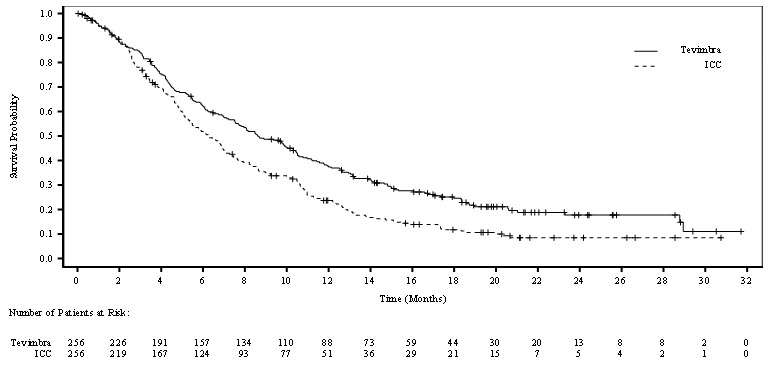
The safety of TEVIMBRA was evaluated in RATIONALE-302, a randomized, active-controlled, open-label, multicenter study in 255 patients with unresectable advanced, recurrent or metastatic ESCC [see Clinical Studies (14.1)]. The trial excluded patients who had brain or leptomeningeal metastases that were symptomatic or required treatment, active autoimmune disease, a medical condition requiring systemic corticosteroids or immunosuppressants, or apparent tumor invasion of organs adjacent to the esophageal site.
Patients received TEVIMBRA 200 mg by intravenous infusion over 30-60 minutes every 3 weeks or investigator's choice: paclitaxel 135-175 mg/m2 every 3 weeks or 80-100 mg/m2 weekly, docetaxel 75 mg/m2 every 3 weeks, or irinotecan 125 mg/m2 on Days 1 and 8 of every 3-week cycle. Patients were treated until disease progression or unacceptable toxicity. The median duration of exposure was 2.8 months (range: 0.2 to 28.3 months) in TEVIMBRA-treated patients and 1.5 months (range: 0.2 to 19.2 months) in paclitaxel, docetaxel, or irinotecan-treated patients.
Serious adverse reactions occurred in 41% of patients; the most frequent serious adverse reactions (≥2%) were pneumonia, dysphagia, hemorrhage, pneumonitis (including pneumonitis and immune-mediated pneumonitis), and esophageal obstruction. Fatal adverse reactions occurred in 7% of patients who received TEVIMBRA, including the following which occurred in more than one patient: pneumonia/pneumonitis (5 patients), hemorrhage (3 patients), and death due to an unknown cause (3 patients).
Permanent discontinuation of TEVIMBRA due to an adverse reaction occurred in 19% of patients. Adverse reactions which resulted in permanent discontinuation in ≥1% of patients were hemorrhage, pneumonitis (including pneumonitis and immune-mediated pneumonitis), and pneumonia.
Dosage interruptions of TEVIMBRA due to an adverse reaction occurred in 23% of patients. Adverse reactions which required dosage interruptions in ≥2% of patients were pneumonia, pneumonitis, and fatigue.
The most common (≥20%) adverse reactions, including laboratory abnormalities, were increased glucose, decreased hemoglobin, decreased lymphocytes, decreased sodium, decreased albumin, increased alkaline phosphatase, anemia, fatigue, increased AST, musculoskeletal pain, decreased weight, increased ALT, and cough.
Adverse reactions and laboratory abnormalities are listed in Table 2 and Table 3, respectively.
Table 2: Adverse Reactions (≥10%) in Patients With ESCC Receiving TEVIMBRA in RATIONALE-302| Adverse Reaction | TEVIMBRA
(N=255) | ICC
(N=240) |
|---|
All Grades
(%) | Grade 3-4
(%) | All Grades
(%) | Grade 3-4
(%) |
|---|
| ICC = investigator's choice of chemotherapy |
| Blood disorders |
| Anemia | 31 | 6 | 45 | 11 |
| General disorders |
| Fatigue Fatigue includes asthenia, fatigue, malaise. | 28 | 2 | 46 | 6 |
| Pyrexia | 16 | 0.4 | 14 | 0 |
| Musculoskeletal and connective tissue disorders |
| Musculoskeletal pain Musculoskeletal pain includes musculoskeletal pain, spinal pain, arthralgia, back pain, neck pain, musculoskeletal chest pain, myalgia, pain in extremity, non-cardiac chest pain, bone pain, arthritis. | 24 | 1 | 25 | 1 |
| Investigations |
| Weight decreased | 23 | 1 | 19 | 0 |
| Respiratory, thoracic and mediastinal disorders |
| Cough Cough includes productive cough, cough. | 22 | 0.4 | 16 | 0.4 |
| Metabolism and nutrition disorders |
| Decreased appetite | 16 | 0.4 | 35 | 4 |
| Infections and infestations |
| Pneumonia Pneumonia includes pneumonia aspiration, pneumonia, pneumonia bacterial, lower respiratory tract infection. | 16 | 6 | 12 | 7 |
| Gastrointestinal disorders |
| Constipation | 15 | 0 | 19 | 0.4 |
| Nausea | 14 | 0.4 | 30 | 3 |
| Diarrhea Diarrhea includes diarrhea, colitis. | 13 | 1 | 32 | 7 |
| Dysphagia | 11 | 6 | 8 | 3 |
| Abdominal pain Abdominal pain includes abdominal pain upper, abdominal pain, abdominal discomfort, abdominal pain lower, gastrointestinal pain. | 11 | 0.8 | 16 | 2 |
| Vomiting | 11 | 0.8 | 20 | 4 |
| Endocrine disorders |
| Hypothyroidism Hypothyroidism includes hypothyroidism, blood thyroid stimulating hormone increased. | 13 | 0.4 | 0.8 | 0 |
| Skin and subcutaneous tissue disorders |
| Rash Rash includes dermatitis, dermatitis acneiform, dermatitis allergic, eczema, erythema, psoriasis, rash, rash follicular, rash maculo-papular, rash pruritic. | 13 | 0.4 | 6 | 0 |
| Vascular disorders |
| Hemorrhage Hemorrhage includes tumor hemorrhage, upper gastrointestinal hemorrhage, gastrointestinal hemorrhage, hemoptysis, esophageal hemorrhage, hematuria, gastric hemorrhage, epistaxis, tracheal hemorrhage, gingival bleeding, pulmonary hemorrhage, procedural hemorrhage, rectal hemorrhage, stoma site hemorrhage. | 12 | 2 | 10 | 3 |
Table 3: Laboratory Abnormalities Worsening From Baseline Occurring in ≥10% of Patients Receiving TEVIMBRA in RATIONALE-302 | TEVIMBRA The denominator used to calculate the rate varied from 136 to 240 based on the number of patients with a baseline value and at least one post-treatment value. | ICC |
|---|
| Laboratory Abnormality | All Grades
(%) | Grade 3-4
(%) | All Grades
(%) | Grade 3-4
(%) |
|---|
| Chemistry |
| Glucose increased | 46 | 4 | 40 | 2 |
| Sodium decreased | 34 | 9 | 36 | 8 |
| Albumin decreased | 33 | 0.8 | 37 | 1 |
| Alkaline phosphatase increased | 32 | 3 | 15 | 0.5 |
| AST increased | 27 | 0.8 | 12 | 0.5 |
| ALT increased | 23 | 0.8 | 15 | 1 |
| Phosphate decreased | 15 | 4 | 20 | 3 |
| Creatine kinase increased | 13 | 1 | 2 | 0 |
| Potassium decreased | 13 | 1 | 15 | 3 |
| Bilirubin increased | 11 | 2 | 8 | 0.5 |
| Glucose decreased | 10 | 0.4 | 10 | 0.5 |
| Hematology |
| Hemoglobin decreased | 45 | 6 | 61 | 10 |
| Lymphocytes decreased | 43 | 11 | 60 | 28 |
| Platelets decreased | 11 | 1 | 11 | 0.9 |
| Leukocytes decreased | 10 | 0.8 | 66 | 31 |
Risk Summary
Based on its mechanism of action, TEVIMBRA can cause fetal harm when administered to a pregnant woman [see Clinical Pharmacology (12.1)]. There are no available data on the use of TEVIMBRA in pregnant women. Animal studies have demonstrated that inhibition of the PD-1/PD-L1 pathway can lead to increased risk of immune-mediated rejection of the developing fetus resulting in fetal death (see Data). Human IgG4 immunoglobulins (IgG4) are known to cross the placental barrier; therefore, tislelizumab-jsgr has the potential to be transmitted from the mother to the developing fetus. Advise women of the potential risk to a fetus.
In the U.S. general population, the estimated background risk of major birth defects and miscarriage in clinically recognized pregnancies is 2% to 4% and 15% to 20%, respectively.
Data
Animal Data
Animal reproduction studies have not been conducted with TEVIMBRA to evaluate its effect on reproduction and fetal development. A central function of the PD-1/PD-L1 pathway is to preserve pregnancy by maintaining maternal immune tolerance to the fetus. In murine models of pregnancy, blockade of PD-L1 signaling has been shown to disrupt tolerance to the fetus and to result in an increase in fetal loss; therefore, potential risks of administering TEVIMBRA during pregnancy include increased rates of abortion or stillbirth. As reported in the literature, there were no malformations related to the blockade of PD-1 signaling in the offspring of these animals; however, immune-mediated disorders occurred in PD-1 and PD-L1 knockout mice. Based on its mechanism of action, fetal exposure to tislelizumab-jsgr may increase the risk of developing immune-mediated disorders or altering the normal immune response.
Risk Summary
There is no information regarding the presence of tislelizumab-jsgr in human milk, or its effects on the breastfed child or on milk production. Because of the potential for serious adverse reactions in breastfed children, advise women not to breastfeed during treatment and for 4 months after the last dose of TEVIMBRA.
Pregnancy Testing
Verify pregnancy status in females of reproductive potential prior to initiating TEVIMBRA [see Use in Specific Populations (8.1)].
Contraception
Females
Advise females of reproductive potential to use effective contraception during treatment with TEVIMBRA and for 4 months after the last dose of TEVIMBRA.
Distribution
The tislelizumab-jsgr steady-state total volume of distribution is 6.42 L (32.6%).
Elimination
The tislelizumab-jsgr total clearance is 0.153 L/day (29.5%) and the terminal half-life (t½) is 24 days (31.0%).
Specific Populations
No clinically significant differences in the pharmacokinetics of tislelizumab-jsgr were observed based on age (range: 18 to 90 years), weight (range: 32 to 130 kg), race (White, Asian, or Black), mild to moderate renal impairment (CLCr ≥30 mL/min, estimated by Cockcroft-Gault), mild to moderate hepatic impairment (total bilirubin ≤3 times ULN and any AST, estimated by NCI criteria). The effect of severe hepatic impairment (total bilirubin >3 times ULN and any AST), severe renal impairment (CLCr 15-29 mL/min), or end stage renal disease (CLCr <15 mL/min) on the pharmacokinetics of tislelizumab-jsgr is unknown.
How Supplied
TEVIMBRA injection is a clear to slightly opalescent, colorless to slightly yellow solution supplied in a carton containing one 100 mg/10 mL (10 mg/mL) single-dose vial (NDC 72579-121-01).
Immune-Mediated Adverse Reactions
Inform patients of the risk of immune-mediated adverse reactions that may be severe or fatal, may occur after discontinuation of treatment, and may require corticosteroid treatment and interruption or discontinuation of TEVIMBRA. These reactions may include:
- Pneumonitis: Advise patients to contact their healthcare provider immediately for new or worsening cough, chest pain, or shortness of breath [see Warnings and Precautions (5.1)].
- Colitis: Advise patients to contact their healthcare provider immediately for diarrhea, or severe abdominal pain [see Warnings and Precautions (5.1)].
- Hepatitis: Advise patients to contact their healthcare provider immediately for jaundice, severe nausea or vomiting, pain on the right side of the abdomen, or easy bruising or bleeding [see Warnings and Precautions (5.1)].
- Endocrinopathies: Advise patients to contact their healthcare provider immediately for signs or symptoms of hypophysitis, adrenal insufficiency, hypothyroidism, hyperthyroidism, thyroiditis, or Type 1 diabetes mellitus [see Warnings and Precautions (5.1)].
- Nephritis: Advise patients to contact their healthcare provider immediately for signs or symptoms of nephritis [see Warnings and Precautions (5.1)].
- Dermatologic Adverse Reactions: Advise patients to contact their healthcare provider immediately for any signs or symptoms of severe skin reactions, SJS, TEN, or DRESS [see Warnings and Precautions (5.1)].
- Other Immune-Mediated Adverse Reactions:
- Advise patients that immune-mediated adverse reactions can occur and may involve any organ system, and to contact their healthcare provider immediately for any new or worsening signs or symptoms [see Warnings and Precautions (5.1)].
- Advise patients of the risk of solid organ transplant rejection and to contact their healthcare provider immediately for signs or symptoms of organ transplant rejection [see Warnings and Precautions (5.1)].
Infusion-Related Reactions
Advise patients to contact their healthcare provider immediately for signs or symptoms of infusion-related reactions [see Warnings and Precautions (5.2)].
Complications of Allogeneic HSCT
Advise patients of potential risk of post-allogeneic hematopoietic stem cell transplantation complications [see Warnings and Precautions (5.3)]
Embryo-Fetal Toxicity
Advise females of reproductive potential of the potential risk to a fetus and to inform their healthcare provider of a known or suspected pregnancy [see Warnings and Precautions (5.4), Use in Specific Populations (8.1, 8.3)].
Advise females of reproductive potential to use effective contraception during treatment with TEVIMBRA and for 4 months after the last dose [see Warnings and Precautions (5.4), Use in Specific Populations (8.1, 8.3)].
Lactation
Advise women not to breastfeed during treatment with TEVIMBRA and for 4 months after the last dose [see Use in Specific Populations (8.2)].
Manufactured by:
BeiGene USA, Inc.
San Mateo, CA 94404
U.S. License No. 2232
TEVIMBRA® is a registered trademark owned by BeiGene, Ltd.
BeiGene, Ltd. 2024