The efficacy of sapropterin dihydrochloride was evaluated in five clinical studies in patients with PKU.
Study 1 was a multicenter, open-label, uncontrolled clinical trial of 489 patients with PKU, ages 8 to 48 years (mean 22 years), who had baseline blood Phe levels ≥ 450 μmol/L and who were not on Phe-restricted diets. All patients received treatment with sapropterin dihydrochloride 10 mg/kg per day for 8 days. For the purposes of this study, response to sapropterin dihydrochloride treatment was defined as a ≥ 30% decrease in blood Phe from baseline. At Day 8, 96 patients (20%) were identified as responders.
Study 2 was a multicenter, double-blind, placebo-controlled study of 88 patients with PKU who responded to sapropterin dihydrochloride in Study 1. After a washout period from Study 1, patients were randomized equally to either sapropterin dihydrochloride 10 mg/kg per day (N=41) or placebo (N=47) for 6 weeks. Efficacy was assessed by the mean change in blood Phe level from baseline to Week 6 in the sapropterin dihydrochloride-treated group as compared to the mean change in the placebo group.
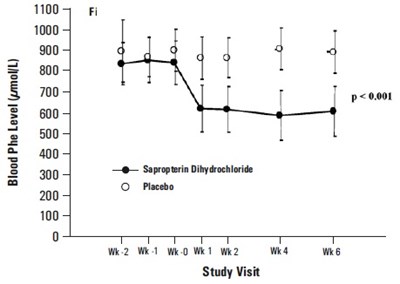
The results showed that at baseline, the mean (±SD) blood Phe level was 843 (±300) μmol/L in the sapropterin dihydrochloride-treated group and 888 (±323) μmol/L in the placebo group. At Week 6, the sapropterin dihydrochloride treated group had a mean (±SD) blood Phe level of 607 (±377) μmol/L, and the placebo group had a mean blood Phe level of 891 (±348) μmol/L. At Week 6, the sapropterin dihydrochloride- and placebo treated groups had mean changes in blood Phe level of –239 and 6 μmol/L, respectively (mean percent changes of –29% (±32) and 3% (±33), respectively). The difference between the groups was statistically significant (p < 0.001) (Table 6).
Table 6: Blood Phe Results in Study 2
|
Sapropterin (N=41) |
Placebo (N=47) |
Baseline Blood Phe Level*
(μ
mol/L) |
Mean (±SD)
|
843 (±300)
|
888 (±323)
|
Percentiles (25
th, 75
th)
|
620, 990
|
618, 1141
|
Week 6 Blood Phe Level (μ
mol/L) |
Mean (±SD)
|
607 (±377)
|
891 (±348)
|
Percentiles (25
th, 75
th)
|
307, 812
|
619, 1143
|
Mean Change in Blood Phe From Baseline to Week 6 (μ
mol/L) |
Adjusted Mean (±SE)
† |
-239 (±38)
|
6 (±36)
|
Percentiles (25
th, 75
th)
|
-397, -92
|
-96, 93
|
Mean Percent Change in Blood Phe From Baseline to Week 6 |
Mean (±SD)
|
-29 (±32)
|
3 (±33)
|
Percentiles (25
th, 75
th)
|
-61, -11
|
-13, 12
|
*The mean baseline levels shown in this table represent the mean of 3 pretreatment levels (Wk -2, Wk -1, and Wk 0). Treatment with sapropterin dihydrochloride or placebo started at Wk 0.
†p-value < 0.001, adjusted mean and standard error from an ANCOVA model with change in blood Phe level from baseline to Week 6 as the response variable, and both treatment group and baseline blood Phe level as covariates.
Change in blood Phe was noted in the sapropterin dihydrochloride-treated group at Week 1 and was sustained through Week 6 (Figure 2).
Figure 2: Mean Blood Phenylalanine (Phe) Level Over Time*
Sapropterindihydrochloridetabletsfigure2 (Sapropterindihydrochloridetabletsfigure2)
*Error bars indicate 95% confidence interval.
Study 3 was a multicenter, open-label, extension study in which 80 patients who responded to sapropterin dihydrochloride treatment in Study 1 and completed Study 2 underwent 6 weeks of forced dose-titration with 3 different doses of sapropterin dihydrochloride. Treatments consisted of 3 consecutive 2-week courses of sapropterin dihydrochloride at doses of 5, then 20, and then 10 mg/kg per day. Blood Phe level was monitored after 2 weeks of treatment at each dose level. At baseline, mean (±SD) blood Phe was 844 (±398) μmol/L. At the end of treatment with 5, 10, and 20 mg/kg per day, mean (±SD) blood Phe levels were 744 (±384) μmol/L, 640 (±382) μmol/L, and 581 (±399) μmol/L, respectively (Table 7).
Table 7: Blood Phe Results From Forced Dose-Titration in Study 3
Sapropterin Dihydrochloride Dose Level (mg/kg per day) |
No. of Patients |
Mean (±
SD)
Blood Phe Level (μ
mol/L) |
Mean Changes (±
SD) in Blood Phe Level From Week 0 (μ
mol/L) |
Baseline
(No Treatment) |
80
|
844 (±398)
|
—
|
5 |
80
|
744 (±384)
|
-100 (±295)
|
10 |
80
|
640 (±382)
|
-204 (±303)
|
20 |
80
|
581 (±399)
|
-263 (±318)
|
Study 4 was a multicenter study of 90 pediatric patients with PKU, ages 4 to 12 years, who were on Phe-restricted diets and who had blood Phe levels ≤480 μmol/L at screening. All patients were treated with open-label sapropterin dihydrochloride 20 mg/kg per day for 8 days. Response to sapropterin dihydrochloride was defined as a ≥30% decrease in blood Phe from baseline at Day 8. At Day 8, 50 patients (56%) had a ≥30% decrease in blood Phe.
Study 5 was an open label, single arm, multicenter trial in 93 pediatric patients with PKU, aged 1 month to 6 years, who had Phe levels greater than or equal to 360 μmol/L at screening. All patients were treated with sapropterin dihydrochloride at 20 mg/kg per day and maintained on a Phe-restricted diet. At Week 4, 57 patients (61%) were identified as responders (defined as ≥ 30% decreased in blood Phe from baseline) (see Figure 1 section 8.4).


