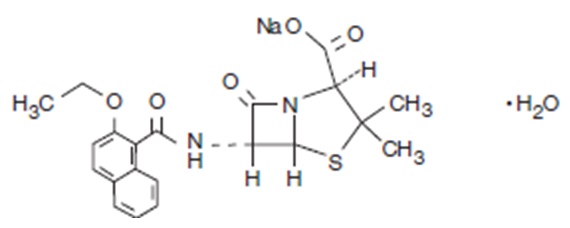
Nafcillin for Injection is available for intramuscular and intravenous use.
The usual IV dosage for adults is 500 mg every 4 hours. For severe infections, 1 gram every 4 hours is recommended. Administer slowly over at least 30 to 60 minutes to minimize the risk of vein irritation and extravasation.
Recommended Dosage for Nafcillin for Injection, USP
| Drug | Adults | Infants and Children <40 kg
(88 lbs) | Other Recommendations |
| Nafcillin | 500 mg IM every 4 to 6 hours.
IV every 4 hours | 25 mg/kg IM twice daily | Neonates 10 mg/kg IM twice daily |
| Nafcillin | 1 gram IM or IV every
4 hours (severe infections) | | |
Bacteriologic studies to determine the causative organisms and their susceptibility to nafcillin should always be performed. Duration of therapy varies with the type and severity of infection as well as the overall condition of the patient; therefore, it should be determined by the clinical and bacteriological response of the patient. In severe staphylococcal infections, therapy with nafcillin should be continued for at least 14 days. The treatment of endocarditis and osteomyelitis may require a longer duration of therapy.
No dosage alterations are necessary for patients with renal dysfunction, including those on hemodialysis. Hemodialysis does not accelerate nafcillin clearance from the blood.
With intravenous administration, particularly in elderly patients, care should be taken because of the possibility of thrombophlebitis.
Parenteral drug products should be inspected visually for particulate matter and discoloration prior to administration whenever solution and container permit.
Do not add supplementary medication to Nafcillin for Injection, USP.
DIRECTIONS FOR USE
For Intramuscular Use
Reconstitute with Sterile Water for Injection, USP, 0.9% Sodium Chloride Injection, USP or Bacteriostatic Water for Injection, USP (with benzyl alcohol or parabens); add 3.4 mL to the 1 gram vial for 4 mL resulting solution and 6.6 mL to the 2 grams vial for 8 mL resulting solution. All reconstituted vials have a concentration of 250 mg per mL.
The clear solution should be administered by deep intragluteal injection immediately after reconstitution.
Reconstituted Stability
Reconstitute with the required amount of Sterile Water for Injection, USP, 0.9% Sodium Chloride Injection, USP or Bacteriostatic Water for Injection, USP (with benzyl alcohol or parabens). The resulting solutions are stable for 3 days at room temperature or 7 days under refrigeration and 90 days frozen.
For Direct Intravenous Use
The required amount of drug should be diluted in 15 to 30 mL of Sterile Water for Injection, USP or Sodium Chloride Injection, USP and injected over a 5- to 10- minute period. This may be accomplished through the tubing of an intra- venous infusion if desirable.
For Administration by Intravenous Drip
Reconstitute as directed above (For Intravenous Use) prior to diluting with intravenous solutions.
STABILITY PERIODS FOR NAFCILLIN FOR INJECTION, USP*
* IMPORTANT: This chemical stability information in no way indicates that it would be acceptable practice to use this product well after the preparation time. Good professional practice suggests that a product should be used as soon after preparation as feasible. |
Concentration
mg/mL | Sterile
Water for
Injection, USP | Sodium
Chloride Injection USP (0.9%) | Sodium
Lactate Solution USP (M/6 Molar) | Dextrose
Injection USP (5%) | Dextrose and Sodium Chloride Injection USP
(5% Dextrose and 0.45%
Sodium Chloride) | Invert
Sugar Injection USP (10%) | Lactated
Ringer’s
Injection USP |
| ROOM TEMPERATURE (25°C) |
10 to 200 | 24 Hrs | 24 Hrs | | | | | |
30 | | | 24 Hrs | | | | |
2 to 30 | | | | 24 Hrs | 24 Hrs | | |
10 to 30 | | | | | | 24 Hrs | 24 Hrs |
| REFRIGERATION (4°C) |
10 to 200 | 7 Days | 7 Days | | | | | |
10 to 30 | | | 7 Days | 7 Days | 7 Days | 7 Days | 7 Days |
| FROZEN (-15°C) |
250 | 90 Days | 90 Days | | | | | |
10 to 250 | | | 90 Days | 90 Days | 90 Days | 90 Days | 90 Days |
Only those solutions listed above should be used for the intra- venous infusion of Nafcillin for Injection, USP. The concentrations of the antibiotic should fall within the range specified. The drug concentration and the rate and volume of the infusion should be adjusted so that the total dose of nafcillin is administered before the drug loses its stability in the solution in use.
There is no clinical experience available on the use of this agent in neonates or infants for this route of administration.
This route of administration should be used for relatively short- term therapy (24 to 48 hours) because of the occasional occurrence of thrombophlebitis particularly in elderly patients.
If another agent is used in conjunction with nafcillin therapy, it should not be physically mixed with nafcillin but should be administered separately.