Dofetilide
Product Images NDC 72664-231

View Photos of Packaging, Regulatory Labels, and Product Appearance

Product Visual Gallery

This gallery contains 10 technical images submitted to the FDA as part of the official labeling for Dofetilide (NDC 72664-231). Unlike standard consumer photos, these assets often include clinical data figures, molecular chemical structures, and official manufacturer packaging layouts.

As provided by Vgyaan Pharmaceuticals Llc, these visuals offer a comprehensive scientific overview of the product's physical and chemical identity, aiding pharmacists and researchers in product verification and study.

FDA Label Image

Chemicalstructure (Chemicalstructure)

FDA Label Image

Container-label125mcg (Container Label125mcg)

Container-label125mcg (Container Label125mcg)
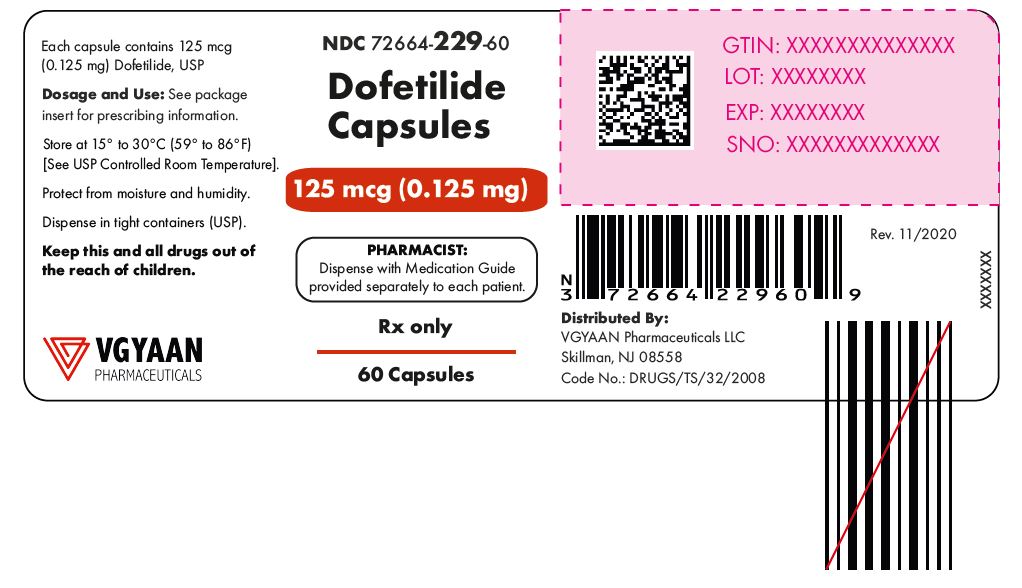
Each capsule contains 125mg of Dofetilide, USP. It is advised to store the capsules between 15°C to 30°C (59°F to 86°F) to protect them from moisture and humidity. The medication should be dispensed in tight containers, and the medication guide should be provided separately for every patient. This drug should be kept out of reach of children. The prescription of the drug is provided by VGYAAN Pharmaceuticals LLC in Skillman, NJ.*
FDA Label Image

Container-label250mcg (Container Label250mcg)

FDA Label Image

Container-label500mcg (Container Label500mcg)

Container-label500mcg (Container Label500mcg)
The text is a medicine label for Dofetilide capsules. Each capsule contains 500 meg (0.5mg) of Dofetilide, USP. It is important to keep this drug out of the reach of children and to store it at controlled room temperature (15° to 30°C or 59° to 86°F). The drug should be protected from moisture and should be dispensed in light containers. The package insert contains information about dosage and usage instructions. This medication is only available with a prescription, and the pharmacist should provide each patient with a medication guide. The manufacturer is VGYAAN Pharmaceuticals LLC. The rest of the information contains lot number, expiration date and other codes.*
FDA Label Image

Figure1 (Figure1)

Figure1 (Figure1)
The text shows a graph of the mean change in QTc from baseline to Day 23 while taking Dofetilide. The graph shows the mean plasma concentration of Dofetilide (in ng/mL) on the X-axis and the change in QTc (in msec) on the Y-axis. The data represents a steady state of Dofetilide after 23 days of treatment.*
FDA Label Image

Figure2 (Figure2)

Figure2 (Figure2)
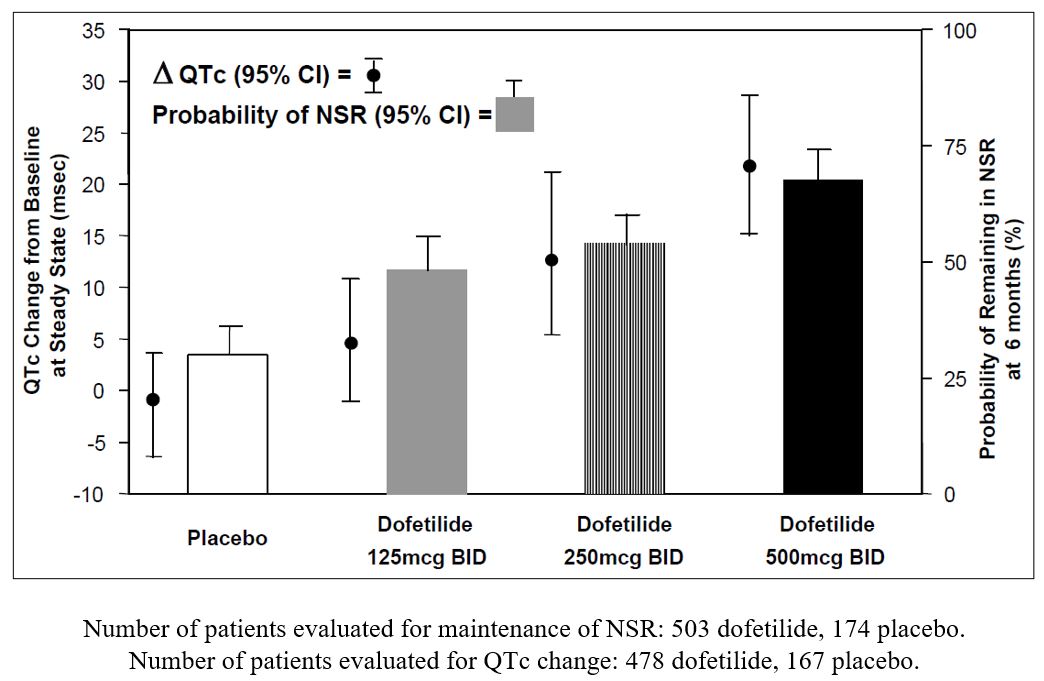
This is a chart showing the QTc change from baseline at steady state (in milliseconds) for patients taking different doses of Dofetilide and Placebo. The chart also provides information about the probability of maintaining normal sinus rhythm and the number of patients evaluated for QTc change and maintenance of normal sinus rhythm.*
FDA Label Image

Figure3 (Figure3)

Figure3 (Figure3)
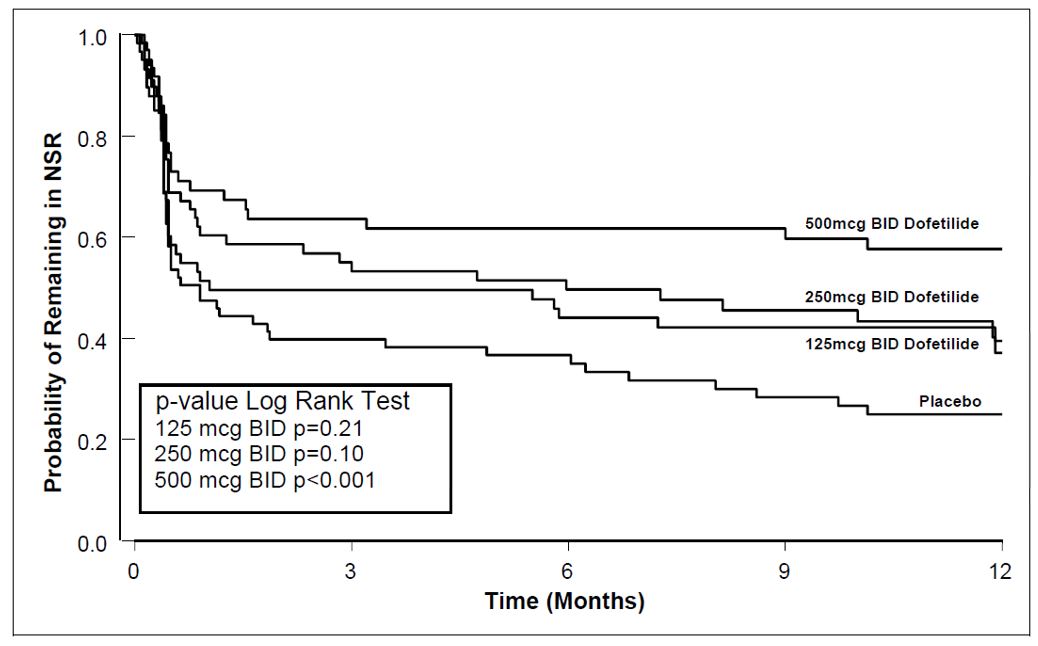
This is a graph representing the probability of remaining in normal sinus rhythm (NSR) over time. The x-axis represents time in months, and the y-axis represents the probability of remaining in NSR. The graph shows four different treatment options: 500mcg BID Dofetilide, 4 250mcg BID Dofetilide, 125mcg BID Dofetilide, and Placebo. The log rank test was used to calculate the p-value for each treatment option after 3, 6, 9, and 12 months. The results show that higher dosages of Dofetilide lead to a significantly higher probability of remaining in NSR compared to the placebo. The graph also indicates that the probability of remaining in NSR decreases over time for all treatment options.*
FDA Label Image

Figure4 (Figure4)

Figure4 (Figure4)
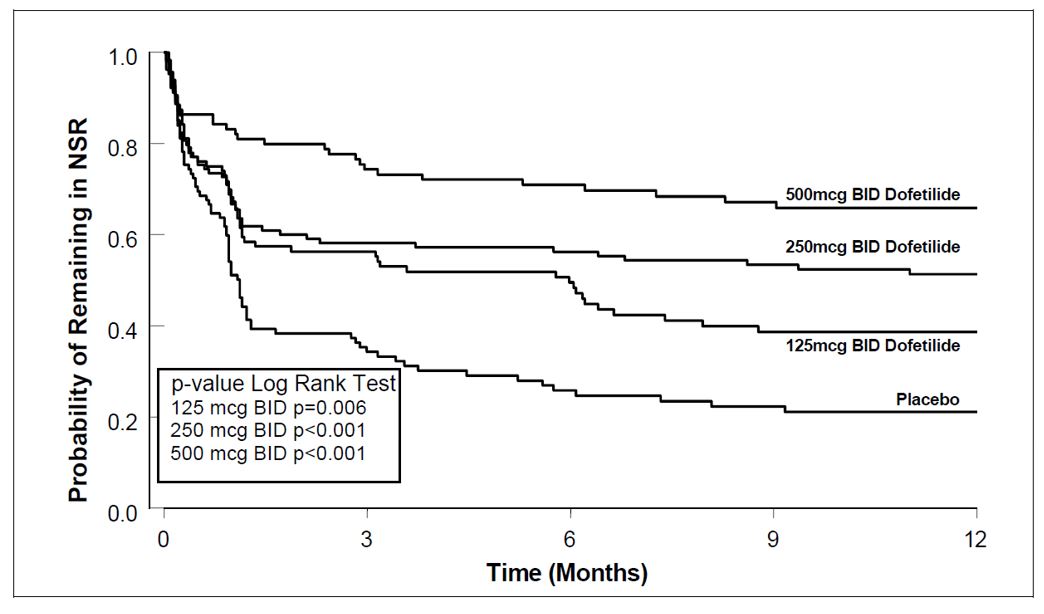
The text describes a probability chart and log-rank test results for different doses of a medication called Dofetilide, as well as a placebo. The chart shows the probability of remaining in normal sinus rhythm (NSR) over time (measured in months). The log rank test results indicate statistical significance (low p-values) for 250mcg and 500mcg BID doses of Dofetilide compared to placebo, while the 125mcg BID dose did not reach significance.*
FDA Label Image

Figure5 (Figure5)

Figure5 (Figure5)
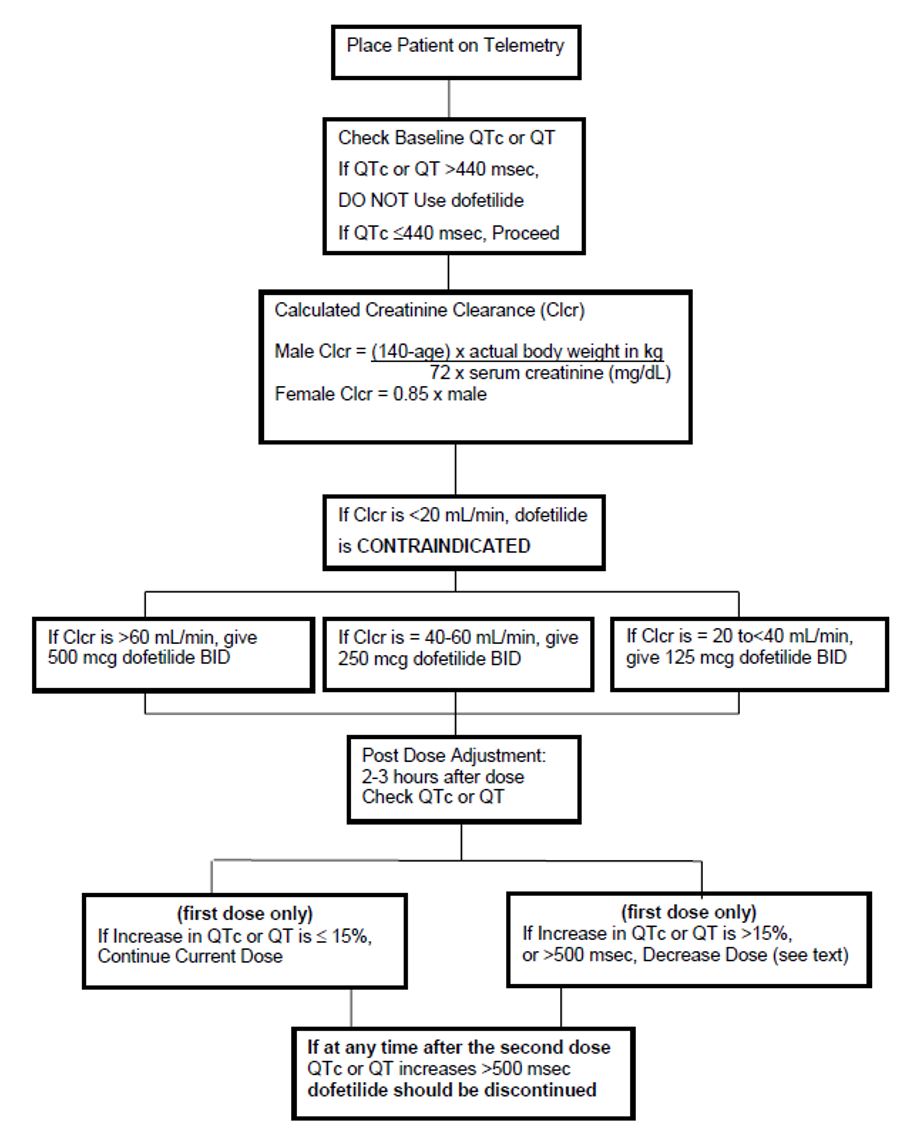
This is a set of instructions for healthcare professionals on how to administer dofetilide, a medication to treat irregular heartbeats. It includes guidance on checking a patient's baseline QTc or QT before administering the drug, and not using it if the QTc or QT is greater than 440 msec. It also gives instructions for calculating the patient's creatinine clearance, and which doses of the drug to administer based on the Clcr. There are also instructions for checking QTc or QT 2-3 hours after the first dose and adjusting it accordingly. If at any time after the second dose QTc or QT increases more than 500 msec, dofetilide should be discontinued.*
FDA Label Image

Figure6 (Figure6)

Figure6 (Figure6)
This text provides a formula to calculate the creatinine clearance for males and females based on their age, actual body weight, and serum creatinine level. The formula is different for females, as it involves multiplying the result by 0.85. This information can be useful for healthcare providers in monitoring kidney function in patients.*

* These product label images have been analyzed using experimental machine learning. Please verify findings with the primary label text.