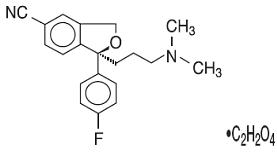
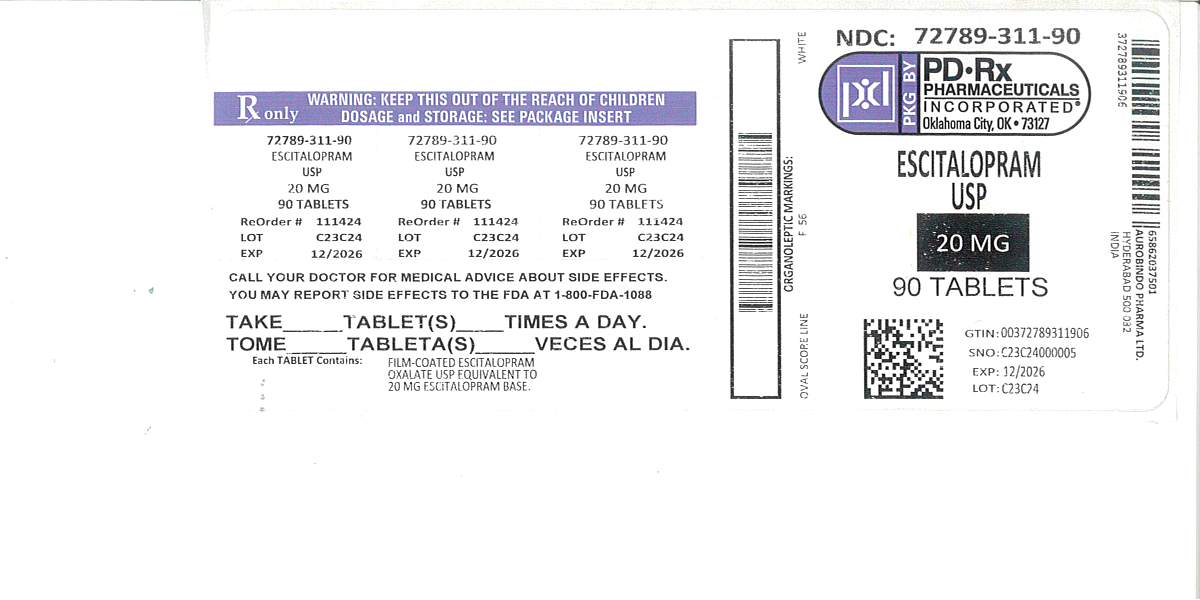
Advise the patient to read the FDA-approved patient labeling (
Medication Guide).
Suicidal Thoughts and Behaviors
Advise patients, their families and caregivers to look for the emergence of suicidal ideation and behavior, especially during treatment and when the dose is adjusted up or down, and instruct them to report such symptoms to their healthcare provider
[see
Boxed Warning and
Warnings and Precautions (5.1)].
Serotonin Syndrome
Patients should be cautioned about the risk of serotonin syndrome with the concomitant use of escitalopram oxalate with other serotonergic drugs including triptans, tricyclic antidepressants, fentanyl, lithium, tramadol, tryptophan, buspirone, amphetamines and St. John’s Wort, and with drugs that impair metabolism of serotonin (in particular, MAOIs, both those intended to treat psychiatric disorders and also others, such as linezolid)
[see
Warnings and Precautions (5.2)].
Activation of Mania or Hypomania
Advise patients and their caregivers to observe for signs of activation of mania/hypomania and instruct them to report such symptoms to the healthcare provider
[see
Warnings and Precautions (5.5)]
.
Abnormal Bleeding
Patients should be cautioned about the concomitant use of escitalopram oxalate and NSAIDs, aspirin, warfarin, or other drugs that affect coagulation since combined use of psychotropic drugs that interfere with serotonin reuptake and these agents has been associated with an increased risk of bleeding
[see
Warnings and Precautions (5.7)].
Angle Closure Glaucoma
Patients should be advised that taking escitalopram oxalate can cause mild pupillary dilation, which in susceptible individuals, can lead to an episode of angle closure glaucoma. Pre-existing glaucoma is almost always open-angle glaucoma because angle closure glaucoma, when diagnosed, can be treated definitively with iridectomy. Open-angle glaucoma is not a risk factor for angle closure glaucoma. Patients may wish to be examined to determine whether they are susceptible to angle closure, and have a prophylactic procedure (e.g., iridectomy), if they are susceptible
[see
Warnings and Precautions (5.9)]
.
Sexual Dysfunction
Advise patients that use of escitalopram oxalate may cause symptoms of sexual dysfunction in both male and female patients. Inform patients that they should discuss any changes in sexual function and potential management strategies with their healthcare provider [
see
Warnings and Precautions (5.11)].
Concomitant Medications
Since escitalopram is the active isomer of racemic citalopram (Celexa), the two agents should not be coadministered. Patients should be advised to inform their physician if they are taking, or plan to take, any prescription or over-the-counter drugs, as there is a potential for interactions.
Continuing the Therapy Prescribed
While patients may notice improvement with escitalopram oxalate therapy in 1 to 4 weeks, they should be advised to continue therapy as directed.
Interference with Psychomotor Performance
Because psychoactive drugs may impair judgment, thinking, or motor skills, patients should be cautioned about operating hazardous machinery, including automobiles, until they are reasonably certain that escitalopram oxalate therapy does not affect their ability to engage in such activities.
Alcohol
Patients should be told that, although escitalopram oxalate has not been shown in experiments with normal subjects to increase the mental and motor skill impairments caused by alcohol, the concomitant use of escitalopram oxalate and alcohol in depressed patients is not advised.
Pregnancy
Advise pregnant women to notify their healthcare providers if they become pregnant or intend to become pregnant during treatment with escitalopram oxalate.
Advise patients that escitalopram oxalate use later in pregnancy may lead to increased risk for neonatal complications requiring prolonged hospitalization, respiratory support, tube feeding, and/or persistent pulmonary hypertension (PPHN) of the newborn
[see
Use in Specific Populations (8.1)]
.
Advise women that there is a pregnancy exposure registry that monitors pregnancy outcomes in women exposed to escitalopram oxalate during pregnancy
[see
Use in Specific Populations (8.1)].
Lactation
Advise breastfeeding women using escitalopram oxalate to monitor infants for excess sedation, restlessness, agitation, poor feeding and poor weight gain and to seek medical care if they notice these signs
[see
Use in Specific Populations (8.2)]
.
Need for Comprehensive Treatment Program
Escitalopram oxalate is indicated as an integral part of a total treatment program for MDD that may include other measures (psychological, educational, social) for patients with this syndrome. Drug treatment may not be indicated for all adolescents with this syndrome. Safety and effectiveness of escitalopram oxalate in MDD has not been established in pediatric patients less than 12 years of age. Antidepressants are not intended for use in the adolescent who exhibits symptoms secondary to environmental factors and/or other primary psychiatric disorders. Appropriate educational placement is essential and psychosocial intervention is often helpful. When remedial measures alone are insufficient, the decision to prescribe antidepressant medication will depend upon the physician’s assessment of the chronicity and severity of the patient’s symptoms.
Distributed by:
Aurobindo Pharma USA, Inc.
279 Princeton-Hightstown Road
East Windsor, NJ 08520
Manufactured by:
Aurobindo Pharma Limited
Hyderabad-500 032, India
Revised: 10/2021
Dispense with Medication Guide available at:
www.aurobindousa.com/medication-guides