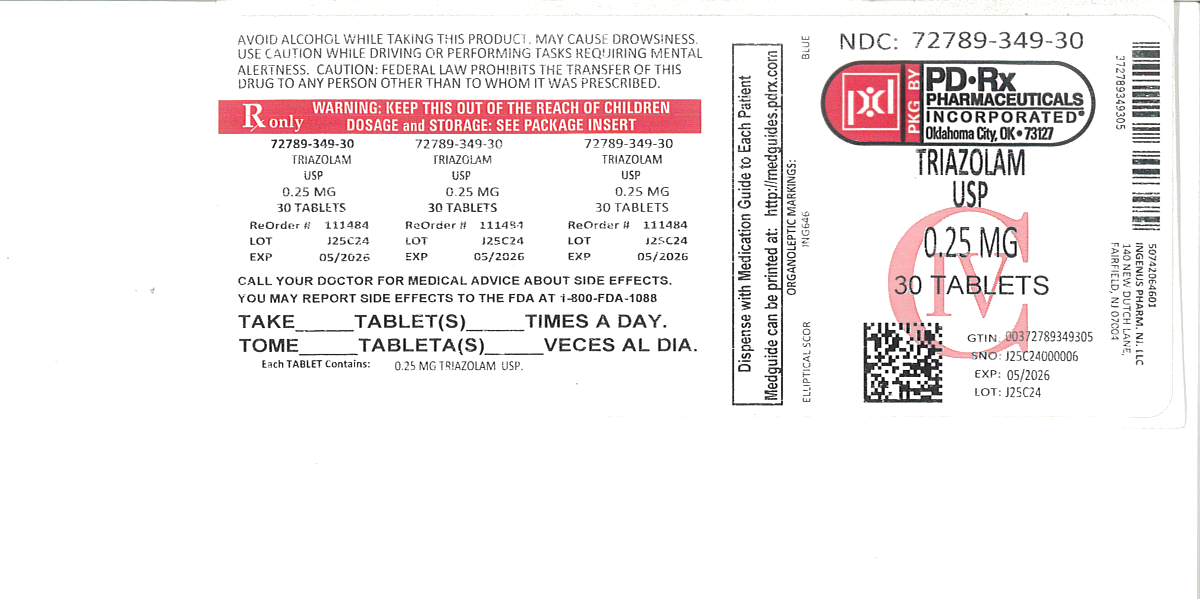
Advise the patient to read the FDA-approved patient labeling (Medication Guide).
Risks from Concomitant Use with Opioids
Advise both patients and caregivers about the risks of potentially fatal respiratory depression and sedation when triazolam is used with opioids and not to use such drugs concomitantly unless supervised by a healthcare provider. Advise patients not to drive or operate heavy machinery until the effects of concomitant use with the opioid have been determined
[see Warnings and Precautions (
5.1), Drug Interactions (
7.1)
].
Abuse, Misuse, and Addiction
Inform patients that the use of triazolam, even at recommended dosages, exposes users to risks of abuse, misuse, and addiction, which can lead to overdose and death, especially when used in combination with other medications (e.g., opioid analgesics), alcohol, and/or illicit substances. Inform patients about the signs and symptoms of benzodiazepine abuse, misuse, and addiction; to seek medical help if they develop these signs and/or symptoms; and on the proper disposal of unused drug
[see Warnings and Precautions (
5.2), Drug Abuse and Dependence (
9.2)]
.
Withdrawal Reactions
Inform patients that the continued use of triazolam may lead to clinically significant physical dependence and that abrupt discontinuation or rapid dosage reduction of triazolam may precipitate acute withdrawal reactions, which can be life-threatening. Inform patients that in some cases, patients taking benzodiazepines have developed a protracted withdrawal syndrome with withdrawal symptoms lasting weeks to more than 12 months. Instruct patients that discontinuation or dosage reduction of triazolam may require a slow taper
[see Warnings and Precautions (
5.3), Drug Abuse and Dependence (
9.3)]
.
“Sleep-driving” and Other Complex Behaviors
There have been reports of people getting out of bed after taking a sedative-hypnotic and driving their cars while not fully awake, often with no memory of the event. Advise patients to report similar experiences to their healthcare provider immediately, since “sleep-driving” can be dangerous. This behavior is more likely to occur when sedative-hypnotics are taken with alcohol or other CNS depressants
[see Warnings and Precautions (
5.5)
]. Other complex behaviors (e.g., preparing and eating food, making phone calls, or having sex) have been reported in patients who are not fully awake after taking a sedative hypnotic. As with sleep-driving, patients usually do not remember these events.
Advise patients that increased drowsiness and decreased consciousness may increase the risk of falls in some patients.
Effects on Driving and Operating Heavy Machinery
Caution patients against driving a motor vehicle or operating heavy machinery until the effects of taking triazolam are determined due to its CNS depressant effects. Also advise patients to avoid the use of alcohol or other CNS depressants while taking triazolam
[see Warnings and Precautions (
5.7)
].
Patients with Depression
Advise patients, their families and caregivers to look out for any signs of suicidality or worsening depression, and to inform the patient’s prescriber or healthcare provider immediately
[see Warnings and Precautions (5.9)].
Concomitant Medications
Advise patients to inform their healthcare provider of all medicines they take, including prescription and nonprescription medicines, vitamins and herbal supplements
[see Drug Interactions (
7.1)
].
Grapefruit Juice
Advise patients to avoid eating grapefruit or drinking grapefruit juice while taking triazolam
[see Drug Interactions (
7.1)
].
Pregnancy
Advise pregnant females that use of triazolam late in pregnancy can result in sedation (respiratory depression, lethargy, hypotonia) and/or withdrawal symptoms (hyperreflexia, irritability, restlessness, tremors, inconsolable crying, and feeding difficulties) in newborns
[see Warnings and Precautions (
5.10), Use in Specific Populations (
8.1)]
. Instruct patients to inform their healthcare provider if they are pregnant.
Advise patients that there is a pregnancy exposure registry that monitors pregnancy outcomes in women exposed to triazolam during pregnancy
[see Use in Specific Populations (
8.1)]
.
Lactation
Instruct patients to notify their healthcare provider if they are breastfeeding or intend to breastfeed. Instruct breastfeeding patients using triazolam to monitor infants for excessive sedation, poor feeding and poor weight gain, and to seek medical attention if they notice these signs. A lactating woman may consider pumping and discarding breastmilk during treatment and for 28 hours after triazolam administration to minimize drug exposure to a breastfed infant
[see Use in Specific Populations (
8.2)
].
Manufactured for:
Ingenus Pharmaceuticals, LLC
Orlando, FL 32811
554405 Rev. 01/2023
Dispense with Medication Guide available at: www.ingenus.com/medguide/triazolam-tablets.pdf
ingenus