Two 12-week, randomized, double-blind, placebo-controlled, multicenter studies were conducted with 8 mg daily of silodosin. In these two studies, 923 patients [mean age 64.6 years; Caucasian (89.3%), Hispanic (4.9%), Black (3.9%), Asian (1.2%), Other (0.8%)] were randomized and 466 patients received silodosin 8 mg daily. The two studies were identical in design except for the inclusion of pharmacokinetic sampling in Study 1. The primary efficacy assessment was the International Prostate Symptom Score (IPSS) which evaluated irritative (frequency, urgency, and nocturia), and obstructive (hesitancy, incomplete emptying, intermittency, and weak stream) symptoms. Maximum urine flow rate (Q
max) was a secondary efficacy measure.
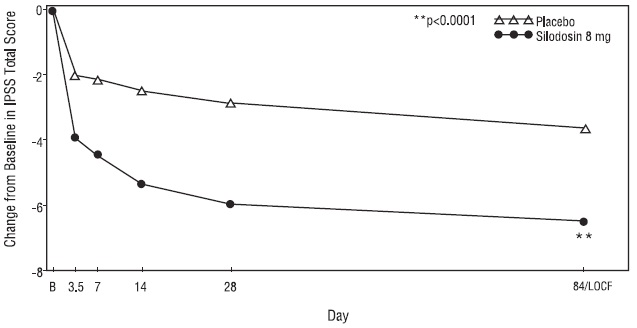
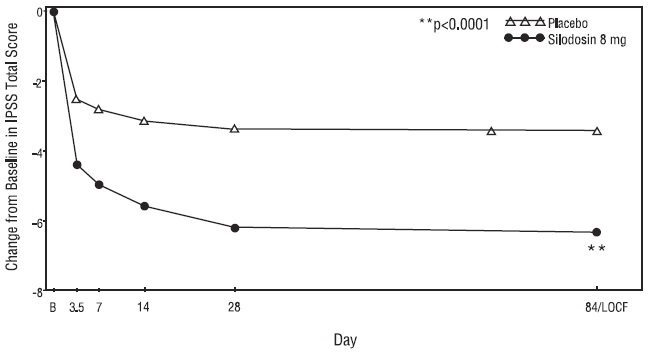
Mean changes from baseline to last assessment (Week 12) in total IPSS score were statistically significantly greater for groups treated with silodosin than those treated with placebo in both studies (Table 4 and Figures 2 and 3).
Table 4 Mean Change (SD) from Baseline to Week 12 in International Prostate Symptom Score in Two Randomized, Controlled, Double-Blind Studies | LOCF – Last observation carried forward for those not completing 12 weeks of treatment. |
Total Symptom Score
| Study 1
| Study 2
|
Silodosin
8 mg
(n = 233)
| Placebo
(n = 228)
| p-value
| Silodosin
8 mg
(n = 233)
| Placebo
(n = 229)
| p-value
|
Baseline
| 21.5 (5.38)
| 21.4 (4.91)
|
| 21.2 (4.88)
| 21.2 (4.92)
|
|
Week 12 / LOCF Change from Baseline
| -6.5 (6.73)
| -3.6 (5.85)
| < 0.0001
| -6.3 (6.54)
| -3.4 (5.83)
| < 0.0001
|
Figure 2 Mean Change from Baseline in IPSS Total Score by Treatment Group and Visit in Study 1

Figure 2 Mean Change From Baseline In Ipss Total Score By Treatment Group And Visit In Study 1 (Silodosin Fig2)
B – Baseline determination taken Day 1 of the study before the initial dose. Subsequent values are observed cases except for LOCF values.
LOCF – Last observation carried forward for those not completing 12 weeks of treatment.
Figure 3 Mean Change from Baseline in IPSS Total Score by Treatment Group and Visit in Study 2
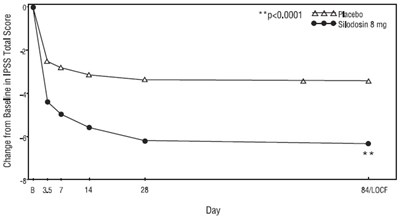
Figure 3 Mean Change From Baseline In Ipss Total Score By Treatment Group And Visit In Study 2 (Silodosin Fig3)
B – Baseline determination taken Day 1 of the study before the initial dose. Subsequent values are observed cases except for LOCF values.
LOCF – Last observation carried forward for those not completing 12 weeks of treatment.
Mean IPSS total score for silodosin once daily groups showed a decrease starting at the first scheduled observation and remained decreased through the 12 weeks of treatment in both studies.
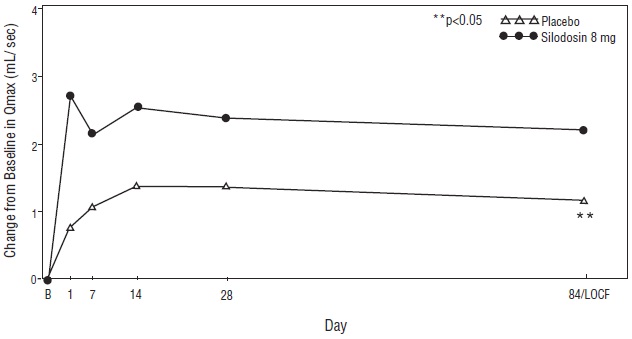
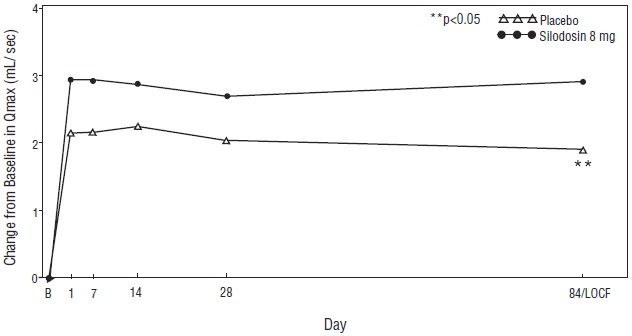
Silodosin produced statistically significant increases in maximum urinary flow rates from baseline to last assessment (Week 12) versus placebo in both studies (Table 5 and Figures 4 and 5). Mean peak flow rate increased starting at the first scheduled observation at Day 1 and remained greater than the baseline flow rate through the 12 weeks of treatment for both studies.
Table 5 Mean Change (SD) from Baseline in Maximum Urinary Flow Rate (mL/sec) in Two Randomized, Controlled, Double-Blind Studies | LOCF – Last observation carried forward for those not completing 12 weeks of treatment. |
Mean Maximum Flow Rate (mL/sec)
| Study 1
| Study 2
|
Silodosin
8 mg
(n = 233)
| Placebo
(n = 228)
| p-value
| Silodosin
8 mg
(n = 233)
| Placebo
(n = 229)
| p-value
|
Baseline
| 9.0 (2.60)
| 9.0 (2.85)
|
| 8.4 (2.48)
| 8.7 (2.67)
|
|
Week 12 / LOCF Change from Baseline
| 2.2 (4.31)
| 1.2 (3.81)
| 0.0060
| 2.9 (4.53)
| 1.9 (4.82)
| 0.0431
|
Figure 4 Mean Change from Baseline in Q
max(mL/sec) by Treatment Group and Visit in Study 1
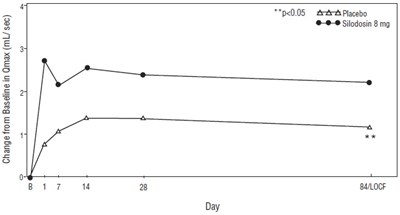
Figure 4 Mean Change From Baseline In Qmax (ml/sec) By Treatment Group And Visit In Study 1 (Silodosin Fig4)
B – Baseline determination taken Day 1 of the study before the initial dose. Subsequent values are observed cases except for LOCF values.
LOCF – Last observation carried forward for those not completing 12 weeks of treatment.
Note – The first Q
maxassessments at Day 1 were taken 2 to 6 hours after patients received the first dose of double-blind medication.
Note – Measurements at each visit were scheduled 2 to 6 hours after dosing (approximate peak plasma silodosin concentration).
Figure 5 Mean Change from Baseline in Q
max(mL/sec) by Treatment Group and Visit in Study 2
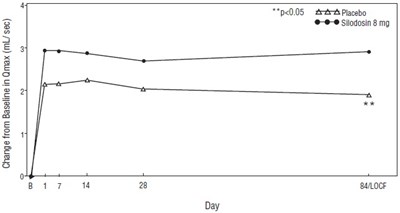
Figure 5 Mean Change From Baseline In Qmax (ml/sec) By Treatment Group And Visit In Study 2 (Silodosin Fig5)
B – Baseline determination taken Day 1 of the study before the initial dose. Subsequent values are observed cases except for LOCF values.
LOCF – Last observation carried forward for those not completing 12 weeks of treatment.
Note – The first Q
maxassessments at Day 1 were taken 2 to 6 hours after patients received the first dose of double-blind medication.
Note – Measurements at each visit were scheduled 2 to 6 hours after dosing (approximate peak plasma silodosin concentration).