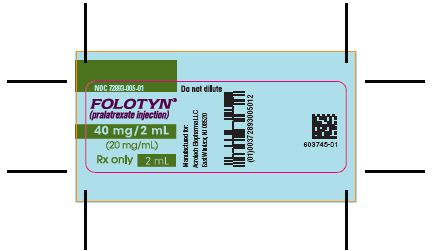
FOLOTYN is a clear, yellow solution. Parenteral drug products should be inspected visually for particulate matter and discoloration prior to administration, whenever solution and container permit. Do not use any vials exhibiting particulate matter or discoloration.
Monitor complete blood cell counts and severity of mucositis at baseline and weekly. Perform serum chemistry tests, including renal and hepatic function, prior to the start of the first and fourth dose of each cycle.
- Mucositis should be ≤ Grade 1.
- Platelet count should be ≥ 100,000/mcL for first dose and ≥ 50,000/mcL for all subsequent doses.
- Absolute neutrophil count (ANC) should be ≥ 1,000/mcL.
Doses may be omitted or reduced based on patient tolerance. Omitted doses will not be made up at the end of the cycle; once a dose reduction occurs for toxicity, do not re-escalate. For dose modifications and omissions, use the guidelines in Tables 1, 2, and 3.
For patients with severe renal impairment (eGFR 15 to < 30 mL/min/1.73 m2), the recommended starting dose of FOLOTYN is 15 mg/m2 with dose modification to 10 mg/m2 for the toxicities specified in Tables 1, 2, and 3.
Table 1 FOLOTYN Dose Modifications for Mucositis
| Mucositis Gradea on Day of Treatment | Action
| Dose upon Recovery to ≤ Grade 1
| Dose Upon Recovery in Patients with Severe Renal Impairment
|
| Grade 2 | Omit dose
| Continue prior dose
| Continue prior dose
|
| Grade 2 recurrence | Omit dose
| 20 mg/m2
| 10 mg/m2
|
| Grade 3 | Omit dose
| 20 mg/m2
| 10 mg/m2
|
| Grade 4 | Stop therapy
| | |
a Per National Cancer Institute-Common Terminology Criteria for Adverse Events (NCI CTCAE, Version 3.0)
Table 2 FOLOTYN Dose Modifications for Hematologic Toxicities
| Blood Count on Day of Treatment | Duration of Toxicity
| Action
| Dose upon Restart
| Dose Upon Recovery in Patients with Severe Renal Impairment
|
| Platelet < 50,000/mcL | 1 week
| Omit dose
| Continue prior dose
| Continue prior dose
|
2 weeks
| Omit dose
| 20 mg/m2
| 10 mg/m2
|
3 weeks
| Stop therapy
| | |
| ANC 500-1,000/mcL and no fever | 1 week
| Omit dose
| Continue prior dose
| Continue prior dose
|
| ANC 500-1,000/mcL with fever or ANC < 500/mcL | 1 week
| Omit dose, give G‑CSF or GM‑CSF support
| Continue prior dose with G-CSF or GM‑CSF support
| Continue prior dose with G-CSF or GM‑CSF support
|
2 weeks or recurrence
| Omit dose, give G‑CSF or GM‑CSF support
| 20 mg/m2 with G-CSF or GM-CSF support
| 10 mg/m2 with G-CSF or GM-CSF support
|
3 weeks or 2nd recurrence
| Stop therapy
| | |
G-CSF=granulocyte colony-stimulating factor; GM-CSF=granulocyte macrophage colony-stimulating factor
Table 3 FOLOTYN Dose Modifications for All Other Treatment-related Toxicities
| Toxicity Grade a on Day of Treatment | Action
| Dose upon Recovery to ≤ Grade 2
| Dose Upon Recovery in Patients with Severe Renal Impairment
|
| Grade 3 | Omit dose
| 20 mg/m2
| 10 mg/m2
|
| Grade 4 | Stop therapy
| | |
a Per National Cancer Institute-Common Terminology Criteria for Adverse Events (NCI CTCAE, Version 3.0)
Most Frequent Adverse Reactions
Table 4 summarizes the most frequent adverse reactions, regardless of causality, using the National Cancer Institute-Common Terminology Criteria for Adverse Events (NCI CTCAE, version 3.0).
Table 4 Adverse Reactions Occurring in PTCL Patients (Incidence ≥ 10% of patients)
| N=111
|
Total
| Grade 3
| Grade 4
|
Preferred Term
| N
| %
| N
| %
| N
| %
|
Any Adverse Event
| 111
| 100
| 48
| 43
| 34
| 31
|
Mucositisa
| 78
| 70
| 19
| 17
| 4
| 4
|
Thrombocytopeniab
| 45
| 41
| 15
| 14
| 21
| 19b
|
Nausea
| 44
| 40
| 4
| 4
| 0
| 0
|
Fatigue
| 40
| 36
| 5
| 5
| 2
| 2
|
Anemia
| 38
| 34
| 17
| 15
| 2
| 2
|
Constipation
| 37
| 33
| 0
| 0
| 0
| 0
|
Pyrexia
| 36
| 32
| 1
| 1
| 1
| 1
|
Edema
| 33
| 30
| 1
| 1
| 0
| 0
|
Cough
| 31
| 28
| 1
| 1
| 0
| 0
|
Epistaxis
| 29
| 26
| 0
| 0
| 0
| 0
|
Vomiting
| 28
| 25
| 2
| 2
| 0
| 0
|
Neutropenia
| 27
| 24
| 14
| 13
| 8
| 7
|
Diarrhea
| 23
| 21
| 2
| 2
| 0
| 0
|
Dyspnea
| 21
| 19
| 8
| 7
| 0
| 0
|
Anorexia
| 17
| 15
| 3
| 3
| 0
| 0
|
Hypokalemia
| 17
| 15
| 4
| 4
| 1
| 1
|
Rash
| 17
| 15
| 0
| 0
| 0
| 0
|
Pruritus
| 16
| 14
| 2
| 2
| 0
| 0
|
Pharyngolaryngeal pain
| 15
| 14
| 1
| 1
| 0
| 0
|
Liver function test abnormalc
| 14
| 13
| 6
| 5
| 0
| 0
|
Abdominal pain
| 13
| 12
| 4
| 4
| 0
| 0
|
Pain in extremity
| 13
| 12
| 0
| 0
| 0
| 0
|
Back pain
| 12
| 11
| 3
| 3
| 0
| 0
|
Leukopenia
| 12
| 11
| 3
| 3
| 4
| 4
|
Night sweats
| 12
| 11
| 0
| 0
| 0
| 0
|
Asthenia
| 11
| 10
| 1
| 1
| 0
| 0
|
Tachycardia
| 11
| 10
| 0
| 0
| 0
| 0
|
Upper respiratory tract infection
| 11
| 10
| 1
| 1
| 0
| 0
|
aStomatitis or mucosal inflammation of the gastrointestinal and genitourinary tracts.
bFive patients with platelets < 10,000/mcL
cAlanine aminotransferase, aspartate aminotransferase, and transaminases increased
Serious Adverse Events
Forty-four percent of patients (n = 49) experienced a serious adverse event while on study or within 30 days after their last dose of FOLOTYN. The most common serious adverse events (> 3%), regardless of causality, were pyrexia, mucositis, sepsis, febrile neutropenia, dehydration, dyspnea, and thrombocytopenia. One death from cardiopulmonary arrest in a patient with mucositis and febrile neutropenia was reported in this trial. Deaths from mucositis, febrile neutropenia, sepsis, and pancytopenia occurred in 1.2% of patients treated on all FOLOTYN trials at doses ranging from 30 to 325 mg/m2.
Discontinuations
Twenty-three percent of patients (n = 25) discontinued treatment with FOLOTYN due to adverse reactions. The adverse reactions reported most frequently as the reason for discontinuation of treatment were mucositis (6%, n = 7) and thrombocytopenia (5%, n = 5).
Dose Modifications
The target dose of FOLOTYN was 30 mg/m2 once weekly for 6 weeks in 7-week cycles. The majority of patients (69%, n = 77) remained at the target dose for the duration of treatment. Overall, 85% of scheduled doses were administered.
Dermatologic Reactions
Toxic epidermal necrolysis, sometimes fatal, has been reported during post-marketing use of FOLOTYN. Fatal cases have been reported following the first dose of FOLOTYN, including when a reduced dose is given, and have been reported in patients with end-stage renal disease undergoing dialysis [see Warnings and Precautions (5.3), Use in Specific Populations (8.7), and Clinical Pharmacology (12.3)].
Embryo-Fetal Toxicity
FOLOTYN can cause fetal harm when administered to a pregnant woman. Pralatrexate was embryotoxic and fetotoxic in rats at IV doses of 0.06 mg/kg/day (0.36 mg/m2/day or about 1.2% of the clinical dose on a mg/m2 basis) given on gestation days 7 through 20. Treatment with pralatrexate caused a dose-dependent decrease in fetal viability manifested as an increase in late, early, and total resorptions. There was also a dose-dependent increase in post-implantation loss. In rabbits, IV doses of 0.03 mg/kg/day (0.36 mg/m2/day) or greater given on gestation days 8 through 21 also caused abortion and fetal lethality. This toxicity manifested as early and total resorptions, post-implantation loss, and a decrease in the total number of live fetuses. If this drug is used during pregnancy, or if the patient becomes pregnant while taking this drug, the patient should be apprised of the potential hazard to the fetus.
Absorption
The pharmacokinetics of pralatrexate administered as a single agent at a dose of 30 mg/m2 administered as an intravenous push over 3-5 minutes once weekly for 6 weeks in 7-week cycles have been evaluated in 10 patients with PTCL. The total systemic clearance of pralatrexate diastereomers was 417 mL/min (S-diastereomer) and 191 mL/min (R-diastereomer). The terminal elimination half-life of pralatrexate was 12-18 hours (coefficient of variance [CV] = 62-120%). Pralatrexate total systemic exposure (AUC) and maximum plasma concentration (Cmax) increased proportionally with dose (dose range 30-325 mg/m2, including pharmacokinetics data from high-dose solid tumor clinical studies). The pharmacokinetics of pralatrexate did not change significantly over multiple treatment cycles, and no accumulation of pralatrexate was observed.
Distribution
Pralatrexate diastereomers showed a steady-state volume of distribution of 105 L (S-diastereomer) and 37 L (R-diastereomer). In vitro studies indicate that pralatrexate is approximately 67% bound to plasma proteins.
Elimination
Metabolism
In vitro studies using human hepatocytes, liver microsomes and S9 fractions, and recombinant human CYP450 isozymes showed that pralatrexate is not significantly metabolized by the phase I hepatic CYP450 isozymes or phase II hepatic glucuronidases.
Excretion
The mean fraction of unchanged pralatrexate diastereomers excreted in urine following a pralatrexate dose of 30 mg/m2 administered as an intravenous push over 3‑5 minutes was 31% (S‑diastereomer) (CV = 47%) and 38% (R-diastereomer) (CV = 45%), respectively. In a mass balance study conducted in patients with advanced cancer, an average of 39% (CV = 28%) of the administered radiolabeled pralatrexate dose was excreted in urine as parent, racemic pralatrexate (fe). An average of 34% (CV = 88%) of the administered dose was recovered in feces as total radiation (feTR) which included both parent pralatrexate and/or any metabolites. An average of 10% (CV = 95%) of total dose was exhaled as total radioactivity over 24 hours.
Pharmacokinetics in Specific Populations
Renal Impairment
In patients with cancer without renal impairment, approximately 34% of pralatrexate was excreted unchanged into urine following a single dose of 30 mg/m2 administered as an intravenous push over 3-5 minutes. The pharmacokinetics of FOLOTYN was studied in patients with varying degrees of renal impairment. In patients with severe renal impairment (eGFR 15 to <30 mL/min/1.73 m2), the FOLOTYN dose was 15 mg/m2. Patients with normal renal clearance, mild renal impairment, and moderate renal impairment were all dosed with 30 mg/m2. Mean exposures of the pralatrexate S-diastereomer and R-diastereomer were comparable across cohorts. The mean fraction of the administered dose excreted as unchanged diastereomers in urine (fe) decreased with declining renal function. The non-renal clearance and volume of distribution of pralatrexate were unaffected by renal impairment [see Use in Specific Populations (8.7)].
Hepatic Impairment
Pralatrexate has not been studied in patients with hepatic impairment.
Gender
There was no significant effect of gender on pharmacokinetics.
Drug Interactions
In vitro studies indicated that pralatrexate does not induce or inhibit the activity of CYP450 isozymes at concentrations of pralatrexate that can be reasonably expected clinically.
In vitro, pralatrexate is a substrate for the breast cancer resistance protein (BCRP), MRP2, multidrug resistance-associated protein 3 (MRP3), and organic anion transport protein 1B3 (OATP1B3) transporter systems at concentrations of pralatrexate that can be reasonably expected clinically. Pralatrexate is not a substrate of the P glycoprotein (P-gp), organic anion transport protein 1B1 (OATP1B1), organic cation transporter 2 (OCT2), organic anion transporter 1 (OAT1), and organic anion transporter 3 (OAT3) transporter systems.
In vitro, pralatrexate inhibits MRP2 and MRP3 transporter systems ([I]/IC50 > 0.1) at concentrations of pralatrexate that can be reasonably expected clinically. MRP3 is a transporter that may affect the transport of etoposide and teniposide.
In vitro, pralatrexate did not significantly inhibit the P-gp, BCRP, OCT2, OAT1, OAT3, OATP1B1, and OATP1B3 transporter systems at concentrations of pralatrexate that can be reasonably expected clinically.
Carcinogenesis
Carcinogenicity studies have not been performed with pralatrexate.
Mutagenesis
Pralatrexate did not cause mutations in the Ames test or the Chinese hamster ovary cell chromosome aberration assay. Nevertheless, these tests do not reliably predict genotoxicity for this class of compounds. Pralatrexate did not cause mutations in the mouse micronucleus assay.
Impairment of Fertility
No fertility studies have been performed.
Peripheral T-cell Lymphoma (PTCL)
The safety and efficacy of FOLOTYN was evaluated in an open-label, single-arm, multi-center, international trial that enrolled 115 patients with relapsed or refractory PTCL. One hundred and eleven patients were treated with FOLOTYN at 30 mg/m2 once weekly by IV push over 3-5 minutes for 6 weeks in 7-week cycles until disease progression or unacceptable toxicity. Of the 111 patients treated, 109 patients were evaluable for efficacy. Evaluable patients had histologically confirmed PTCL by independent central review using the Revised European American Lymphoma (REAL) World Health Organization (WHO) disease classification, and relapsed or refractory disease after at least one prior treatment.
The primary efficacy endpoint was overall response rate (complete response, complete response unconfirmed, and partial response) as assessed by International Workshop Criteria (IWC). The key secondary efficacy endpoint was duration of response. Response assessments were scheduled at the end of cycle 1 and then every other cycle (every 14 weeks). Duration of response was measured from the first day of documented response to disease progression or death. Response and disease progression were evaluated by independent central review using the IWC.
The median age of treated patients was 59.0 years (range 21-85); 68% were male and 32% were female. Most patients were White (72%) and other racial origins included: Black (13%), Hispanic (8%), Asian (5%), other and unknown (<1% each). Patients had an Eastern Cooperative Oncology Group (ECOG) performance status at study entry of 0 (39%), 1 (44%), or 2 (17%). The median time from initial diagnosis to study entry was 15.6 months (range 0.8 – 322.3).
The median number of prior systemic therapies was 3 (range 1-12). Approximately one-fourth of patients (24%, n = 27) did not have evidence of response to any previous therapy. Approximately two-thirds of patients (63%, n = 70) did not have evidence of response to their most recent prior therapy before entering the study.
In all evaluable patients (n = 109) treated with FOLOTYN, the response rate, as determined by independent central review by IWC, was 27% (n = 29) (Table 5).
Table 5 Response Analysis per Independent Central Review (IWC)
| Evaluable Patients
(N=109)
| |
| N (%)
| 95% CI
| Median Duration of Response
| Range of Duration of Response
|
Overall Response
|
CR+CRu+PR
| 29 (27)
| 19, 36
| 287 days
(9.4 months)
| 1-503 days
|
CR/CRu
| 9 (8)
| | | |
PR
| 20 (18)
| | | |
Responses ≥ 14 weeks
|
CR+CRu+PR
| 13 (12)
| 7, 20
| Not Reached
| 98-503 days
|
CR/CRu
| 7 (6)
| | | |
PR
| 6 (6)
| | | |
Fourteen patients went off treatment in cycle 1; 2 patients were unevaluable for response by IWC due to insufficient materials provided to central review.
CR = Complete Response, CRu = Complete Response unconfirmed, PR = Partial Response
The initial response assessment was scheduled at the end of cycle 1. Of the responders, 66% responded within cycle 1. The median time to first response was 45 days (range 37-349 days).