Glabellar Lines
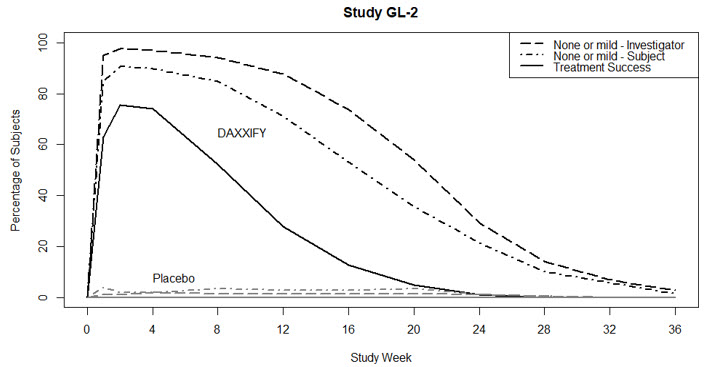
In the two randomized, placebo-controlled, Phase 3 clinical trials that assess the use of DAXXIFY for the temporary improvement in the appearance of moderate to severe glabellar lines, GL-1 and GL-2, 406 subjects received a single dose treatment of 40 Units DAXXIFY and 203 subjects received placebo.
The most frequent adverse reactions are presented in Table 3.
TABLE 3: Most Common Adverse Reactions ≥1% and More Frequent than Placebo in Pooled Double-Blind, Placebo-Controlled Trials for Glabellar Lines| Adverse Reaction | DAXXIFY
N=406
n (%) | Placebo
N=203
n (%) |
|---|
| Headache | 26 (6%) | 4 (2%) |
| Eyelid ptosis | 9 (2%) | 0 (0%) |
| Facial paresis Facial paresis, including facial asymmetry. | 5 (1%) | 0 (0%) |
Injection site reactions were reported in 6% of subjects treated with DAXXIFY and in 6% of subjects treated with placebo (these reactions included injection site pain, injection site erythema, injection site oedema, injection site bruising, injection site hematoma, injection site papule, injection site pruritus).
In an 84-week open label repeat-dose safety study in glabellar lines, 2691 subjects were treated with 40 U of DAXXIFY. Of these, 2380 subjects received one treatment with DAXXIFY, 882 received two treatments with DAXXIFY and 568 subjects received three treatments with DAXXIFY. Adverse reactions were reported in 535 of the 2691 subjects (20%). The adverse reaction profile was similar to that reported in single dose trials.
Injection site reactions were the most common adverse reactions, reported in 9% of subjects [including injection site pain (4%) , injection site erythema (3%), injection site oedema (3%), injection site bruising (1%), injection site papule (<1%), injection site pruritus (<1%)], followed by headache (5%), edema (2%), erythema (2%) and eyelid ptosis in 1% of subjects. The incidence of these adverse reactions did not increase with multiple re-treatments.
Risk Summary
There are no available data on DAXXIFY use in pregnant women to evaluate for a drug-associated risk of major birth defects, miscarriage, or adverse maternal or fetal outcomes. In animal reproduction studies, intramuscular administration of DAXXIFY during pregnancy resulted in adverse effects on fetal growth (decreased fetal body weight and skeletal ossification) at maternally toxic doses approximately equivalent to 40 times the maximum recommended human dose (MRHD) (see Data).
The background risk of major birth defects and miscarriage for the indicated population is unknown. In the U.S. general population, the estimated background risk of major birth defects and miscarriages in clinically recognized pregnancies is 2-4% and 15-20%, respectively.
Data
Animal Data
Embryofetal development studies were conducted in rats and rabbits with DAXXIFY. For comparison of animal to human doses based on a body weight comparison, the MRHD is set at 40 Units/subject (0.67 Units/kg for an average 60 kg subject).
Intramuscular administration of DAXXIFY (3, 10 or 30 Units/kg) to pregnant rats four times during the period of organogenesis (on gestation days 7, 10, 13, and 16) caused decreased fetal body weight and decreased fetal skeletal ossification at the highest dose, which was associated with maternal toxicity. No embryofetal developmental toxicity was noted at doses up to 10 Units/kg which is 15 times the MRHD.
Intramuscular administration of DAXXIFY (0.02, 0.1, 0.48 or 2.4 Units/kg/day) to pregnant rabbits during the period of organogenesis (total of 13 doses) resulted in maternal lethality at 2.4 Units/kg/day and significant decreased maternal body weight at 0.48 Units/kg/day. No embryofetal developmental toxicity was noted at doses up to 0.48 Units/kg/day which is approximately equivalent to the MRHD.
Risk Summary
There are no data on the presence of DAXXIFY in human or animal milk, the effects on the breastfed infant, or the effects on milk production. The developmental and health benefits of breastfeeding should be considered along with the mother's clinical need for DAXXIFY and any potential adverse effects on the breastfed infant from DAXXIFY or from the underlying maternal condition.
How Supplied
DAXXIFY (daxibotulinumtoxinA-lanm) for injection is a sterile lyophilized powder supplied in a single-dose vial in the following sizes:
Carton containing one 50 Units/Vial NDC 72960-111-01
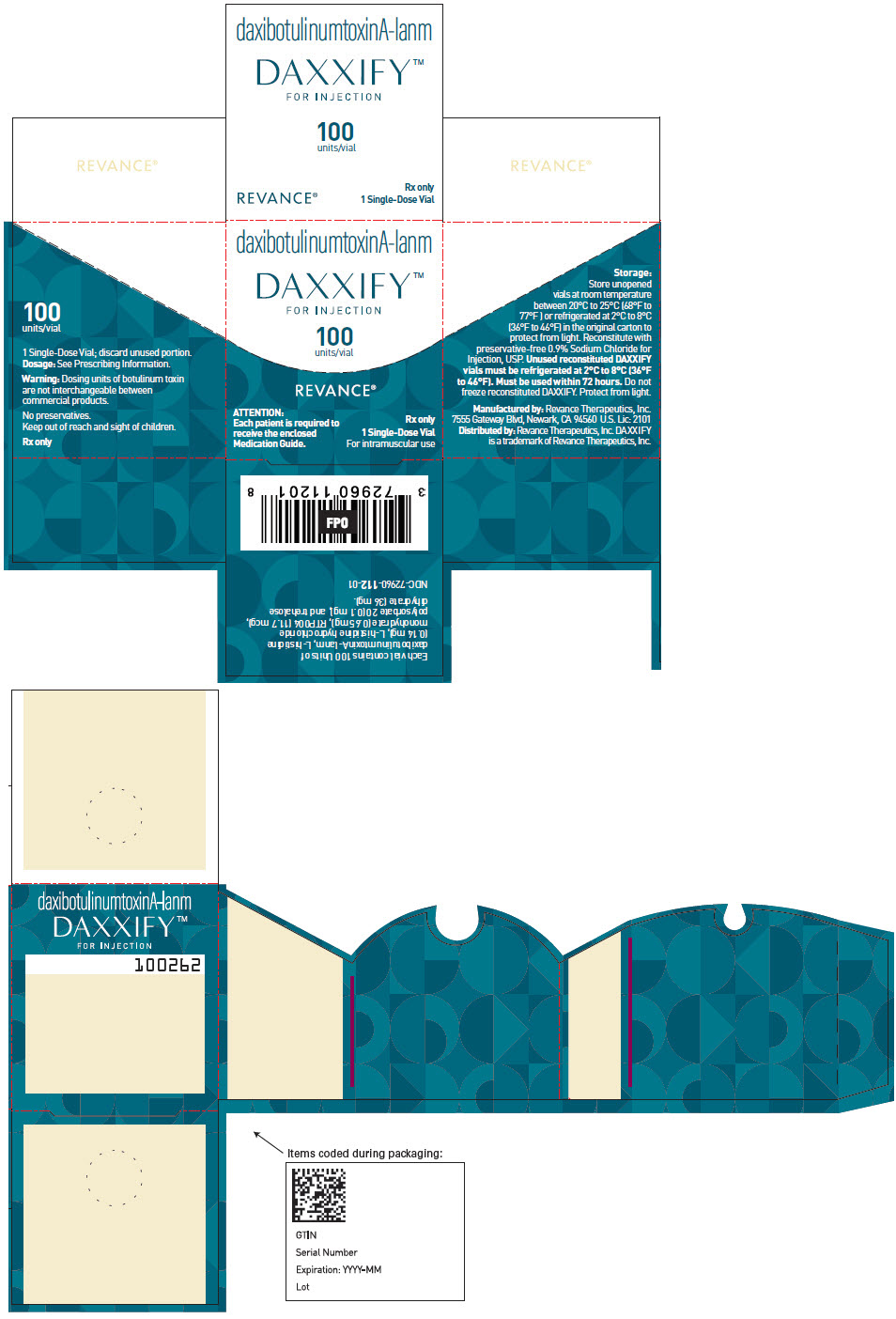
Carton containing one 100 Units/Vial NDC 72960-112-01
Swallowing, Speaking or Breathing Difficulties, or other Unusual Symptoms
Advise patients or caregivers to seek immediate medical care if swallowing, speech or respiratory disorders arise or existing symptoms worsen. [see Warnings and Precautions (5.7)]
Ability to Operate Machinery or Vehicles
Advise patients if they develop any unusual symptoms such as loss of strength, muscle weakness, blurred vision, or drooping eyelids occur, they should avoid driving a car or engaging in other potentially hazardous activities. [see Warnings and Precautions (5)]
Ophthalmic Adverse Reaction
Inform patients that DAXXIFY injection may cause eye dryness. Advise patients to report symptoms of eye dryness (e.g., eye pain, eye irritation, photosensitivity, or changes in vision) to their doctor. [see Warnings and Precautions (5.9)]
Manufactured by:
Revance Therapeutics, Inc.
Newark, CA 94560
U.S. License Number 2101
© 2022 Revance Therapeutics, Inc.
DAXXIFY is a trademark of Revance Therapeutics, Inc.
PI761127-0.8