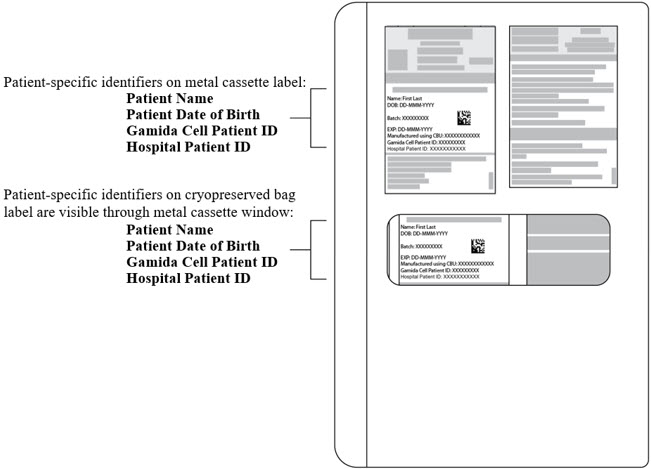
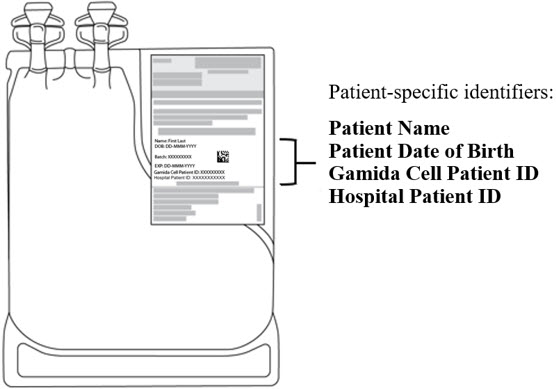
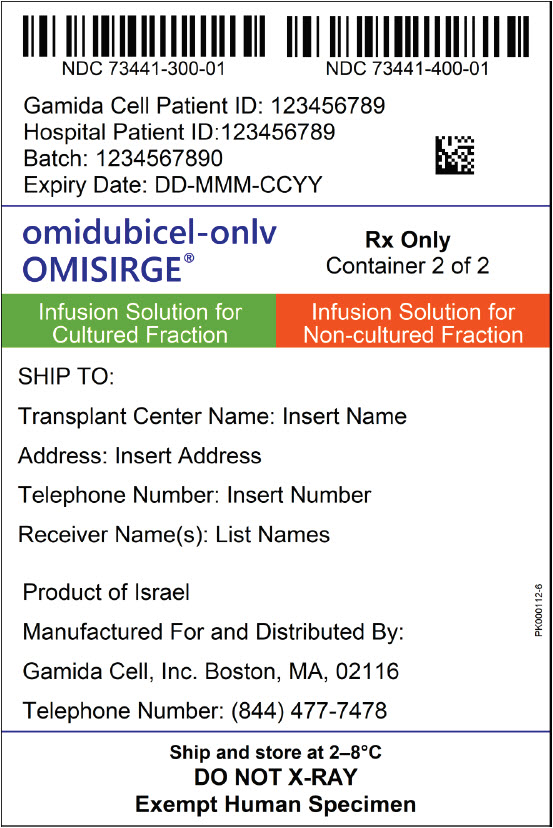
Follow universal precautions and local biosafety guidelines for handling and disposal of human cells to avoid potential transmission of infectious diseases.
- Monitor the patient for hypersensitivity or other infusion-related reactions during the infusion and post-infusion, per institutional guidelines.
- The infusion rate should be reduced if the fluid load is not tolerated. The infusion should be paused in the event of a hypersensitivity reaction or if the patient develops a moderate to severe infusion reaction. Appropriate medical therapy should be administered as needed. [See Warnings and Precautions (5.1 and 5.2)]
- Monitor for graft failure, GvHD, infections and other post-transplant complications according to institutional guidelines.
Infusion Reactions
Infusion reactions occurred in 29 (56%) patients in the OMISIRGE arm and in 40 (71%) patients in the UCB arm, including CTCAE Grade 3-4 events in 17% and 21% of patients, respectively. The most common infusion reactions were hypertension, mucosal inflammation, arrythmia, and fatigue. The most common Grade 3 to 4 infusion reaction was hypertension, reported in 3 (6%) patients treated with OMISIRGE and 9 (16%) patients treated with UCB.
Infections
Infections, including life-threatening and fatal infections, occurred after OMISIRGE infusion. Infections were graded per the Blood and Marrow Transplant Clinical Trials Network (BMT CTN) grading criteria. Data were collected for treated Grade 1 and all Grade 2/3 infections. The incidence of infections following transplantation are shown in the table below.
Table 2: Infections Following Transplantation with OMISIRGE or UCB in Study P0501 | | OMISIRGE
N = 52 | | | UCB
N = 56 | |
|---|
| Grade 1-3
% | Grade 2
% | Grade 3
% | Grade 1-3
% | Grade 2
% | Grade 3
% |
|---|
| Viral infections | 75 | 48 | 8 | 80 | 32 | 27 |
| Bacterial infections | 65 | 27 | 8 | 80 | 46 | 23 |
| Fungal Infections | 21 | 4 | 6 | 27 | 0 | 18 |
Graft-versus-Host Disease
Acute and chronic GvHD occurred following treatment with OMISIRGE.
Grade II to IV acute GvHD (Przepiorka et al., 1995) was reported in 62% of patients treated with OMISIRGE and 43% in patients treated with UCB. Grade III to IV acute GvHD was reported in 15% versus 21% of patients, respectively.
Chronic GvHD (National Institutes of Health [NIH] Consensus Criteria) was reported in 35% of patients in the OMISIRGE arm and 25% in the UCB arm. Moderate to severe chronic GvHD was reported in 23% versus 20% of patients, respectively.
Graft Failure
Primary graft failure (defined as failure to achieve an absolute neutrophil count greater than or equal to 0.5 Gi/L by Day 42 after transplantation) occurred in 2% of patients treated with OMISIRGE, compared to 11% of patients receiving UCB. One patient treated with OMISIRGE had a secondary graft failure approximately six months following transplantation, concurrent with a diagnosis of acute lymphocytic leukemia (ALL) relapse.
Relapse of Hematologic Malignancy
Disease relapse occurred in 21% of patients treated with OMISIRGE compared to 13% of patients treated with UCB.
Other Adverse Reactions
CTCAE Grade 3-5 non-laboratory adverse reactions in Study P0501 with greater or equal to 10% incidence are summarized in Table 3. The most common Grade 3-5 adverse reactions for patients treated with OMISIRGE, were pain (33%), mucosal inflammation (31%), hypertension (25%), and gastrointestinal toxicity (19%).
Table 3: CTCAE Grade 3 or Higher Adverse Reactions in ≥ 10% of Patients with Hematologic Malignancies Following Transplantation with OMISIRGE or UCB in Study P0501| Adverse Reaction | OMISIRGE
N = 52
% | UCB
N = 56
% |
|---|
| Abbreviation: CTCAE, common terminology criteria for adverse events; UCB, umbilical cord blood |
| General disorders and administration site conditions | | |
| Pain | 33 | 18 |
| Mucosal inflammation | 31 | 34 |
| Fatigue Fatigue includes asthenia and fatigue | 4 | 21 |
| Fever | 2 | 11 |
| Vascular disorders | | |
| Hypertension | 25 | 38 |
| Hemorrhage Hemorrhage include cystitis hemorrhagic, epistaxis, gastrointestinal hemorrhage, hemorrhage, pulmonary alveolar hemorrhage, subarachnoid hemorrhage, and upper gastrointestinal hemorrhage | 12 | 18 |
| Gastrointestinal disorders | | |
| Gastrointestinal toxicity | 19 | 34 |
| Dysphagia | 12 | 13 |
| Renal and urinary disorders | | |
| Renal impairment Renal impairment includes acute kidney injury, blood creatinine increased and renal failure | 12 | 5 |
| Respiratory, thoracic, and mediastinal disorders | | |
| Respiratory Failure Respiratory failure includes acute respiratory distress syndrome, acute respiratory failure, hypoxia, and respiratory failure | 12 | 30 |
| Dyspnea | 8 | 16 |
Table 4 summarizes selected chemistry abnormalities by treatment arm for patients treated in Study P0501.
Table 4: Chemistry Laboratory Abnormalities in ≥10% of Patients in Study P0501 | OMISIRGE
N = 52 | UCB
N = 56 |
|---|
| Laboratory Abnormality | Grade 1-4
% | Grade 3-4
% | Grade 1-4
% | Grade 3-4
% |
|---|
| Magnesium decreased | 94 | 4 | 91 | 2 |
| Aspartate aminotransferase increased | 56 | 13 | 61 | 7 |
| Alanine aminotransferase increased | 56 | 13 | 57 | 9 |
| Creatinine increased | 50 | 4 | 57 | 2 |
| Bilirubin increased | 42 | 12 | 61 | 21 |
| Alkaline phosphatase increased | 42 | 0 | 54 | 2 |
| Magnesium increased | 15 | 2 | 29 | 9 |
Risk Summary
There are no available data with OMISIRGE use in pregnant women. No animal reproductive and developmental toxicity studies have been conducted with OMISIRGE to assess whether it can cause fetal harm when administered to a pregnant woman.
OMISIRGE should be used during pregnancy only if the potential benefit justifies the potential risk to the fetus.
In the United States (U.S.) general population, the estimated background risk of major birth defects and miscarriage in clinically recognized pregnancies is 2-4% and 15-20%, respectively.
Risk Summary
There is no information regarding the presence of OMISIRGE in human milk, the effect on the breastfed infant, and the effects on milk production. The developmental and health benefits of breastfeeding should be considered along with the mother's clinical need for OMISIRGE and any potential adverse effects on the breastfed infant from OMISIRGE or from the underlying maternal condition.
Pregnancy Testing
Pregnancy status of females with reproductive potential should be verified. Sexually-active females of reproductive potential should have a pregnancy test prior to starting the conditioning regimen for OMISIRGE.
Contraception
See the prescribing information for the medications used for conditioning for information on the need for effective contraception in patients who receive a conditioning regimen.
There are insufficient exposure data to provide a recommendation concerning duration of contraception following treatment with OMISIRGE.
Infertility
There are no data on the effect of OMISIRGE on fertility.
Per Protocol Population:
Among the patients treated with OMISIRGE (n=52), neutrophil recovery with 42 days of follow-up was achieved in 94% of patients at a median of 10 days (95% CI: 8, 12), compared to 89% of patients treated with UCB (n=56), at a median of 20 days (95% CI: 18, 24). BMT CTN Grade 2/3 bacterial or Grade 3 fungal infections by 100 days were reported in 35% of patients treated with OMISIRGE and 61% of patients treated with UCB, respectively.
The Cryopreserved Cell Fractions
OMISIRGE is comprised of two cryopreserved cell fractions, a Cultured Fraction (CF) and a Non-cultured Fraction (NF) each in a separate cryopreserved bag labeled for the specific patient. Each cryopreserved bag is protected by a corresponding transparent overwrap bag and each cryopreserved bag enclosed in its overwrap bag is individually packed in a metal cassette. The cassettes are NOT to be opened upon receipt. Both cryopreserved OMISIRGE cell fractions are shipped together in the vapor phase of liquid nitrogen in a liquid nitrogen dry vapor shipper with the Prescribing Information (PI) and a Chimerism Testing Sample(s).
At the time of cryopreservation, the CF contains a minimum of 8.0 × 10⁸ total viable cells with a minimum of 8.7% CD34+ cells and a minimum of 9.2 × 10⁷ CD34+ cells suspended in 20 mL of a cryopreservation solution containing 10% DMSO.
See the CoA for the CF for actual cell counts. CoAs are attached to the RFI Certificate available via the Gamida Cell Assist Hospital Portal.
Upon cryopreservation, the CF appears white and is frozen at the bottom of the cryopreserved bag. The cassette may not be opened until the time of thaw for the specific fraction.
At the time of cryopreservation, the NF contains a minimum of 4 × 10⁸ total viable cells with a minimum of 2.4 × 10⁷ CD3+ cells suspended in 10 mL cryopreservation solution containing 10% DMSO.
See the CoA for the NF for actual cell counts.
Upon cryopreservation, the NF appears red and is frozen at the bottom of the cryopreserved bag. The cassette may not be opened until the time of thaw for the specific fraction.
The Refrigerated Infusion Solutions
The Infusion Solutions (IS) used to dilute OMISIRGE CF and NF are provided in two IS bags labeled for the specific patient and for diluting the specific fraction. The IS for diluting the CF contains approximately 80 mL and the IS for diluting the NF contains approximately 40 mL of IS consisting of 6.8% Dextran 40 and 8% HSA. The Infusion Solutions are shipped in a refrigerated shipping container with the PI.
Hypersensitivity Reactions:
Report immediately any signs and symptoms of hypersensitivity reactions including wheezing, swelling, itching, or hives [See Warnings and Precautions (5.1)].
Infusion Reactions:
Report immediately any signs and symptoms of infusion reactions including fever, chills, fatigue, tachycardia, hypoxia, severe nausea, severe vomiting, diarrhea, muscle pain, joint pain, low blood pressure, high blood pressure, or dizziness/lightheadedness [see Warnings and Precautions (5.2), Adverse Reactions (6.1)].
Graft-versus-Host-Disease:
Report immediately any signs and symptoms suggestive of graft vs host disease, including rash, diarrhea or yellowing of the eyes [see Warnings and Precautions (5.3), Adverse Reactions (6.1)].
Engraftment Syndrome:
Report immediately any signs and symptoms suggestive of engraftment syndrome including fever, rash, or unexplained weight gain [See Warnings and Precautions (5.4)].
Graft Failure:
Advise patients that primary graft failure, which may be fatal, can occur [See Warnings and Precautions (5.5), Adverse Reactions (6.1)].
Malignancies of Donor Origin:
Advise patients of the need to contact Gamida Cell at (844)-477-7478 if they are diagnosed with a secondary malignancy after treatment with OMISIRGE [See Warnings and Precautions (5.6), Adverse Reactions (6.1)].
Transmission of Serious Infections:
Advise patients of the risk of transmission of infectious disease [See Warnings and Precautions (5.7)].
Transmission of Rare Genetic Diseases:
Advise patients of the risk of transmission of rare genetic diseases [See Warnings and Precautions (5.8)].
Manufactured by:
Gamida Cell Ltd., Jerusalem 91340, Israel
U.S. License number 2223
Distributed by:
Gamida Cell Inc., Boston, MA 02116
OMISIRGE® is a registered trademark of Gamida Cell Inc.
© Gamida Cell, Inc. All Rights Reserved.