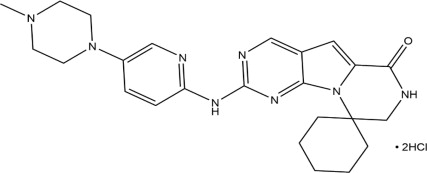
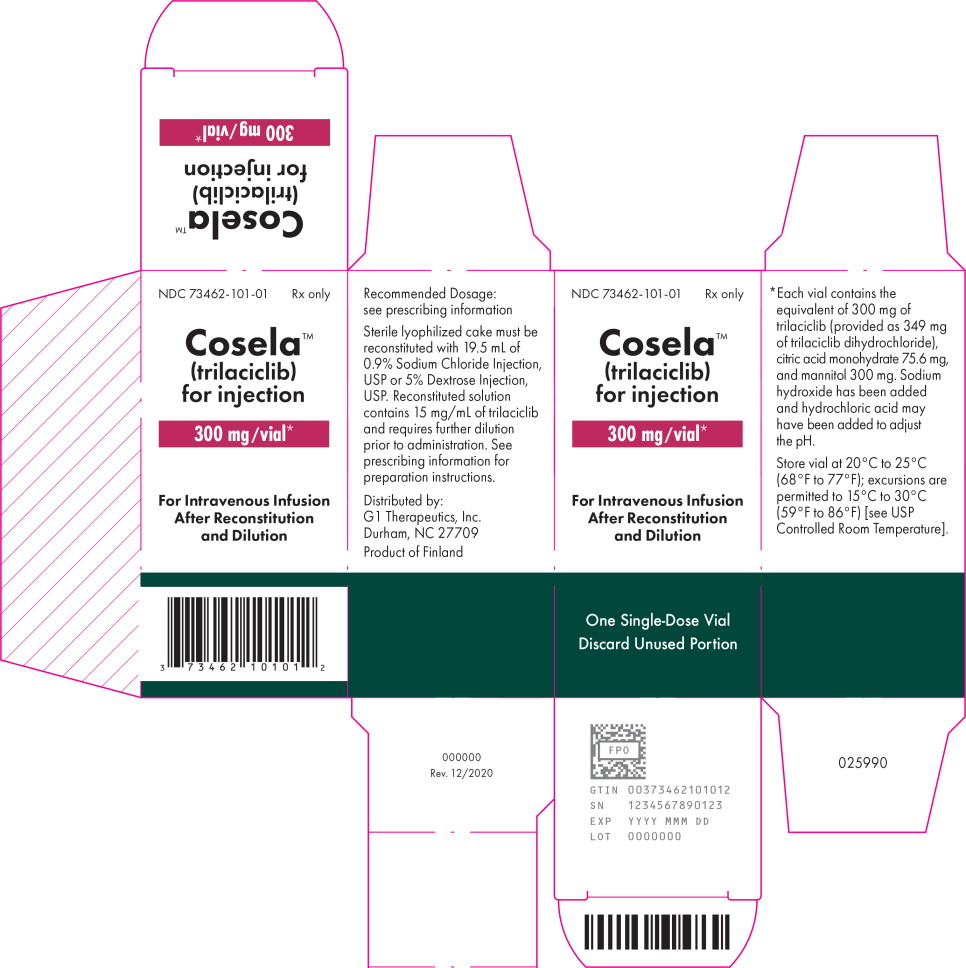
- Administer diluted COSELA solution as a 30-minute intravenous infusion completed within 4 hours prior to the start of chemotherapy.
- Diluted COSELA solution must be administered with an infusion set, including an in-line filter (0.2 or 0.22 micron). Compatible in-line filters include polyethylene sulfone, polyvinylidene fluoride, and cellulose acetate.
- Do not administer diluted COSELA solution with a polytetrafluorethylene (PTFE) in-line filter. PTFE in-line filters are not compatible with diluted COSELA solution.
- Do not co-administer other drugs through the same infusion line.
- Do not co-administer other drugs through a central access device unless the device supports co-administration of incompatible drugs.
- Upon completion of infusion of diluted COSELA solution, the infusion line/cannula must be flushed with at least 20 mL sterile 0.9% Sodium Chloride Injection, USP or 5% Dextrose Injection, USP.
Study 1: COSELA Prior to Etoposide, Carboplatin, and Atezolizumab (E/P/A)
Patients with newly diagnosed ES-SCLC not previously treated with chemotherapy
Study 1 (G1T28-05; NCT03041311) was an international, randomized (1:1), double-blind, placebo-controlled study of COSELA or placebo administered prior to treatment with etoposide, carboplatin, and atezolizumab (E/P/A) for patients with newly diagnosed ES-SCLC not previously treated with chemotherapy. The data presented below are for the 105 patients who received study treatment.
Eighty-five percent of patients receiving COSELA and 91% receiving placebo completed 4 cycles of induction therapy.
Study 2: COSELA Prior to Etoposide and Carboplatin (E/P)
Patients with newly diagnosed ES-SCLC not previously treated with chemotherapy
Study 2 (G1T28-02; NCT02499770) was an international, randomized (1:1), double-blind, placebo-controlled study of COSELA or placebo administered prior to treatment with etoposide and carboplatin (E/P) for patients with newly diagnosed ES-SCLC not previously treated with chemotherapy. The data presented below are for the 75 patients who received study treatment.
Seventy-six percent of patients in the COSELA group and 87% of patients in the placebo group completed at least 4 cycles of therapy. The median duration of treatment was 6 cycles in each treatment group.
Study 3: COSELA Prior to Topotecan
Patients with ES-SCLC previously treated with chemotherapy
Study 3 (G1T28-03; NCT02514447) was an international, randomized (2:1), double-blind, placebo-controlled study of COSELA or placebo administered prior to treatment with topotecan for patients with ES-SCLC previously treated with chemotherapy. The data presented below are for the 60 patients who received study treatment with the 1.5 mg/m2 dose of topotecan.
Thirty-eight percent of patients receiving COSELA and 29% of patients receiving placebo completed 5 or more cycles of therapy. The median duration of treatment was 3 cycles in each treatment group.
Integrated Safety Analysis
The adverse reaction summary presented in Table 3 are pooled safety results from Studies 1, 2, and 3. The patients included in the pooling are those randomized patients that received at least 1 dose of COSELA (122 patients) or placebo (118 patients).
Seventy-one percent of patients receiving COSELA and 78% of patients receiving placebo completed at least 4 cycles of therapy. The median duration of treatment was the same (4 cycles) for patients receiving COSELA and placebo.
Serious adverse reactions occurred in 30% of patients receiving COSELA. Serious adverse reactions reported in >3% of patients who received COSELA included respiratory failure, hemorrhage, and thrombosis.
Permanent discontinuation due to an adverse reaction occurred in 9% of patients who received COSELA. Adverse reactions leading to permanent discontinuation of any study treatment for patients receiving COSELA included pneumonia (2%), asthenia (2%), injection-site reaction, thrombocytopenia, cerebrovascular accident, ischemic stroke, infusion-related reaction, respiratory failure, and myositis (<1% each).
Fatal adverse reactions were observed in 5% of patients receiving COSELA. Fatal adverse reactions for patients receiving COSELA included pneumonia (2%), respiratory failure (2%), acute respiratory failure (<1%), hemoptysis (<1%), and cerebrovascular accident (<1%).
Infusion interruptions due to an adverse reaction occurred in 4.1% of patients who received COSELA.
The most common adverse reactions (≥10%) were fatigue, hypocalcemia, hypokalemia, hypophosphatemia, aspartate aminotransferase increased, headache, and pneumonia. The most frequently reported Grade ≥3 adverse reaction (≥5%) in patients receiving COSELA occurring at the same or higher incidence than in patients receiving placebo was hypophosphatemia.
The most common adverse reactions reported in at least 5% of patients receiving COSELA with a ≥2% higher incidence compared to patients receiving placebo are shown in Table 3.
Table 3: Adverse Reactions in ≥5% Patients with SCLC Receiving COSELA (with ≥2% Higher Incidence in COSELA Compared to Placebo)
| Adverse Reaction | COSELA
(N=122) | Placebo
(N=118) |
|---|
All
Gradesa
(%) | Grade ≥3 (%) | All
Gradesa
(%) | Grade ≥3 (%) |
|---|
|
|
|
|
|
| Fatigue
| 34
| 3
| 27
| 2
|
| Hypocalcemiab | 24
| <1
| 21
| <1
|
| Hypokalemiac | 22
| 6
| 18
| 3
|
| Hypophosphatemiad | 21
| 7
| 16
| 2
|
| Aspartate aminotransferase increasede | 17
| <1
| 14
| <1
|
| Headache
| 13
| 0
| 9
| 0
|
| Pneumonia
| 10
| 7
| 8
| 7
|
| Rash
| 9
| <1
| 6
| 0
|
| Infusion-related reaction
| 8
| 0
| 2
| 0
|
| Edema peripheral
| 7
| 0
| 4
| <1
|
| Abdominal pain upper
| 7
| 0
| 3
| 0
|
| Thrombosis
| 7
| 3
| 2
| 2
|
| Hyperglycemia
| 6
| 2
| 3
| 0
|
Grade 3/4 hematological adverse reactions occurring in patients treated with COSELA and placebo included neutropenia (32% and 69%), febrile neutropenia (3% and 9%), anemia (16% and 34%), thrombocytopenia (18% and 33%), leukopenia (4% and 17%), and lymphopenia (<1% and <1%), respectively.
Risk Summary
Based on the mechanism of action, COSELA can cause fetal harm when administered to a pregnant woman [see Clinical Pharmacology (12)]. There are no available human or animal data on COSELA use to evaluate for a drug-associated risk of major birth defects, miscarriage, or adverse maternal or fetal outcomes. Advise pregnant women of the potential risk to a fetus.
The background risk of major birth defects and miscarriage for the indicated population is unknown. All pregnancies have a background risk of birth defect, loss, or other adverse outcomes. However, the background risk of major birth defects is 2% to 4% and of miscarriage is 15% to 20% of clinically recognized pregnancies in the United States general population.
Risk Summary
There are no data on the presence of trilaciclib in either human or animal milk, the effects on the breastfed child or the effects on milk production. Because of the potential for serious adverse reactions in breastfed children, advise lactating women to not breastfeed while taking COSELA and for at least 3 weeks after the last dose.
Pregnancy Testing
Based on its mechanism of action, COSELA can cause fetal harm if administered to a pregnant woman [see Use in Specific Populations (8.1)]. Pregnancy testing is recommended for females of reproductive potential prior to initiating COSELA.
Contraception
COSELA can cause fetal harm when administered to pregnant women [see Use in Specific Populations (8.1)]. Advise female patients of reproductive potential to use effective contraception during treatment with COSELA and for at least 3 weeks after the final dose.
Infertility
No studies have been performed in humans to evaluate the effects of COSELA on fertility in either sex.
Based on animal toxicology studies, COSELA may impair fertility in females of reproductive potential [see Nonclinical Toxicology (13)].
Bone Marrow
Trilaciclib exhibited dose-dependent inhibition of CD45+/CD3+ lymphocyte proliferation following administration of single-dose COSELA 96 or 192 mg/m2 (0.4 or 0.8 times the approved recommended dose) in healthy subjects.
Trilaciclib increased the percentage of cells arrested in G1 up to 32 hours post-infusion for all bone marrow progenitor subsets evaluated (hematopoietic stem cell/multipotent progenitor, oligopotent progenitor, monocyte lineage, granulocyte lineage, erythroid lineage, and megakaryocyte lineage) following a single dose of COSELA 192 mg/m2 (0.8 times the approved recommended dose) in healthy subjects. Partial recovery of the total bone marrow with resumption of proliferation of the bone marrow progenitor subsets was observed by 32 hours post-dose. This transient G1 arrest of hematopoietic stem cells contributed to the myeloprotective effect of trilaciclib.
Cardiac Electrophysiology
COSELA is associated with dose-dependent and delayed increase in the QTc interval. The underlying mechanism of the delayed QT effect is unknown. At the clinical dose of 240 mg/m2, COSELA did not have a clinically relevant effect on QTc (i.e., >10 msec). QTc prolongation was observed at higher doses.
Distribution
Protein binding of trilaciclib has not been fully characterized in vitro. The blood/plasma ratio ranged from 1.21 to 1.53 for trilaciclib across concentrations of 0.5 μg/mL to 50 μg/mL in vitro. The volume of distribution at steady state was 1130 L.
Elimination
The mean terminal half-life of trilaciclib is approximately 14 hours. Clearance was estimated to be 158 L/hr.
Metabolism
Trilaciclib undergoes extensive metabolism. Trilaciclib is the predominant circulating compound in plasma following intravenous administration, representing ~50% of plasma total radioactivity.
Excretion
After a single dose of radiolabeled trilaciclib 192 mg/m2 (0.8 times the approved recommended dosage), approximately 79.1% of the dose was recovered in feces (7% unchanged) and 14% was recovered in urine (2% unchanged).
Trilaciclib is eliminated mainly via the fecal route, with a small contribution of the renal route.
Specific Populations
No clinically significant differences in the pharmacokinetics of trilaciclib were observed based on age (range: 19 to 80 years), sex, race, mild to moderate renal impairment (30 to 89 mL/min/1.73 m2 measured by estimated glomerular filtration rate [eGFR]), or mild hepatic impairment (total bilirubin ≤ULN and AST >ULN, or total bilirubin >1.0 to 1.5 × ULN, irrespective of AST). The effect of severe renal impairment (<30 mL/min/1.73 m2), end stage renal disease or dialysis, or moderate or severe hepatic impairment (total bilirubin >1.5 × ULN and any AST) on trilaciclib pharmacokinetics has not been studied.
Drug Interaction Studies
Clinical Studies
Cytochrome P450 (CYP) Enzymes: There were no clinically significant differences in trilaciclib pharmacokinetics when used concomitantly with itraconazole (strong CYP3A inhibitor) or rifampin (strong CYP3A inducer). There were no clinically significant differences in midazolam (CYP3A substrate) pharmacokinetics when used concomitantly with trilaciclib.
Transporter Systems: Concomitant use of trilaciclib increased metformin (OCT2, MATE1, and MATE-2K substrate) AUCinf and Cmax by approximately 65% and 81%, respectively. Renal clearance of metformin was decreased by 37%. There were no clinically significant differences in topotecan (MATE1 and MATE-2K substrate) pharmacokinetics when used concomitantly with trilaciclib.
In Vitro Studies
CYP Enzymes: Trilaciclib did not inhibit CYP1A2, CYP2B6, CYP2C8, CYP2C9, CYP2C19, or CYP2D6. Trilaciclib is an inducer for CYP1A2, and is not an inducer for CYP2B6 or CYP3A4.
Transporter Systems: Trilaciclib did not inhibit P-glycoprotein (P-gp), breast cancer resistance protein (BCRP), organic anion transporting polypeptide 1B1 (OATP1B1), OATP1B3, OAT1, or OAT3. Trilaciclib was a substrate of BCRP and P-gp, but not bile salt export pump (BSEP), MATE1, MATE-2K, or OCT.
Study 1: COSELA Prior to Etoposide, Carboplatin, and Atezolizumab (E/P/A)
Patients with newly diagnosed ES-SCLC not previously treated with chemotherapy
Study 1 (G1T28-05) was a randomized (1:1), double-blind, placebo-controlled study of COSELA or placebo administered prior to treatment with etoposide, carboplatin, and atezolizumab (E/P/A) for patients with newly diagnosed ES-SCLC not previously treated with chemotherapy.
A total of 107 patients were randomized to receive COSELA (n=54) or placebo (n=53) prior to administration of E/P/A; patients were stratified by Eastern Cooperative Oncology Group (ECOG) performance status (0 to 1 vs 2) and the presence of brain metastases. Carboplatin (AUC 5) and atezolizumab (1200 mg) were administered on Day 1 and etoposide (100 mg/m2) and COSELA (240 mg/m2) or placebo were administered on Days 1, 2, and 3 of a 21-day cycle for a maximum of 4 cycles (induction). After induction, maintenance atezolizumab (1200 mg) monotherapy on Day 1 of a 21-day cycle continued until disease progression or unacceptable toxicity. COSELA was not administered during maintenance.
The study population characteristics were: median age 64 years (range: 45 to 83); 70% male; 97% white; 14% ECOG performance status 2; 28% with a history of brain metastases; 38% current smokers; 46% lactate dehydrogenase (LDH) >ULN.
The mean relative dose intensities (RDIs) for E/P/A in patients receiving COSELA were 93%, 95%, and 93%, respectively. The mean RDIs for E/P/A in patients receiving placebo were 88%, 89%, and 91%, respectively. Dose reductions of carboplatin occurred in 2% of patients receiving COSELA and in 25% of patients receiving placebo; dose reductions of etoposide occurred in 6% of patients receiving COSELA and in 26% of patients receiving placebo. No dose reduction was allowed for COSELA or atezolizumab.
The study demonstrated a statistically significantly shorter duration of severe neutropenia (DSN) in Cycle 1 (0 vs 4 days) and a lower proportion of patients with severe neutropenia (SN) (2% vs 49%) in patients receiving COSELA compared with placebo (Table 5). Nineteen percent of patients receiving COSELA had Grade 3 or 4 decreased hemoglobin compared with 28% of patients receiving placebo (adjusted relative risk 0.663 [95% CI: 0.336, 1.310]). The rate of RBC transfusions over time was 1.7/100 weeks for patients receiving COSELA and 2.6/100 weeks for patients receiving placebo (adjusted relative risk was not estimable). Six percent of patients receiving COSELA received erythropoiesis-stimulating agents (ESAs) compared with 11% of patients receiving placebo (adjusted relative risk 0.529 [95% CI: 0.145, 1.927]).
Table 5: Study 1: Myeloprotective Efficacy Results in Patients Treated with COSELA or Placebo Prior to Chemotherapy (Intent-to-Treat Analysis)
| Endpoint | COSELA 240 mg/m2 (N=54) | Placebo
(N=53) | Treatment Effecta
(Mean Difference* or Adjusted Relative Risk)
(95% CI) | Adjusted 1-sided p-valueb |
|---|
|
|
|
| Primary Endpoints |
| DSN in Cycle 1 (days): mean (SD)
| 0 (1.0)
| 4 (4.7)
| -3.6* (-4.9, -2.3)
| <0.0001
|
| Number (%) of patients with severe neutropenia
| 1 (1.9%)
| 26 (49.1%)
| 0.038
(0.008, 0.195)
| <0.0001
|
| Key Secondary Endpoints |
| Number of all-cause dose reductions, event rate per cycle
| 0.021
| 0.085
| 0.242
(0.079, 0.742)
| 0.0195
|
| Number (%) of patients with RBC transfusion on/after 5 weeks
| 7 (13.0%)
| 11 (20.8%)
| 0.642
(0.294, 1.404)
| --
|
| Number (%) of patients with G-CSF administration
| 16 (29.6%)
| 25 (47.2%)
| 0.646
(0.403, 1.034)
| --
|
Study 2: COSELA Prior to Etoposide and Carboplatin
Patients with newly diagnosed ES-SCLC not previously treated with chemotherapy
Study 2 (G1T28-02) was a randomized (1:1), double-blind, placebo-controlled evaluation of COSELA or placebo administered prior to treatment with etoposide and carboplatin (E/P) for patients with newly diagnosed ES-SCLC not previously treated with chemotherapy. A total of 77 patients were randomized to COSELA (n=39) or placebo (n=38) and stratified by ECOG performance status (0 to 1 vs 2). Carboplatin (AUC 5) was administered on Day 1 and etoposide (100 mg/m2) and COSELA (240 mg/m2) or placebo were administered on Days 1, 2, and 3 of a 21-day cycle until disease progression or unacceptable toxicity.
Ten percent of patients receiving COSELA had Grade 3 or 4 decreased hemoglobin compared with 18% of patients receiving placebo. The rate of RBC transfusions over time was 0.5/100 weeks for patients receiving COSELA and 1.9/100 weeks for patients receiving placebo. Three percent of patients receiving COSELA received ESAs compared with 5% of patients receiving placebo.
Table 6: Study 2: Myeloprotective Efficacy Results in Patients Treated with COSELA or Placebo Prior to Chemotherapy (Intent-to-Treat Analysis)
| Endpoint | COSELA
240 mg/m2 (N=39) | Placebo
(N=38) |
|---|
|
| DSN in Cycle 1 (days): mean (SD)
| 0 (0.5)
| 3 (3.9)
|
| Number (%) of patients with severe neutropenia
| 2 (5.1%)
| 16 (42.1%)
|
| Number of all-cause dose reductions, event rate per cycle
| 0.022
| 0.084
|
| Number (%) of patients with RBC transfusion on/after 5 weeks
| 2 (5.1%)
| 9 (23.7%)
|
| Number (%) of patients with G-CSF administration
| 4 (10.3%)
| 24 (63.2%)
|
Study 3: COSELA Prior to Topotecan
Patients with ES-SCLC previously treated with chemotherapy
Study 3 (G1T28-03) included a randomized, double-blind, placebo-controlled evaluation of COSELA or placebo administered prior to topotecan in patients with ES-SCLC previously treated with chemotherapy. A total of 61 patients were randomized to COSELA (n=32) or placebo (n=29). Patients were stratified by ECOG performance status (0 to 1 vs 2) and sensitivity to first-line treatment. Topotecan (1.5 mg/m2) and COSELA (240 mg/m2) or placebo were administered on Days 1-5 of a 21-day cycle. Treatment was administered until disease progression or unacceptable toxicity.
Thirty-eight percent of patients receiving COSELA had Grade 3 or 4 decreased hemoglobin compared with 59% of patients receiving placebo. The rate of RBC transfusions over time was 2.6/100 weeks for patients receiving COSELA and 6.3/100 weeks for patients receiving placebo. Three percent of patients receiving COSELA received ESAs compared with 21% of patients receiving placebo.
Table 7: Study 3: Myeloprotective Efficacy Results in Patients Treated with COSELA or Placebo Prior to Chemotherapy (Intent-to-Treat Analysis)
| Endpoint | COSELA
240 mg/m2 (N=32) | Placebo
(N=29) |
|---|
|
| Primary Endpoints |
| DSN in Cycle 1 (days): mean (SD)
| 2 (3.9)
| 7 (6.2)
|
| Number (%) of patients with severe neutropenia
| 13 (40.6%)
| 22 (75.9%)
|
| Key Secondary Endpoints |
| Number of all-cause dose reductions, event rate per cycle
| 0.051
| 0.116
|
| Number (%) of patients with RBC transfusion on/after 5 weeks
| 10 (31.3%)
| 12 (41.4%)
|
| Number (%) of patients with G-CSF administration
| 16 (50.0%)
| 19 (65.5%)
|
| Number (%) of patients with platelet transfusion
| 8 (25.0%)
| 9 (31.0%)
|
Patient Subgroups
Treatment efficacy was examined across different subgroups, including those quantifying the risk of febrile neutropenia, anemia, and RBC transfusions; results were consistent across subgroups.
Injection-Site Reactions, Including Phlebitis and Thrombophlebitis
Inform patients of the signs and symptoms of injection-site reactions, including phlebitis and thrombophlebitis. Advise patients to contact their healthcare provider immediately for signs and symptoms of injection-site reactions, including phlebitis and thrombophlebitis [see Warnings and Precautions (5.1)].
Acute Drug Hypersensitivity Reactions
Advise patients to contact their healthcare provider immediately for signs and symptoms of acute drug hypersensitivity reactions including facial, eye, and tongue edema, urticaria, pruritis, and anaphylactic reactions [see Warnings and Precautions (5.2)].
Interstitial Lung Disease/Pneumonitis
Advise patients to immediately report new or worsening respiratory symptoms [see Warnings and Precautions (5.3) and Dosage and Administration (2.2)].
Embryo-Fetal Toxicity
Advise females of reproductive potential of the potential risk to a fetus and to inform their healthcare provider of a known or suspected pregnancy [see Use in Specific Populations (8.1)].
Advise females of reproductive potential to use effective contraception during treatment with COSELA and for at least 3 weeks after the final dose [see Use in Specific Populations (8.1, 8.3)].
Lactation
Advise women not to breastfeed during treatment with COSELA and for at least 3 weeks after the final dose of COSELA [see Use in Specific Populations (8.2)].
Drug Interactions
Advise patients to inform their healthcare providers of all concomitant medications, including prescription medicines, over-the-counter drugs, vitamins, and herbal products [see Drug Interactions (7)].
Distributed by:
G1 Therapeutics, Inc.
Durham, NC 27709
COSELATM is a trademark of G1 Therapeutics, Inc.
©2021 G1 Therapeutics, Inc.
025991
10003 Rev. 2/2021