Among patients who received MONJUVI, 57% were exposed for 6 months or longer, 42% were exposed for greater than one year, and 24% were exposed for greater than two years.
Serious adverse reactions occurred in 52% of patients who received MONJUVI. Serious adverse reactions in ≥6% of patients included infections (26%) including pneumonia (7%), and febrile neutropenia (6%). Fatal adverse reactions occurred in 5% of patients who received MONJUVI, including cerebrovascular accident (1.2%), respiratory failure (1.2%), progressive multifocal leukoencephalopathy (1.2%) and sudden death (1.2%).
Permanent discontinuation of MONJUVI or lenalidomide due to an adverse reaction occurred in 25% of patients and permanent discontinuation of MONJUVI due to an adverse reaction occurred in 15%. The most frequent adverse reactions which resulted in permanent discontinuation of MONJUVI were infections (5%), nervous system disorders (2.5%), respiratory, thoracic and mediastinal disorders (2.5%).
Dosage interruptions of MONJUVI or lenalidomide due to an adverse reaction occurred in 69% of patients and dosage interruption of MONJUVI due to an adverse reaction occurred in 65%. The most frequent adverse reactions which required a dosage interruption of MONJUVI were blood and lymphatic system disorders (41%), and infections (27%).
The most common adverse reactions (≥ 20%) were neutropenia, fatigue, anemia, diarrhea, thrombocytopenia, cough, pyrexia, peripheral edema, respiratory tract infection, and decreased appetite.
Table 3 summarizes the adverse reactions in L-MIND.
Clinically relevant adverse reactions in <10% of patients who received MONJUVI were:
- Blood and lymphatic system disorders: lymphopenia (6%)
- General disorders and administration site conditions: infusion-related reaction (6%)
- Infections: sepsis (4.9%)
- Investigations: weight decreased (4.9%)
- Musculoskeletal and connective tissue disorders: arthralgia (9%), pain in extremity (9%), musculoskeletal pain (2.5%)
- Neoplasms benign, malignant and unspecified: basal cell carcinoma (1.2%)
- Nervous system disorders: headache (9%), paresthesia (7%), dysgeusia (6%)
- Respiratory, thoracic and mediastinal disorders: nasal congestion (4.9%), exacerbation of chronic obstructive pulmonary disease (1.2%)
- Skin and subcutaneous tissue disorders: erythema (4.9%), alopecia (2.5%), hyperhidrosis (2.5%)
Table 4 summarizes the laboratory abnormalities in L-MIND.
Table 4: Select Laboratory Abnormalities (>20%) Worsening from Baseline in Patients with Relapsed or Refractory Diffuse Large B-Cell Lymphoma Who Received MONJUVI in L-MIND| Laboratory Abnormality | MONJUVI The denominator used to calculate the rate was 74 based on the number of patients with a baseline value and at least one post-treatment value. |
|---|
All Grades
(%) | Grade 3 or 4
(%) |
|---|
| Chemistry | | |
| Glucose increased | 49 | 5 |
| Calcium decreased | 47 | 1.4 |
| Gamma glutamyl transferase increased | 34 | 5 |
| Albumin decreased | 26 | 0 |
| Magnesium decreased | 22 | 0 |
| Urate increased | 20 | 7 |
| Phosphate decreased | 20 | 5 |
| Creatinine increased | 20 | 1.4 |
| Aspartate aminotransferase increased | 20 | 0 |
| Coagulation | | |
| Activated partial thromboplastin time increased | 46 | 4.1 |
Risk Summary
Based on its mechanism of action, MONJUVI may cause fetal B-cell depletion when administered to a pregnant woman [see Clinical Pharmacology (12.1)]. There are no available data on MONJUVI use in pregnant women to evaluate for a drug-associated risk. Animal reproductive toxicity studies have not been conducted with tafasitamab-cxix.
In the U.S. general population, the estimated background risk of major birth defects and miscarriage in clinically recognized pregnancies is 2% to 4% and 15% to 20%, respectively.
MONJUVI is administered in combination with lenalidomide for up to 12 cycles. Lenalidomide can cause embryo-fetal harm and is contraindicated for use in pregnancy. Refer to the lenalidomide prescribing information for additional information. Lenalidomide is only available through a REMS program.
Clinical Considerations
Fetal/Neonatal Adverse Reactions
Immunoglobulin G (IgG) monoclonal antibodies are transferred across the placenta. Based on its mechanism of action, MONJUVI may cause depletion of fetal CD19 positive immune cells. Defer administering live vaccines to neonates and infants exposed to tafasitamab-cxix in utero until a hematology evaluation is completed.
Data
Animal Data
Animal reproductive studies have not been conducted with tafasitamab-cxix. Tafasitamab-cxix is an IgG antibody and thus has the potential to cross the placental barrier permitting direct fetal exposure and depleting fetal B lymphocytes.
Risk Summary
There are no data on the presence of tafasitamab-cxix in human milk or the effects on the breastfed child or milk production. Maternal immunoglobulin G is known to be present in human milk. The effects of local gastrointestinal exposure and limited systemic exposure in the breastfed infant to MONJUVI are unknown. Because of the potential for serious adverse reactions in the breastfed child, advise women not to breastfeed during treatment with MONJUVI and for at least 3 months after the last dose. Refer to lenalidomide prescribing information for additional information.
Pregnancy Testing
Refer to the prescribing information for lenalidomide for pregnancy testing requirements prior to initiating the combination of MONJUVI with lenalidomide.
Contraception
Females
Advise females of reproductive potential to use effective contraception during treatment with MONJUVI and for at least 3 months after the last dose. Additionally, refer to the lenalidomide prescribing information for additional recommendations for contraception.
Males
Refer to the lenalidomide prescribing information for recommendations.
Distribution
The total volume of distribution for tafasitamab-cxix was 9.3 L (95% CI: 8.6, 10 L).
Elimination
The clearance of tafasitamab-cxix was 0.41 L/day (CV: 32%) and terminal elimination half-life was 17 days (95% CI: 15, 18 days).
Specific Populations
Body weight (40 to 163 kg) has a significant effect on the pharmacokinetics of tafasitamab-cxix, with higher clearance and volume of distribution expected with higher body weight. No clinically meaningful differences in the pharmacokinetics of tafasitamab-cxix were observed based on age (16 to 90 years), sex, mild to moderate renal impairment (CLcr 30-89 mL/min estimated by the Cockcroft-Gault equation), and mild hepatic impairment (total bilirubin ≤ ULN and AST > ULN, or total bilirubin 1 to 1.5 times ULN and any AST). The effect of severe renal impairment to end-stage renal disease (CLcr < 30 mL/min), moderate to severe hepatic impairment (total bilirubin > 1.5 times ULN and any AST), and race/ethnicity on tafasitamab-cxix pharmacokinetics is unknown.
Drug Interaction Studies
No clinically meaningful differences in tafasitamab-cxix pharmacokinetics were observed when used concomitantly with lenalidomide.
Infusion-Related Reactions
Advise patients to contact their healthcare provider if they experience signs and symptoms of infusion-related reactions [see Warnings and Precautions (5.1)].
Myelosuppression
Inform patients about the risk of myelosuppression. Advise patients to immediately contact their healthcare provider for a fever of 100.4°F (38°C) or greater or signs or symptoms of bruising or bleeding. Advise patients of the need for periodic monitoring of blood counts [see Warnings and Precautions (5.2)].
Infections
Inform patients about the risk of infections. Advise patients to immediately contact their healthcare provider for a fever of 100.4°F (38°C) or greater or signs or symptoms of infection [see Warnings and Precautions (5.3)].
Embryo-Fetal Toxicity
- Advise pregnant women of the potential risk to a fetus. Advise females of reproductive potential to inform their healthcare provider of a known or suspected pregnancy [see Warnings and Precautions (5.4), Use in Specific Population (8.1)].
- Advise females of reproductive potential to use effective contraception during treatment with MONJUVI and for at least 3 months after the last dose [see Use in Specific Populations (8.3)].
- Advise patients that lenalidomide has the potential to cause fetal harm and has specific requirements regarding contraception, pregnancy testing, blood and sperm donation, and transmission in sperm. Lenalidomide is only available through a REMS program [see Use in Specific Populations (8.1,8.3)].
Lactation
Advise women not to breastfeed during treatment with MONJUVI and for at least 3 months after the last dose [see Use in Specific Populations (8.2)].
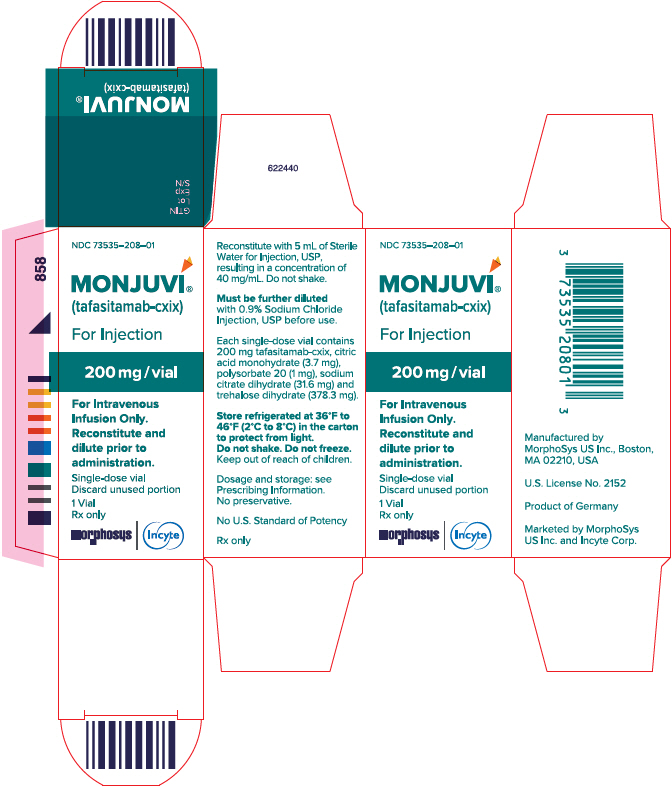
Manufactured by:
MORPHOSYS US INC.
Boston, MA 02210
U.S. License No. 2152
Marketed by:
MORPHOSYS US INC. and INCYTE Corporation.
MONJUVI is a registered trademark of MorphoSys AG
Copyright © 2020 MorphoSys AG. All rights reserved.
Product of Germany