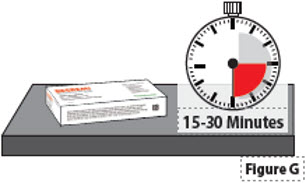
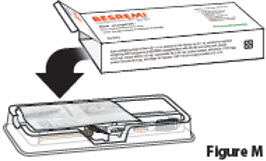
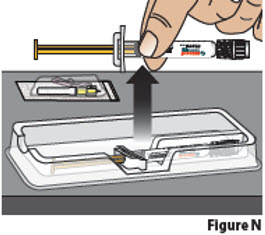
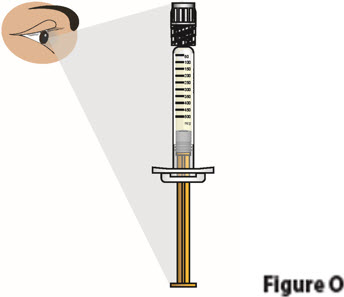
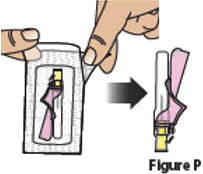
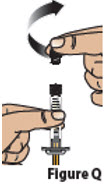
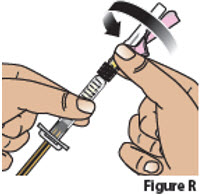
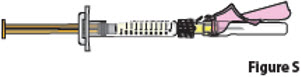
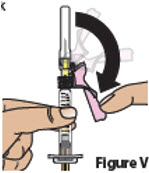
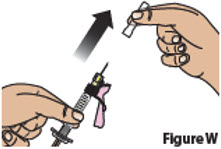
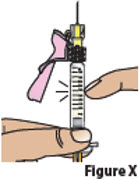
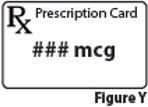
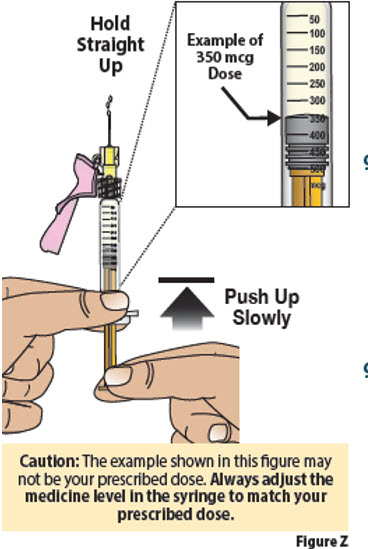
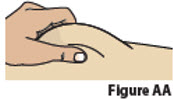
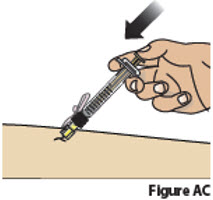
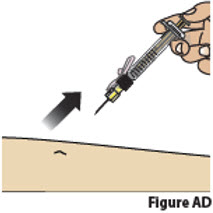
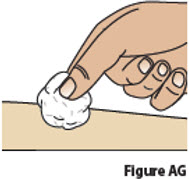
- Carefully push the pink needle shield over the needle until it snaps into place and covers the needle. Do not recap the needle using the needle cap; only use the pink needle shield to cover the needle.
- Throw away the used prefilled syringe with the needle still attached, into an FDA-cleared sharps disposal container.
Risk Summary
Available human data with BESREMi use in pregnant women are insufficient to identify a drug-associated risk of major birth defects, miscarriage or adverse maternal or fetal outcomes. Animal studies assessing reproductive toxicity of BESREMi have not been conducted. Based on mechanism of action and the role of interferon alfa in pregnancy and fetal development, BESREMi may cause fetal harm and should be assumed to have abortifacient potential when administered to a pregnant woman. There are adverse effects on maternal and fetal outcomes associated with polycythemia vera in pregnancy (see Clinical Considerations). Advise pregnant women of the potential risk to a fetus.
The estimated background risk of major birth defects and miscarriage for the indicated population is unknown. All pregnancies have a background risk of birth defect, loss, or other adverse outcomes. In the U.S. general population, the estimated background risk of major birth defects and miscarriage is 2-4% and 15-20%, respectively.
Clinical Considerations
Disease-Associated Maternal and/or Embryo-Fetal Risk
Untreated polycythemia vera during pregnancy is associated with adverse maternal outcomes such as thrombosis and hemorrhage. Adverse pregnancy outcomes associated with polycythemia vera include increased risk for miscarriage.
Pregnancy Testing
Pregnancy testing prior to BESREMi treatment is recommended for females of reproductive potential.
Contraception
Females
Advise female patients of reproductive potential to use effective contraception during treatment with BESREMi and for at least 8 weeks after the final dose.
Infertility
Females
Based on its mechanism of action, BESREMi can cause disruption of the menstrual cycle [see Clinical Pharmacology (12.1)]. No animal fertility studies have been conducted with BESREMi.
Absorption
The estimated geometric mean (CV%) of the absorption rate constant of BESREMi is 0.12 day-1 (27%) in patients with polycythemia vera.
Distribution
The estimated geometric mean (CV%) of apparent volume of distribution of BESREMi is 4.8 L (21%) in patients with polycythemia vera.
Elimination
BESREMi undergoes receptor independent degradation/excretion and receptor binding and subsequent degradation of the drug-receptor complex. The half-life and clearance of BESREMi is approximately 7 days and 1.7-2.5 L/h in patients with polycythemia vera over a dose range of 100 mcg to 500 mcg, respectively.
Specific Populations
No clinically significant differences in the pharmacokinetics of BESREMi were observed based on age, sex, body surface area, and JAK2V617F mutation.
Drug Interactions
Clinical Studies
No clinical studies evaluating the drug interaction potential of BESREMi have been conducted.
In Vitro Studies
In vitro studies indicate that BESREMi exhibited time-dependent inhibitory potential on CYP2A6. BESREMi did not inhibit CYP1A2, CYP2B6, CYP2C8, CYP2C9, CYP2C19, CYP2D6, CYP2E1, and CYP3A4 in human liver microsomes. BESREMi is not expected to induce CYP enzymes. However, interferon may influence CYP450 through modulating transcription factors and altering protein expression and/or structure. As this mechanism requires more time to exert effect, it cannot be evaluated by in vitro assays.
Depression and Suicide
Inform patients, their caregivers, and family members that suicidal ideation and behavior, as well as new onset or worsening depression have been reported in patients treated with BESREMi. Advise them to be aware of any unusual changes in mood or behavior, new onset or worsening of depression, or the emergence of suicidal thoughts or behavior. Instruct patients, caregivers, and family members to report signs or symptoms of depression to their healthcare provider right away, but to discontinue BESREMi immediately and seek immediate medical attention if suicidal ideation or attempts occur [see Warnings and Precautions (5.1)].
Endocrine Toxicity
Advise patients to report any signs or symptoms of diabetes or thyroid dysfunction [see Warnings and Precautions (5.2)].
Cardiovascular Toxicity
Advise patients to report signs or symptoms of cardiovascular toxicity to their healthcare provider [see Warnings and Precautions (5.3)].
Decreased Peripheral Blood Counts
Advise patients to seek prompt medical attention if they experience weakness/fatigue, fever, easy bruising, or frequent nose bleeds [see Warnings and Precautions (5.4)].
Hypersensitivity
Advise patients to seek immediate medical attention if they experience any symptoms of serious hypersensitivity reactions [see Warnings and Precautions (5.5) and Drug Interactions (7)].
Pancreatitis
Advise patients to report signs or symptoms of pancreatitis [see Warnings and Precautions (5.6)].
Colitis
Advise patients to report signs or symptoms of colitis [see Warnings and Precautions (5.7)].
Pulmonary Toxicity
Advise patients to report signs or symptoms of pulmonary toxicity [see Warnings and Precautions (5.8)].
Ophthalmologic Toxicity
Advise patients to report visual changes and to have eye examinations before and during treatment [see Warnings and Precautions (5.9)].
Hyperlipidemia
Advise patients that BESREMi may increase blood triglycerides and that they will need blood testing to monitor for this toxicity [see Warnings and Precautions (5.10)].
Hepatotoxicity
Advise patients to report signs or symptoms of hepatic toxicity to their healthcare provider [see Warnings and Precautions (5.11) and Use in Specific Populations (8.7)].
Renal Toxicity
Advise patients to report signs or symptoms of kidney disease [see Warnings and Precautions (5.12) and Use in Specific Populations (8.6)].
Dental and Periodontal Toxicity
Advise patients to maintain good oral hygiene and to have regular dental examinations [see Warnings and Precautions (5.13)].
Dermatologic Toxicity
Advise patients to seek medical attention if significant pruritus, alopecia, rash and/or other dermatological toxicities occur [see Warnings and Precautions (5.14)].
Hazardous Occupations/Operating Machinery
Advise patients to refrain from engaging in operating heavy or potentially dangerous machinery until they know how BESREMi will affect their abilities. Advise patients who experience dizziness, somnolence and hallucinations not to drive or use heavy machinery [see Warnings and Precautions (5.15)].
Pregnancy and Contraception
Advise women about the need to use an effective method of contraception while taking BESREMi and for at least 8 weeks after the final dose [see Use in Specific Populations (8.1, 8.3)].
Lactation
Advise women not to breastfeed during treatment and for 8 weeks after the final dose [see Use in Specific Populations (8.2)].
Instruction on Injection Technique
Instruct patients on proper storage, preparation and administration techniques for BESREMi. Instruct patients who are self-administering to inject the prescribed dose of BESREMi [see Dosage and Administration (2.4)].
Manufactured by:
PharmaEssentia Corporation
2F-5 No. 3 YuanQu Street
Nangang Dist. Taipei, Taiwan
U.S. License number 2155
Distributed by:
PharmaEssentia USA Corporation
35 Corporate Dr, Suite 325, Burlington, MA 01803, USA
© PharmaEssentia USA Corporation, 2021