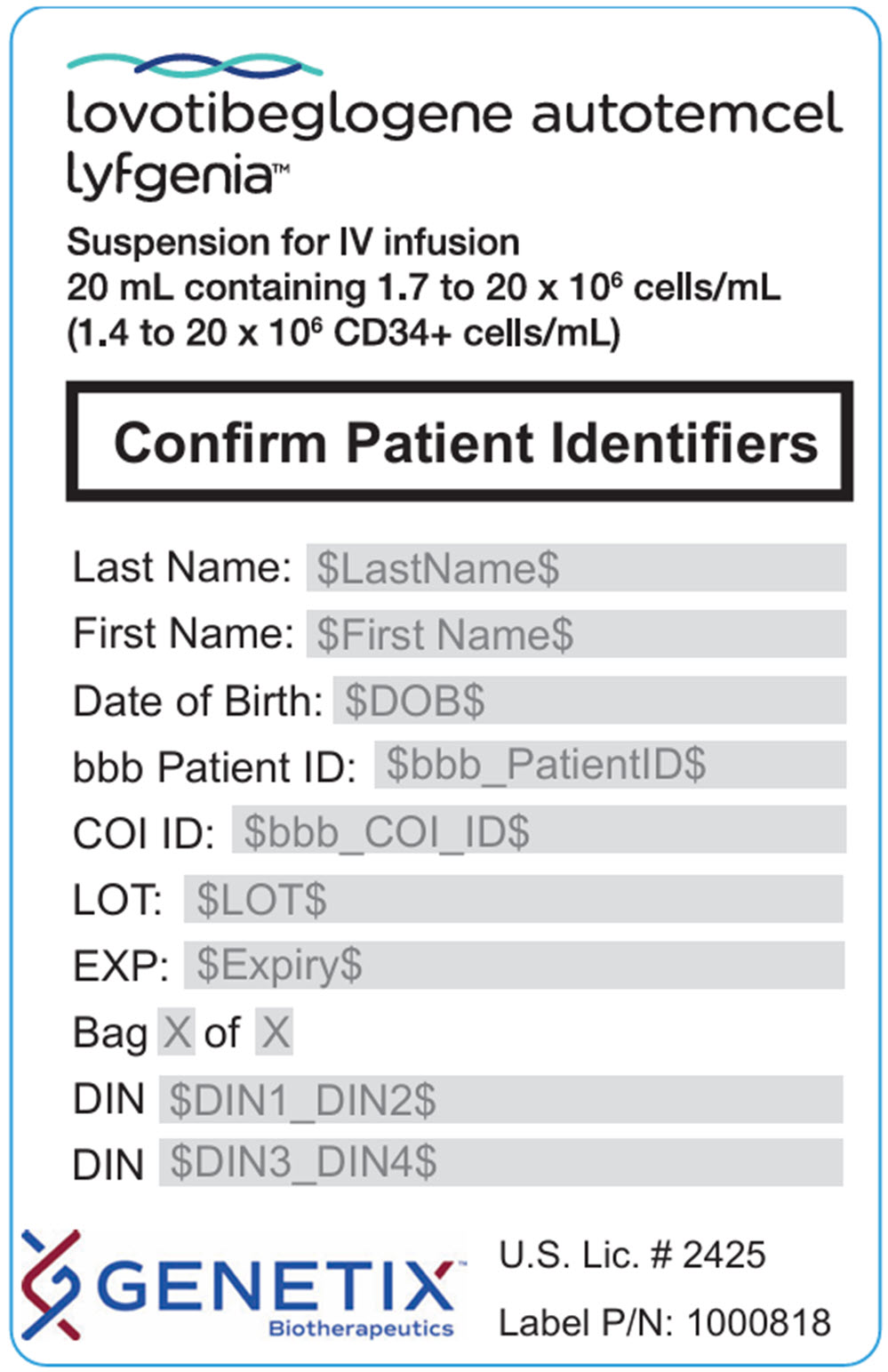
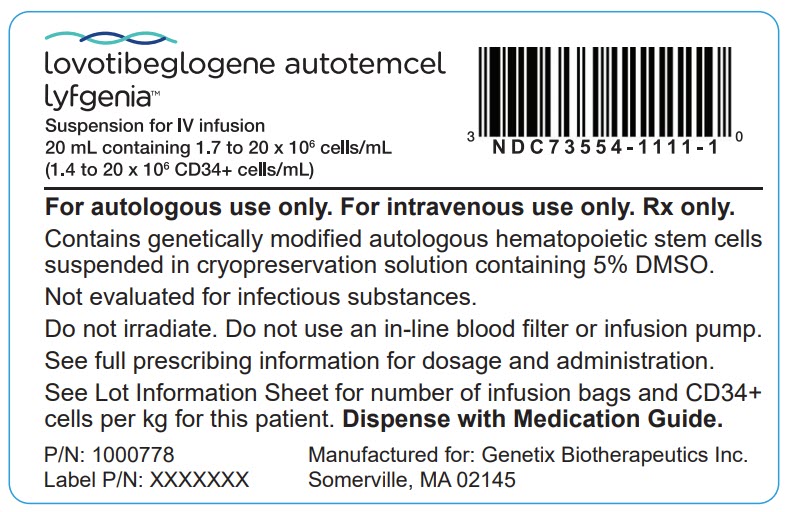
Standard procedures for patient management after HSC transplantation should be followed after LYFGENIA infusion.
- Irradiate any blood products required for at least the first 3 months after LYFGENIA infusion and per transplant physician's recommendation.
- There is no experience regarding the use of hydroxyurea, anti-retrovirals, erythropoietin or disease-modifying agents, such as voxelotor or crizanlizumab, after LYFGENIA infusion.
- Avoid use of myelosuppressive iron chelators for 6 months. If iron chelation is needed, consider administration of non-myelosuppressive iron chelators. Phlebotomy can be used in lieu of iron chelation when appropriate.
- G-CSF is not recommended for 21 days after LYFGENIA infusion.
- Patients should not donate blood, organs, tissues, or cells at any time in the future.
LYFGENIA contains human blood stem cells that are genetically modified with a replication-incompetent, self-inactivating lentiviral vector (LVV). Follow universal precautions and local biosafety guidelines (Biosafety Level 2) for handling and disposal of LYFGENIA to avoid potential transmission of infectious diseases.
Post-Marketing Long Term Follow-Up Study
Patients who intend to receive treatment with LYFGENIA are encouraged to enroll in the study, as available, to assess the long-term safety of LYFGENIA and the risk of malignancies occurring after treatment with LYFGENIA by calling Genetix Biotherapeutics at 1-833-999-6378. The study includes monitoring (at pre-specified intervals) for clonal expansion.
Anemia
Two patients developed anemia following LYFGENIA treatment; one patient continues to require monthly packed red blood cell (pRBC) transfusions. The other patient has been diagnosed with MDS. Both subjects had α-thalassemia trait (-α3.7 /-α3.7) [see Limitations of Use (1)].
Infusion-related reactions to LYFGENIA
Pre-medication for infusion reactions was managed at physician discretion. Infusion-related reactions to LYFGENIA were observed in 2 patients on the day of LYFGENIA infusion. Both infusion-related reactions resolved and were Grade 1. Events included hot flush and decreased diastolic blood pressure.
Platelet engraftment delay
Platelet engraftment, defined as having 3 consecutive platelet values ≥ 50 × 109/L obtained on different days after the initial post-transplant nadir without receiving any platelet transfusions for 7 days immediately preceding and during the evaluation period, was achieved in all patients (median [min, max] Day 37 [19, 235]) after LYFGENIA infusion. Two patients treated with LYFGENIA achieved platelet engraftment after Day 100; one of these patients was administered eltrombopag until Day 234 [see Warnings and Precautions (5.2)].
Neutrophil engraftment
All patients achieved neutrophil engraftment. Neutrophil engraftment, defined as having 3 consecutive ANC laboratory values ≥ 0.5 × 10⁹ cells/L obtained on 3 different days by Day 43, was reported on median (min, max) Day 20 (12, 35) after LYFGENIA infusion.
Risk Summary
There are no available data on LYFGENIA administration in pregnant women. Consider the risks associated with myeloablative conditioning agents on pregnancy and fertility.
No reproductive and developmental toxicity studies in animals have been conducted with LYFGENIA to assess whether it can cause fetal harm when administered to a pregnant woman. It is not known whether LYFGENIA has the potential to be transferred to the fetus. Therefore, LYFGENIA should not be administered to women who are pregnant, and pregnancy after LYFGENIA infusion should be discussed with the treating physician.
In the U.S. general population, the estimated background risk of major birth defects and miscarriage in clinically recognized pregnancies is 2%-4% and 15%-20%, respectively.
Risk Summary
There is no information regarding the presence of LYFGENIA in human milk, the effect on the breastfed infant, and the effects on milk production. The developmental and health benefits of breastfeeding should be considered along with the mother's clinical need for LYFGENIA and any potential adverse effects on the breastfed child from LYFGENIA. Therefore, LYFGENIA is not recommended for women who are breastfeeding, and breastfeeding after LYFGENIA infusion should be discussed with the treating physician.
Pregnancy Testing
A negative serum pregnancy test must be confirmed prior to the start of mobilization and re‑confirmed prior to conditioning procedures and before LYFGENIA administration.
Contraception
There are insufficient exposure data to provide a precise recommendation on duration of contraception following treatment with LYFGENIA.
Women of childbearing potential and men capable of fathering a child should use an effective method of contraception (intra-uterine device or combination of hormonal and barrier contraception) from start of mobilization through at least 6 months after administration of LYFGENIA. Advise patients of the risks associated with conditioning agents.
Infertility
There are no data on the effects of LYFGENIA on fertility.
Data are available on the risk of infertility with myeloablative conditioning. Advise patients of the risks and the options for fertility preservation.
Efficacy Outcomes
The transplant population for VOE efficacy outcomes included patients with a history of at least 4 VOEs in the 24 months prior to informed consent. The efficacy outcomes were complete resolution of VOEs (VOE-CR) and severe VOEs (sVOE-CR) between 6 months and 18 months after infusion of LYFGENIA.
VOEs were defined as any of the following events requiring evaluation at a medical facility:
- an episode of acute pain with no medically determined cause other than vaso-occlusion, lasting more than 2 hours
- acute chest syndrome (ACS)
- acute hepatic sequestration
- acute splenic sequestration
Severe VOE (sVOE) were defined as either of the following events:
- VOE requiring a hospitalization or multiple visits to an emergency department/urgent care over 72 hours and receiving intravenous medications at each visit
- priapism requiring any level of medical attention
Table 3: Summary of VOE Efficacy Outcomes for Patients in Study 1-C| Clinical Attribute | Results |
|---|
| (s)VOE-CR = elimination of (s)VOEs between 6 and 18 months post infusion with LYFGENIA. |
| VOE-CR | |
| n/N (%) | 28/32 (88%) |
| [95% CI] | [71, 97] |
| sVOE-CR | |
| n/N (%) | 30/32 (94%) |
| [95% CI] | [79, 99] |
Globin response (GR) was defined as meeting the following criteria for a continuous period of at least 6 months after drug product infusion:
- weighted average hemoglobin AT87Q percentage of non-transfused total Hb ≥ 30% AND
- weighted average non-transfused total Hb (HbS+HbF+HbA2+HbAT87Q) increase of ≥ 3 g/dL compared to baseline total Hb OR weighted average non-transfused total Hb ≥ 10 g/dL.
All 36 patients infused in Study 1-C (transplant population) were evaluated for globin response. 31/36 (86%) achieved GR. All patients maintained GR once it was achieved.
The median (min, max) duration of follow-up for the patients in Study 1-C (N = 36) is 38 (12, 61) months post LYFGENIA infusion. After the primary evaluation period to last follow-up, 4 of 32 patients who achieved VOE-CR experienced VOEs while maintaining GR. After the primary evaluation period up to 24 months, 17 of 35 (49%) patients were prescribed opioids for sickle cell and non-sickle cell-related pain.
Neurologic outcome
Five patients with history of stroke or vasculopathy were treated on Study 1-C. All were at least 18 years old and on chronic transfusion therapy prior to LYFGENIA infusion. At 44-60 months follow up, all five subjects remain transfusion independent without recurrent stroke.
Manufactured for:
Genetix Biotherapeutics Inc.
Somerville, MA 02145
US License No 2425
LYFGENIA is a registered trademark of Genetix Biotherapeutics Inc.
© Genetix Biotherapeutics Inc. 2025. All rights reserved.