- G-CSF – optional in Study 1 (administered to 75% of patients) and required in Study 2 (beginning on Day 5)
- See Section 6 for engraftment information.
Comparison of SKYSONA with the Natural History of CALD
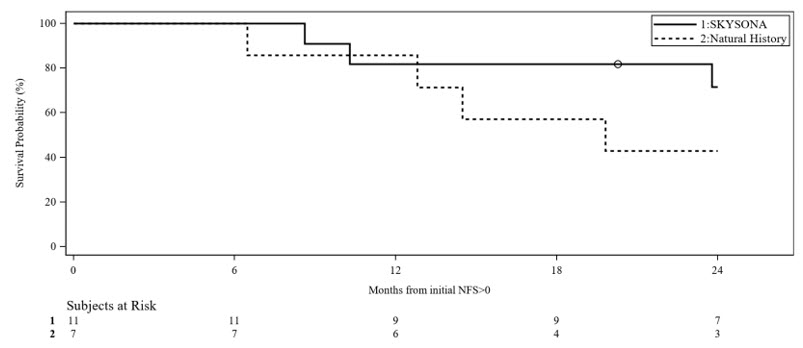
A post-hoc enrichment analysis in symptomatic patients compared time from onset of symptoms (NFS ≥ 1) to time to first Major Functional Disability (MFD) or death (i.e., MFD-free survival) in SKYSONA treated and Natural History patients. The MFDs are defined as: loss of communication, cortical blindness, requirement for tube feeding, total incontinence, wheelchair dependence, or complete loss of voluntary movement. To be included in the analysis, patients had to have symptoms at baseline (NFS=1) or be asymptomatic (NFS=0) at baseline and have developed symptoms (NFS ≥ 1) during the course of follow-up in the study. Additionally, they had to have at least 24 months of follow-up after initial NFS ≥ 1 or have had an event (MFD or death).
The 7 patients in the Natural History Population were a median (min, max) 9 (5, 15) years old at time of CALD diagnosis, and 10 (5, 17) years at time of first NFS ≥ 1. The median Loes score at diagnosis was 5 (2, 9). Four (57%) had a baseline brain MRI pattern of disease inclusive of parieto-occipital involvement, 2 (29%) had frontal disease (without parieto-occipital involvement) and 1 (14%) had isolated pyramidal tract disease. One (14%) had a baseline NFS=1 at diagnosis, and the remainder were asymptomatic (NFS=0) at diagnosis.
The symptomatic SKYSONA subpopulation (N=11) had baseline median (min, max) age at treatment of 6 (4, 10) years, age at first NFS ≥ 1 of 7 (4, 10) years, and a baseline Loes score of 2.5 (1, 9). Ten (91%) patients had a parieto-occipital pattern of disease on brain MRI and 1 (9%) had isolated pyramidal tract disease. At baseline, 2 (18%) patients had an NFS=1 and the remainder were asymptomatic (NFS=0) prior to treatment.
Slower progression to MFD or death from time of symptom onset (first NFS ≥ 1) was seen for early, active CALD patients treated with SKYSONA compared to a similar natural history of disease (Figure 1). Kaplan-Meier (KM) estimated MFD-free survival at Month 24 from time of first NFS ≥ 1 were 72% (95% CI: 35%, 90%) for the symptomatic SKYSONA subpopulation and 43% (95% CI: 10%, 73%) for the Natural History Population. There were insufficient data beyond 24 months for the symptomatic SKYSONA subpopulation to assess long-term MFD-free survival as compared to the natural history of disease. There was insufficient duration of follow-up to assess efficacy in SKYSONA treated patients who remained asymptomatic.
Figure 1 Kaplan-Meier Curve of MFD-free Survival in Symptomatic Patients of SKYSONA and Natural History Populations
Isolated Pyramidal Tract Disease
Two untreated patients in Study 3 had early CALD with isolated pyramidal tract disease on brain MRI. Both remained asymptomatic for approximately 10 years following CALD diagnosis with first symptoms documented at 19 and 20 years of age. Ten patients with early, active pyramidal tract disease were treated with SKYSONA in Studies 1 and 2, and have only been followed a maximum of 77 months following treatment and to a maximum age at last follow-up of 15 years. Two (20%) SKYSONA-treated patients were diagnosed with myelodysplastic syndrome (MDS) and received allo-HSCT as treatment of the hematologic malignancy. One (10%) patient developed symptoms and worsening lesions on brain MRI approximately 6 months following treatment with SKYSONA and was withdrawn from the study to receive allo-HSCT at the investigator's discretion. He subsequently died of transplant-related causes.
Comparison of SKYSONA with Allogeneic Hematopoietic Stem Cell Transplant (allo-HSCT)
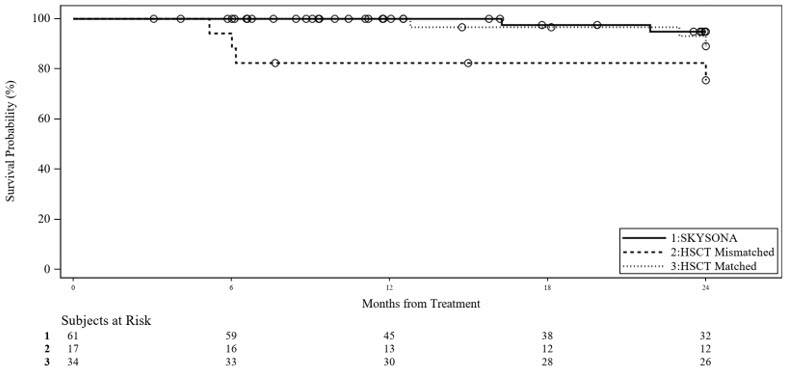
There were insufficient data to compare relative efficacy of SKYSONA to the standard of care, allogeneic hematopoietic stem cell transplant (allo-HSCT) in the treatment of CALD. However, while it does not inform the efficacy analysis, comparison of SKYSONA with an external allo-HSCT control (pooled from Study 3 and from a mixed prospective and retrospective allo-HSCT data collection study, Study 4) was performed for overall survival (OS) due to concerns about treatment-related toxicities. OS was analyzed as time-to-event Kaplan-Meier estimates comparing SKYSONA (entire efficacy population, N=61) to early, active allo-HSCT subpopulations by donor type: human leukocyte antigen (HLA)-Matched allo-HSCT Subpopulation (N=34) and HLA-Mismatched allo-HSCT Subpopulation (N=17) (Figure 2). There were insufficient long-term data to compare OS beyond Month 24. However, a distinct difference in OS in the first 9 months following treatment was seen for the subpopulation who received allo-HSCT from an HLA-mismatched donor as compared to SKYSONA and allo-HSCT from an HLA-matched donor. While this analysis does not provide evidence of efficacy of SKYSONA, it does demonstrate a survival advantage of SKYSONA as compared to allo-HSCT from an HLA-mismatched donor, with early mortality in the HLA-mismatched allo-HSCT Subpopulation largely attributed to allo-HSCT-related toxicities.
No patient experienced acute (≥ Grade II) or chronic graft versus host disease (GVHD) after SKYSONA treatment.
Figure 2 Kaplan-Meier Curve of Overall Survival Between SKYSONA and Allo-HSCT Treated Populations
Post-treatment Brain MRI
At Month 24 following treatment with SKYSONA, 7/36 (19%) evaluable patients had a cerebral MRI Loes score increase of ≥ 6 points; 3/30 (10%) evaluable allo-HSCT patients had a cerebral MRI Loes score increase of ≥ 6 points.
Manufacturing Failure
Ensure that the patient and/or caregiver understands the risk of manufacturing failure. In case of manufacturing failure or the need for additional cells, additional cell collection and manufacturing of SKYSONA may be needed [see Dosage and Administration (2.2)].
Efficacy Failure
Inform the patient and/or caregiver that there has been unexplained efficacy failure after treatment with SKYSONA [see Use in Specific Populations (8.6)].
Hematologic Malignancy
Inform the patient and/or caregiver that insertional oncogenesis has been observed and resulted in myelodysplastic syndrome (MDS) in several children following treatment with SKYSONA. Inform the patient that MDS is a life-threatening disease and that the only curative treatment is another bone marrow transplant, with or without the addition of chemotherapy and total body irradiation. Patients will need monitoring for hematologic malignancies via blood tests at least every 6 months for a minimum of 15 years. Advise patients that they may require more frequent blood tests and invasive bone marrow biopsies if routine blood test results are concerning for the development of malignancy [see Warnings and Precautions (5.1)]. Advise the patient and/or caregiver to seek attention for any signs or symptoms of malignancy, such as fatigue or easy bleeding or bruising, and advise the patient to contact bluebird bio at 1-833-999-6378 if they are diagnosed with a hematologic malignancy.
Need for Allogeneic Hematopoietic Stem Cell Transplant
Inform the patient that some patients have required an allogeneic hematopoietic stem cell transplant after treatment with SKYSONA, in order to treat efficacy failure or hematologic malignancy. Advise the patients that they will be monitored for these complications [see Warnings and Precautions (5.1)].
Serious Infections
Inform the patient that severe infections, including life-threatening infections, have occurred following SKYSONA treatment and may require prolonged hospitalization [see Warnings and Precautions (5.2)].
Prolonged Cytopenias
Inform the patient and/or caregiver that prolonged cytopenias have been observed following SKYSONA treatment and that they may require frequent blood draws until blood counts have returned to safe levels. Advise the patient and/or caregiver to seek attention for any signs or symptoms of thrombocytopenia, neutropenia, or anemia, such as easy bleeding, serious infections, or fatigue [see Warnings and Precautions (5.3)].
Delayed Platelet Engraftment
Inform the patient that a risk of bleeding and a likely need for platelet transfusion exists after myeloablative conditioning and during the weeks to months before platelet engraftment occurs [see Warnings and Precautions (5.4)].
Risk of Neutrophil Engraftment Failure
Inform the patient and/or caregiver of the potential risk of neutrophil engraftment failure and the need for rescue treatment with their back-up collection of CD34+ cells, if engraftment failure occurs [see Warnings and Precautions (5.5)].
Laboratory Test Interference
Advise patients that they may test positive for HIV if tested using a PCR test after being treated with SKYSONA [see Warnings and Precautions (5.8)]. Advise the patient and/or caregiver that they should notify any healthcare provider about this possibility prior to being tested for HIV.
Advise patients that they will be screened for HBV, HCV, HIV, and HTLV before collection of cells.
Inform patients that they should not donate blood, organs, tissues, or cells at any time in the future [see Dosage and Administration (2.3)].
Manufactured for:
bluebird bio, Inc.
Somerville, MA 02145
US License No 2160
SKYSONA and LENTI-D are trademarks of bluebird bio, Inc
© bluebird bio, Inc. 2022. All rights reserved.