Trial 1 and Trial 2
In the two randomized, actively-controlled clinical trials, Trial 1 and Trial 2 [see Clinical Studies (14)], patients were randomized in a 2:1 ratio to intravenous Monoferric (n = 2008) or intravenous iron sucrose (n = 1000) respectively. Monoferric was administered as a single intravenous infusion of 1000 mg diluted in 100 mL 0.9 % sodium chloride and given over approximately 20 minutes (approximately 50 mg iron/min). Iron sucrose was administered as 200 mg undiluted intravenous injections over approximately 2-5 minutes and repeated according to standard practice or physician choice up to a maximum of five times (1000 mg) within the first two weeks starting at baseline.
The data described below reflect exposure to Monoferric in 2008 patients exposed to a 1000 mg single intravenous dose of Monoferric. The mean cumulative intravenous Iron exposure was 984 mg.
Trial 1 included 1483 patients with iron deficiency anemia in the safety analysis that had intolerance to oral iron or have had unsatisfactory response to oral iron or with a clinical need for rapid repletion of iron stores. Trial 2 included 1525 patients in the safety analysis who had non-dialysis dependent CKD. The mean (SD) age of the combined study population was 56.4 (18.3) years. The majority of patients were women (75.7%).
Adverse reactions were reported in 8.6% (172/2008) of patients treated with Monoferric.
Adverse reactions related to treatment and reported by ≥1% of the treated patients in the combined analysis of Trial 1 and 2 are listed in Table 1.
Table 1. Adverse Reactions (≥1%) in Patients Receiving Monoferric in Clinical Trials 1 and 2 | Monoferric (N = 2008)
N (%) | Iron sucrose (N = 1000)
N (%) |
|---|
| Adverse Reaction |
| Nausea | 24 (1.2) | 11 (1.1) |
| Rash | 21 (1) | 1 (0.1) |
Adjudicated serious or severe hypersensitivity reactions were reported in 6/2008 (0.3%) patients in the Monoferric group.
Hypophosphatemia (serum phosphate <2.0 mg/dL) was reported in 3.5% of Monoferric-treated patients in Trials 1 & 2.
Risk Summary
There are no available data on Monoferric use in pregnant women to evaluate for a drug-associated risk of major birth defects, miscarriage or adverse maternal or fetal outcomes. Published studies on the use of intravenous iron products in pregnant women have not reported an association with adverse developmental outcomes. However, these studies cannot establish or exclude the absence of any drug-related risk during pregnancy because the studies were not designed to assess for the risk of major birth defects [see Data]. There are risks to the mother and fetus associated with untreated iron deficiency anemia (IDA) in pregnancy [see Clinical Considerations]. Iron complexes have been reported to be teratogenic and embryocidal in non-iron depleted pregnant animals. The findings in animals may be due to iron overload and may not be applicable to patients with iron deficiency. Animal reproduction studies of ferric derisomaltose administered to rats and rabbits during the period of organogenesis caused adverse developmental outcomes including structural abnormalities and embryo-fetal mortality at doses approximately 0.09 and 0.4 times the maximum recommended human dose (MRHD) of 1000 mg, respectively, based on body surface area [see Data].
The estimated background risk of major birth defects and miscarriage for the indicated populations is unknown. Adverse outcomes in pregnancy occur regardless of the health of the mother or the use of medications. In the U.S. general population, the estimated background risk of major birth defects and miscarriage in clinically recognized pregnancies is 2-4% and 15-20%, respectively.
Clinical Considerations
Disease-associated maternal and/or embryo/fetal risk
Untreated iron deficiency anemia (IDA) in pregnancy is associated with adverse maternal outcomes such as post-partum anemia. Adverse pregnancy outcomes associated with IDA includes increased risk for preterm delivery and low birth weight.
Data
Animal Data
Iron complexes have been reported to be teratogenic and embryocidal in non-anemic pregnant animals at single doses above 125 mg iron/kg body weight. The highest recommended dose in human clinical use is 20 mg iron/kg body weight.
In a combined fertility and embryo-fetal development study in rats, ferric derisomaltose was administered intravenously to female rats 14 days prior to cohabitation and through gestation day (GD) 17 at doses of 3, 11, and 32 mg Fe/kg/day. The doses of 11 and 32 mg Fe/kg/day (approximately 0.1 and 0.3 times the MRHD of 1000 mg, based on body surface area (BSA)) resulted in an increase in the incidence of skeletal developmental delays.
Ferric derisomaltose was administered intravenously to pregnant rabbits during organogenesis, from GD7 to GD20, at doses of 11, 25 and 43 mg Fe/kg/day. The dose of 43 mg Fe/kg/day (approximately 0.8 times the MRHD of 1000 mg, based on BSA) resulted in increased maternal mortality, abortion, and premature delivery, and increased postimplantation loss. Adverse developmental findings at this dose included fetal mortality, reduced fetal weights, and fetal developmental variations and malformations (including domed head, cleft palate, macroglossia, hydrocephaly, small brain). Fetal malformations and reduced fetal weights were also noted in the 25 mg Fe/kg/day group (approximately 0.5 times the MRHD based on BSA).
Risk Summary
The available data on the use of Monoferric in lactating women demonstrate that iron is present in breast milk. However, the data do not inform the potential exposure of iron for the breastfed child or the effects on milk production. The developmental and health benefits of breastfeeding should be considered along with the mother's clinical need for Monoferric in addition to any potential adverse effects on the breastfed child from the drug or from the underlying maternal condition.
Clinical Considerations
Monitor breastfed children for gastrointestinal toxicity (constipation, diarrhea).
Cardiac Electrophysiology
Electrocardiogram (ECG) monitoring for QT prolongation was performed in a sub-study in 35 patients randomized to Monoferric in Trial 1. No large mean increase in QTc (i.e. >20 ms) interval was detected at the 1000 mg single dose of Monoferric.
Distribution
Circulating iron is removed from the plasma by cells of the reticuloendothelial system. The iron is bound to the available protein moieties to form hemosiderin or ferritin, the physiological storage forms of iron, or to a lesser extent, to the transport molecule transferrin.
Elimination
After a single 1000 mg Monoferric dose, the mean (CV%) half-life of serum total iron is 27 (13.3%) hr.
Excretion
Due to the size of the complex, Monoferric is not excreted via the kidneys. Small quantities of iron are excreted in urine and feces.
Iron Deficiency Anemia in Patients Who Had Intolerance to Oral Iron or Who Had Unsatisfactory Response to Oral Iron
In Trial 1 (NCT02940886) 1512 adult patients with IDA caused by different etiologies, who had documented intolerance or lack of response to oral iron or screening hemoglobin (Hb) measurement sufficiently low to require repletion of iron stores were randomized in a 2:1 ratio to treatment with Monoferric or iron sucrose. Adult patients aged ≥18 years with baseline Hb ≤11 g/dL, TSAT <20 %, and s-ferritin <100 ng/mL were eligible for enrollment. The median age of patients was 44 years (range 18-91) and 89 % were women.
The efficacy of Monoferric was established based upon the change in Hb from baseline to week 8. Non-inferiority was demonstrated for change in Hb from baseline to Week 8 (Table 2).
Table 2. Change in Hemoglobin Endpoints in Trial 1| Trial 1 | Monoferric
N = 1009 | Iron sucrose
N = 503 | Difference |
|---|
Mean change in Hb from Baseline to Week 8
MeanLeast square mean (95% CI), g/dL
(Primary endpoint) | 2.49
(2.41;2.56) | 2.49
(2.38;2.59) | Estimate The estimate is from a mixed model for repeated measures with treatment, week, treatment-by-week and stratum as fixed effects and baseline Hb and baseline-by-week as covariates. : 0.00 (95% CI -0.13;0.13)
Non-inferiority confirmed |
Iron Deficiency Anemia in Patients with Non-Hemodialysis Dependent Chronic Kidney Disease (NDD-CKD)
Trial 2 (NCT02940860) was a randomized controlled trial in 1538 patients with NDD-CKD who were randomized in a 2:1 ratio to treatment with Monoferric or iron sucrose respectively. Adult patients aged ≥18 years with Hb ≤11 g/dL, s-ferritin ≤100 ng/mL (or ≤300 ng/mL if TSAT ≤30%), chronic renal impairment with eGFR between 15-59 mL/min, and either no ESAs or ESAs at a stable dose (+/-20 %) for 4 weeks before randomization were eligible for enrollment. The median age of patients was 69 years (range 25-97), 63% were female.
The efficacy of Monoferric was established based upon the demonstration of non-inferiority for change in hemoglobin from baseline to Week 8 (Table 3).
Table 3. Change in Hemoglobin Endpoints in Trial 2| Trial 2 | Monoferric
N = 1027 | Iron sucrose
N = 511 | Difference |
|---|
Mean change in Hb from Baseline to Week 8
MeanLeast square mean (95% CI), g/dL
(Primary endpoint) | 1.22
(1.14;1.31) | 1.14
(1.03;1.26) | Estimate The estimate is from a mixed model for repeated measures with treatment, week, treatment-by-week and stratum as fixed effects and baseline Hb and baseline-by-week as covariates. : 0.08 (95% CI -0.06;0.23)
Non-inferiority confirmed |
Prior History of Allergies to Parenteral Iron Products
Question patients regarding any prior history of reactions to parenteral iron products [see Warnings and Precautions (5.1)].
Hypersensitivity Reactions
Advise patients to report any signs and symptoms of hypersensitivity that may develop during and following Monoferric administration, such as rash, itching, dizziness, lightheadedness, swelling and breathing problems [see Warnings and Precautions (5.1)].
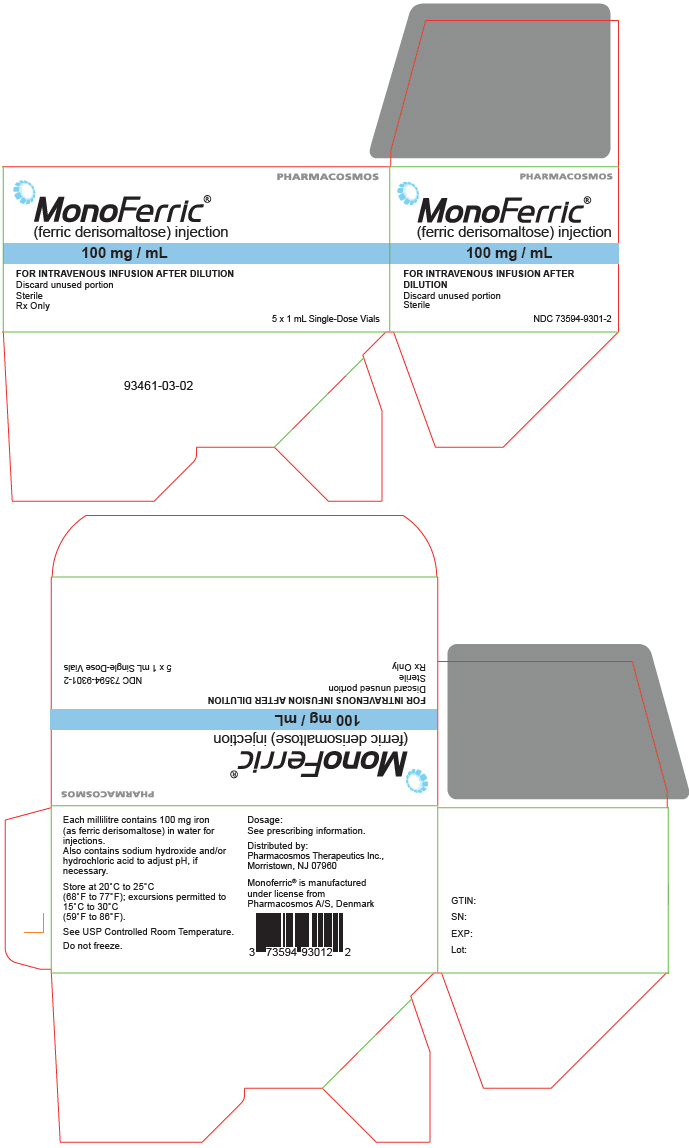
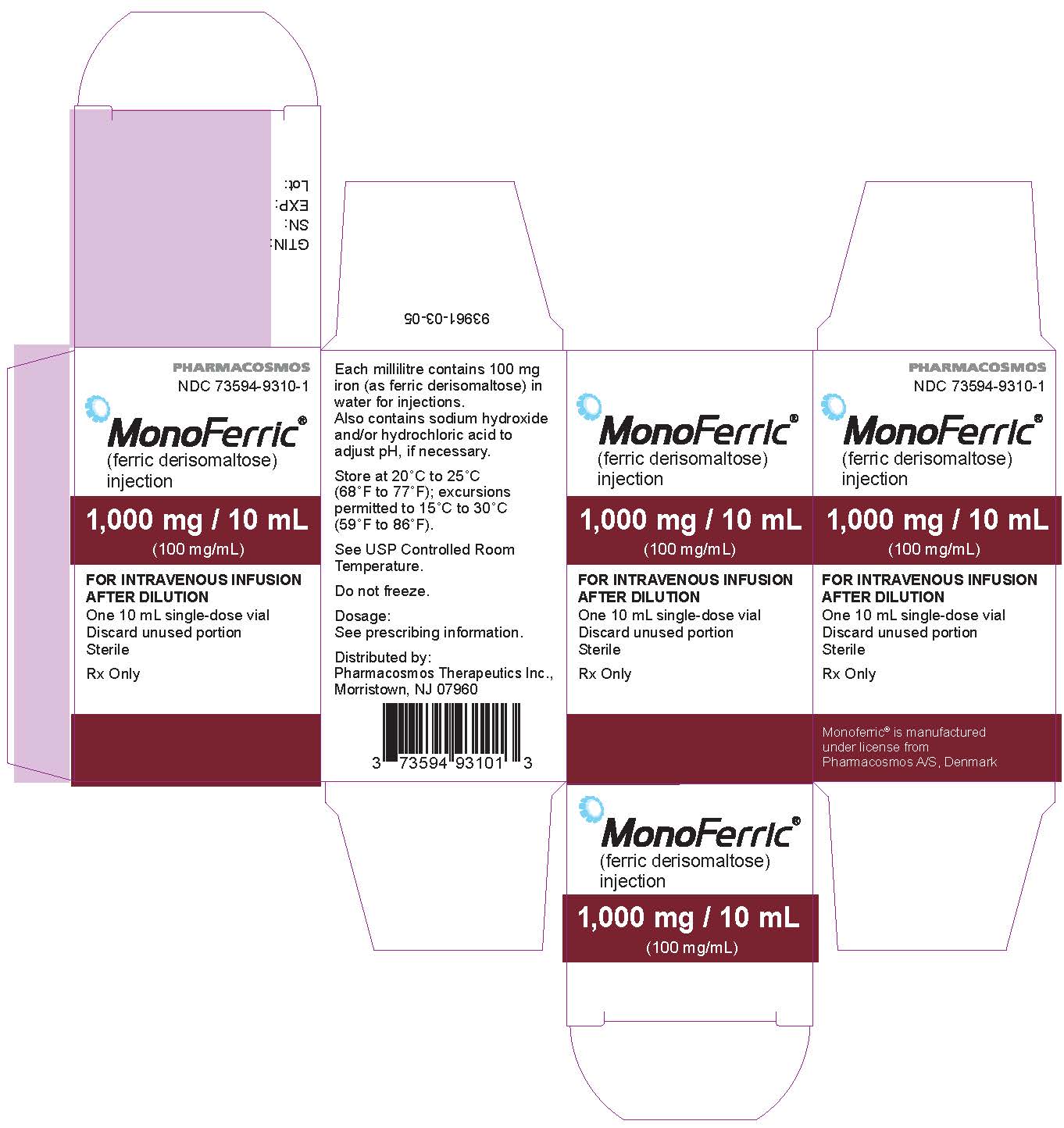
Distributed by: Pharmacosmos Therapeutics Inc., Morristown, NJ 07960
Monoferric is manufactured under license from Pharmacosmos A/S, Denmark