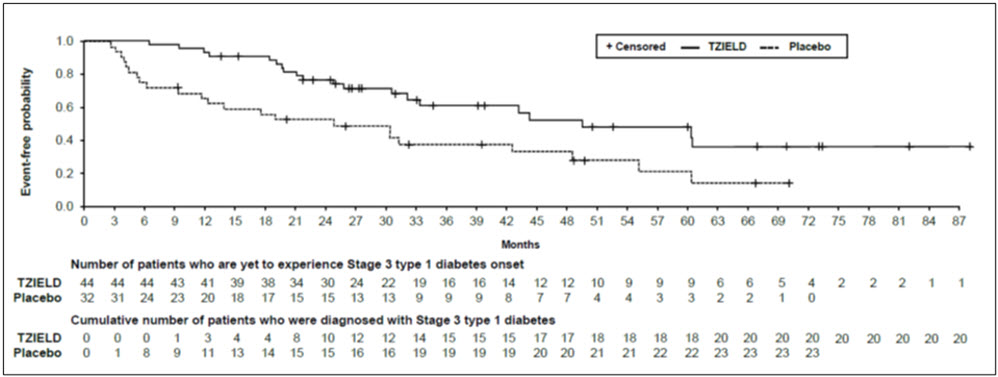
- 773 patients received TZIELD (44 patients with Stage 2 T1D and 729 patients with Stage 3 T1D), and
- 245 patients received either placebo or standard of care control (32 patients with Stage 2 T1D and 213 patients with Stage 3 T1D).
In these studies, 436 patients received a 14-day dosing regimen of TZIELD with a total drug exposure that was comparable to the total drug exposure achieved with the recommended dosage [see Dosage and Administration (2.4)], 168 patients received a 14-day course of TZIELD with a lower total TZIELD drug exposure, and 169 patients received a 6-day course of TZIELD with a lower total TZIELD drug exposure. The mean age of TZIELD-treated patients was 17.6 years (median 15 years), 62% were less than 18 years old (40% age 12 to 17; 21% age 8 to 11), 38% were 18 years and older (36% age 18 to 34; 2% age ≥35), and 64% were male. The population was 72% White, 26% Asian, 1% Black or African American, 1% were multiple or unknown race, and less than 1% American Indian or Alaska Native; 5% were Hispanic or Latino ethnicity.
Common Adverse Reactions
Cytokine Release Syndrome (CRS)
In Study TN-10, CRS was reported in 2% of TZIELD-treated patients compared to 0% of placebo-treated patients.
In the PROTECT Study, CRS was reported in 9% of TZIELD-treated patients compared to 1% of placebo-treated patients.
Of the 39 TZIELD-treated patients developed CRS (5% of all TZIELD-treated patients), in the pool of 5 clinical trials, 13% of the CRS cases were serious adverse reactions [see Warnings and Precautions (5.2)]. Liver transaminase elevations were observed in 56% of TZIELD-treated patients who experienced CRS; 64% were up to 2.5 times ULN, 32% were more than 2.5 to 5 times ULN, and 4.5% were greater than 5 –10 times ULN.
Serious Infections
In Study TN-10, serious infections (cellulitis, gastroenteritis, pneumonia, wound infection) were reported in 9% (4/44) of TZIELD-treated patients compared to 0% (0/32) of placebo-treated patients any time during or after the first dose of study treatment.
In clinical trials, serious infections were reported in 3.5% of TZIELD-treated patients compared to 2% of control-treated patients any time during or after the first dose of study treatment.
Rash and Hypersensitivity Reactions
Hypersensitivity reactions were reported with TZIELD treatment in Study TN-10. Serum sickness was observed in 2% (1/44) of TZIELD-treated patients compared to 0% (0/32) of placebo-treated patients. The patient who developed serum sickness had a prior history of positive anti-nuclear antibody and presented with arthralgias and elevated c-reactive protein and low C4 complement five days after completing their course of TZIELD; illness resolved in 2.5 months.
In the PROTECT Study, hypersensitivity reactions were reported in 1% of TZIELD-treated patients and 0% in the placebo group. One patient in the TZIELD group experienced delayed hypersensitivity. The patient had a prior history of allergic rhinitis and presented with symptoms of rash and arthralgia 16 days after completing Course 1. The event resolved with antihistamine treatment.
In the pool of 5 clinical trials of patients with Stage 2 or Stage 3 T1D:
- Anaphylaxis (with hypoxia and bronchospasm) was observed in one TZIELD-treated patient who was hospitalized.
- Angioedema (periorbital and facial) was observed in 0.3% TZIELD-treated patients, compared to 0% in control-treated patients.
- Peripheral and generalized edema was reported in 1.6% of TZIELD-treated patients and 0% of control-treated patients.
- Rash was observed in 48% of TZIELD-treated patients compared to 15% in control-treated patients, with 33 excess cases of rash per 100 patients. The majority of events of rash observed with TZIELD treatment were not serious and resolved without intervention; although 0.3% (2/773) of TZIELD-treated patients had a serious rash compared to 0% (0/245) of placebo-treated patients.
- Urticaria was reported in 1.9% of TZIELD-treated patients and in 1.2% of control-treated patients.
Immunogenicity: Anti-Drug Antibody-Associated Adverse Reactions
In Study TN-10, rash occurred in 39% of TZIELD-treated patients who developed anti-teplizumab-mzwv antibodies and in 33% of TZIELD-treated patients who did not develop anti-teplizumab-mzwv antibodies [see Clinical Pharmacology (12.6)].
In the PROTECT Study, rash occurred in 30% of TZIELD-treated patients who developed anti-teplizumab-mzwv antibodies and in 17% of TZIELD-treated patients who did not develop anti-teplizumab-mzwv antibodies [see Clinical Pharmacology (12.6)].
Open Label Study in Pediatric Patients Age 1 to Less Than 8 Years with Stage 2 T1D
The safety of TZIELD was evaluated in a non-randomized, single arm, open-label, multicenter study in 23 pediatric patients age 1 to less than 8 years with Stage 2 T1D (PETITE-T1D Study; NCT05757713)[see Clinical Pharmacology (12.3)]. In this trial, 87% completed the full 14-day treatment course. The median age was 4.9 years (1 patient was less than 2 years old; 52% were 2 to less than 5 years old; 44% were 5 to less than 8 years old; range 1.7 to 6.8 years) and 52% were female. The majority of the population (96%) was White and one patient (4%) was Asian; 3 patients (13%) were Hispanic or Latino ethnicity. At baseline, 87% of participants had a first-degree relative with T1D. The majority (87%) were positive for 3 or more diabetes-related autoantibodies. The most common autoantibodies were anti-insulin (87%), anti-ICA (85%), anti-GAD65 (83%), anti-ZnT8 (74%), and anti-IA2 (68%). The median HbA1c was 5.5%.
Overall, the safety profile of TZIELD observed in pediatric patients less than 8 years of age with Stage 2 T1D was consistent with that observed in patients 8 years of age and older with Stage 2 T1D. The most common adverse reactions that occurred in patients less than 8 years of age were vomiting (52%) and diarrhea (30%).
Other Adverse Reactions
Lymphopenia
In Study TN-10, lymphopenia was reported in 73% of TZIELD-treated patients compared to 6% of placebo-treated patients. The average lymphocyte count nadir occurred at Day 5 of treatment, with recovery and return to baseline by Week 6 [see Warnings and Precautions (5.4)].
In the PROTECT Study, lymphopenia was reported in 51% of TZIELD-treated patients compared to 3% of placebo-treated patients. Lymphocyte count nadir occurred at approximately Day 4 of treatment, with recovery and return to baseline by Week 4 [see Warnings and Precautions (5.4)].
Neutropenia
In Study TN-10, neutropenia was observed in 7% of TZIELD-treated patients compared to 3% of placebo-treated patients.
In the PROTECT Study, neutropenia was observed in 23% of TZIELD-treated patients compared to 5% of placebo-treated patients.
Decreased Hemoglobin and Thrombocytopenia
In the pool of 5 clinical trials, decreased hemoglobin was reported in 27% of TZIELD-treated patients compared to 21% of placebo-treated patients, and thrombocytopenia was reported in 13% of TZIELD-treated patients compared to 5% of placebo-treated patients during the 14-day treatment course; recovery occurred within 2 to 4 weeks of treatment. In these clinical trials, 1.8% of TZIELD-treated patients discontinued treatment due to hemoglobin less than 8.5 g/dL (or a decrease of more than 2 g/dL to a value less than 10 g/dL), and 1% discontinued TZIELD due to platelet count less than 50,000 platelets/mcL.
Liver Enzyme Elevations
Liver enzyme and bilirubin elevations were observed in TZIELD-treated patients, both in the context of CRS and in patients without CRS. In the pool of 5 clinical trials, ALT increased was reported in 25% of TZIELD-treated patients compared to 11% of placebo-treated patients during the 14-day treatment course. On laboratory analysis, 5.1% of TZIELD-treated patients experienced a peak ALT more than 3 times the ULN compared to 0.8% of control-treated patients. Most liver enzyme elevations were transient and resolved 1–2 weeks after treatment; 98% resolved by week 14.
Procedure-Related Venous Thrombosis
Venous thrombus and thrombophlebitis have been reported in patients receiving teplizumab intravenously administered via peripherally inserted central catheter (PICC). In the pool of 5 clinical trials of patients, deep vein thrombus was reported in 0.4% of TZIELD-treated patients compared to 0 placebo-treated patients. One teplizumab-treated patient (4.3%) in the PETITE-T1D study experienced a deep vein thrombosis.
Other Laboratory Abnormalities
In the pool of 5 clinical trials, other laboratory abnormalities including decreased bicarbonate (15% in TZIELD-treated patients, compared to 7% in placebo-treated patients) and decreased blood calcium (19% in TZIELD-treated patients, compared to 13% in placebo-treated patients) were noted.