Illuccix Kit
FDA Label NDC 74725-100

39 label sections · Submitted to the FDA by Telix Pharmaceuticals (us) Inc. · Indications, Dosage, Usage, and Precautions

Structured Product Label

The following Structured Product Label (SPL) was submitted to the FDA by Telix Pharmaceuticals (us) Inc. for the product Illuccix (NDC 74725-100). This document serves as the official prescribing information, containing essential scientific data and clinical materials required for healthcare providers and patients.

This specific version of the label includes detailed information regarding 1 indications and usage, 2.1 radiation safety - drug handling, 2.2 recommended dosage and administration instructions, 2.3 patient preparation, 2.4 general instructions for drug preparation, 2.5 preparation with cyclotron-produced ga 68 via ge fastlab liquid target system, 2.6 preparation with ezag galliapharm generator, 2.7 preparation with cyclotron-produced ga 68 via artms qis solid target system, and other regulatory disclosures. Use the navigation below to review specific sections of the FDA submission.

Label Section Quick Index

1 Indications And Usage

ILLUCCIX, after radiolabeling with Ga 68, is indicated for positron emission tomography (PET) of prostate-specific membrane antigen (PSMA) positive lesions in men with prostate cancer:

  • With suspected metastasis who are candidates for initial definitive therapy
  • With suspected recurrence based on elevated serum prostate-specific antigen (PSA) level
  • For selection of patients who are indicated for PSMA-directed therapy as described in the prescribing information of the therapeutic products

2.5 Preparation With Cyclotron-Produced Ga 68 Via Ge Fastlab Liquid Target System

Collection of Gallium Ga 68 Chloride Solution

After purification by the FASTlab Liquid Target System, the Gallium Ga 68 Chloride solution is passed through a sterile filter and into the cassette product vial automatically by the FASTlab Liquid Target System.

When Ga 68 is cyclotron-produced, test for Ga 66 and Ga 67 (with specification of ≤2% combined total) when a new lot of Zn 68 is introduced for manufacturing.

Radiolabeling Procedure

  • Use ILLUCCIX "Configuration A" with cyclotron-produced Ga 68 via GE FASTlab Liquid Target System.
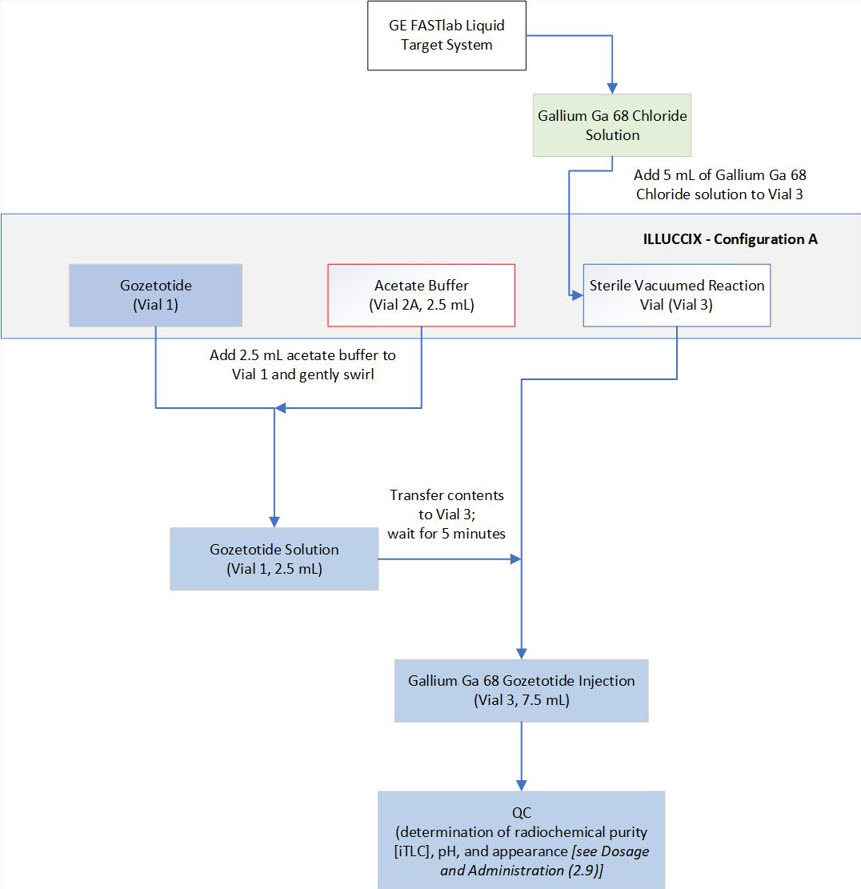
  • A schematic diagram for the preparation is provided in Figure 1.
  • Pierce Vial 3 (Sterile Vacuumed Reaction Vial) with a sterile needle connected to a 0.2 micron sterile vented filter (not supplied) to maintain atmospheric pressure within the vial during the reconstitution process.
  • Aseptically transfer 5 mL of Gallium Ga 68 Chloride solution made using the GE FASTlab Liquid Target System into Vial 3.
  • Insert a sterile 10 mL syringe with a needle into Vial 2 (Acetate Buffer Vial Configuration A) and draw up the contents of the vial (target 2.5 mL).
  • Inject the contents of the 10 mL syringe into Vial 1 (Gozetotide Vial).
  • Gently swirl Vial 1 to ensure the product is thoroughly dissolved.
  • Insert a sterile 10 mL syringe with a needle into Vial 1 containing the dissolved gozetotide and draw up the entire contents of the vial.
  • Transfer the contents of the 10 mL syringe to Vial 3 (Sterile Vacuumed Reaction Vial) containing the Gallium Ga 68 Chloride.
  • Wait for 5 minutes for radiolabeling to take place at room temperature (25°C (77°F); excursions permitted to 15°C to 30°C (59°F to 86°F)).
  • Assay the whole vial containing the Gallium Ga 68 Gozetotide Injection for total radioactivity using a dose calibrator, calculate the radioactivity concentration, and record the result.
  • Perform the quality control of Gallium Ga 68 Gozetotide Injection according to the recommended methods [see Dosage and Administration (2.9)].
  • Prior to use, visually inspect the solution behind a shielded screen for radioprotection purposes. Only use solutions that are clear without visible particles.
  • Keep the vial containing the Gallium Ga 68 Gozetotide Injection upright in a radioprotective shield container at room temperature until use.
  • The final volume of the Gallium Ga 68 Gozetotide Injection is 7.5 mL.
  • Use within 4 hours.
  • Figure 1: Drug Preparation with Cyclotron-Produced Ga 68 via GE FASTlab Liquid Target System

    Figure 1 (Illuccix 01)

    Figure 1 (Illuccix 01)

2.6 Preparation With Ezag Galliapharm Generator

Follow the generator manufacturers' instructions for generator preparation, controls, and continuous routine elution.

Radiolabeling Procedure

  • Use ILLUCCIX "Configuration A" with an EZAG GalliaPharm generator.
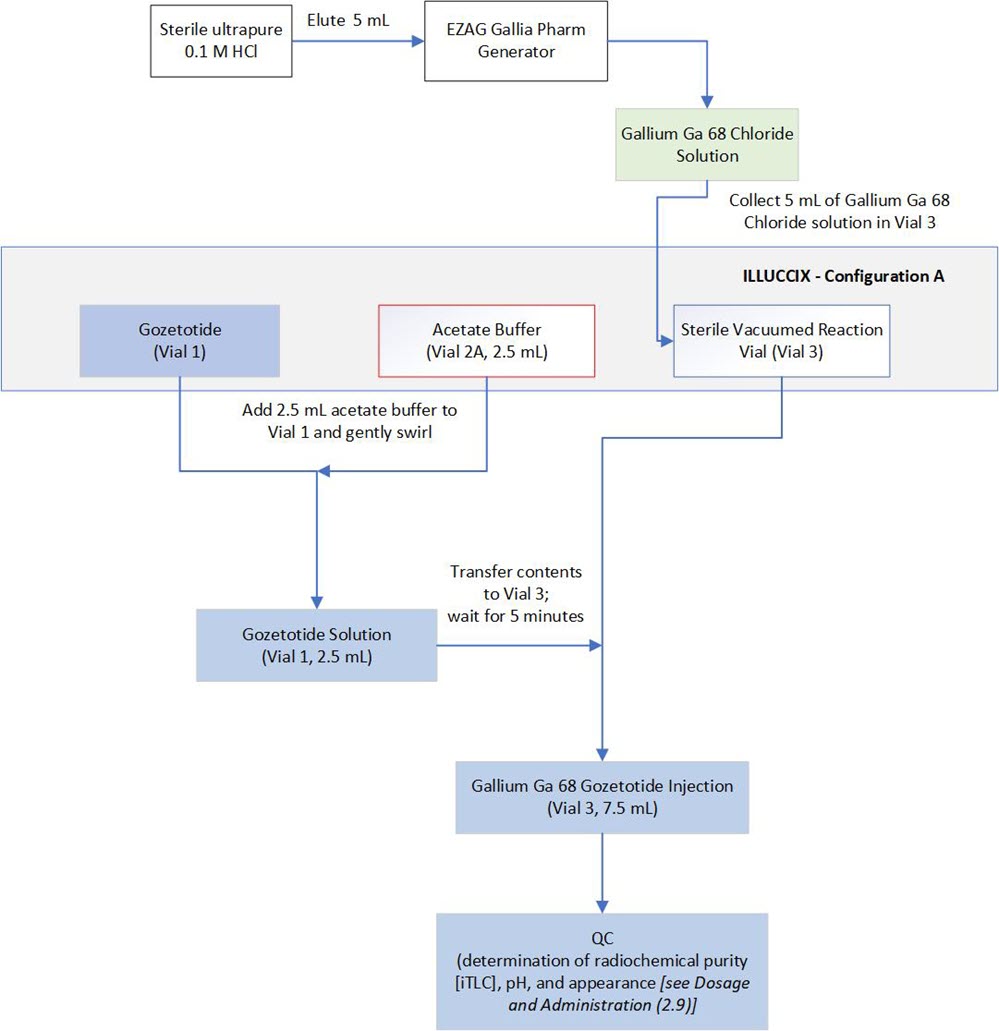
  • A schematic diagram for the preparation is provided in Figure 2.
  • Prepare a syringe containing 5 mL of sterile ultrapure 0.1 M HCl provided with the GalliaPharm generator for elution.
  • Pierce Vial 3 (Sterile Vacuumed Reaction Vial) with a sterile needle connected to a 0.2 micron sterile vented filter (not supplied) to maintain atmospheric pressure within the vial during the reconstitution process.
  • Connect the male luer of the outlet line of the GalliaPharm generator to a sterile needle.
  • Connect Vial 3 directly to the outlet line of the GalliaPharm generator by pushing the needle through the rubber septum and place the vial in a radiation shielded container.
  • Ensure the vent needle and needle to the generator outlet are pulled up as far as possible to not contact the solution in the vial.
  • Elute the generator directly with the 5 mL 0.1 M HCl from step 3 into Vial 3 according to the instructions for use of the GalliaPharm generator that are supplied by EZAG. Perform the elution manually or by means of a pump. Collect 5 mL of eluate.
  • At the end of the elution, disconnect the generator from Vial 3 by removing the needle from the rubber septum and remove the sterile vent filter.
  • Insert a sterile 10 mL syringe with a needle into Vial 2 (Acetate Buffer Vial Configuration A) and draw up the contents of the vial (target 2.5 mL).
  • Inject the contents of the 10 mL syringe into Vial 1 (Gozetotide Vial).
  • Gently swirl Vial 1 to ensure the product is thoroughly dissolved.
  • Insert a sterile 10 mL syringe with a needle into Vial 1 containing the dissolved gozetotide and draw up the entire contents of the vial.
  • Transfer the contents of the 10 mL syringe to Vial 3 (Sterile Vacuumed Reaction Vial) containing the Gallium Ga 68 Chloride.
  • Wait for 5 minutes for radiolabeling to take place at room temperature (25°C (77°F); excursions permitted to 15°C to 30°C (59°F to 86°F)).
  • Assay the whole vial containing the Gallium Ga 68 Gozetotide Injection for total radioactivity using a dose calibrator, calculate the radioactivity concentration, and record the result.
  • Perform the quality control of Gallium Ga 68 Gozetotide Injection according to the recommended methods [see Dosage and Administration (2.9)].
  • Prior to use, visually inspect the solution behind a shielded screen for radioprotection purposes. Only use solutions that are clear without visible particles.
  • Keep the vial containing the Gallium Ga 68 Gozetotide Injection upright in a radioprotective shield container at room temperature until use.
  • The final volume of the Gallium Ga 68 Gozetotide Injection is 7.5 mL.
  • Use within 4 hours.
  • Figure 2: Preparation with EZAG GalliaPharm Generator

    Figure 2 (Illuccix 02)

    Figure 2 (Illuccix 02)

2.7 Preparation With Cyclotron-Produced Ga 68 Via Artms Qis Solid Target System

Collection of Gallium Ga 68 Chloride Solution

After purification by the ARTMS QIS, the Gallium Ga 68 Chloride solution is passed through a sterile filter and into the cassette product vial automatically by the ARTMS QIS.

When Ga 68 is cyclotron-produced, test for Ga 66 and Ga 67 (with specification of ≤2% combined total) when a new lot of Zn 68 is introduced for manufacturing.

Radiolabeling Procedure

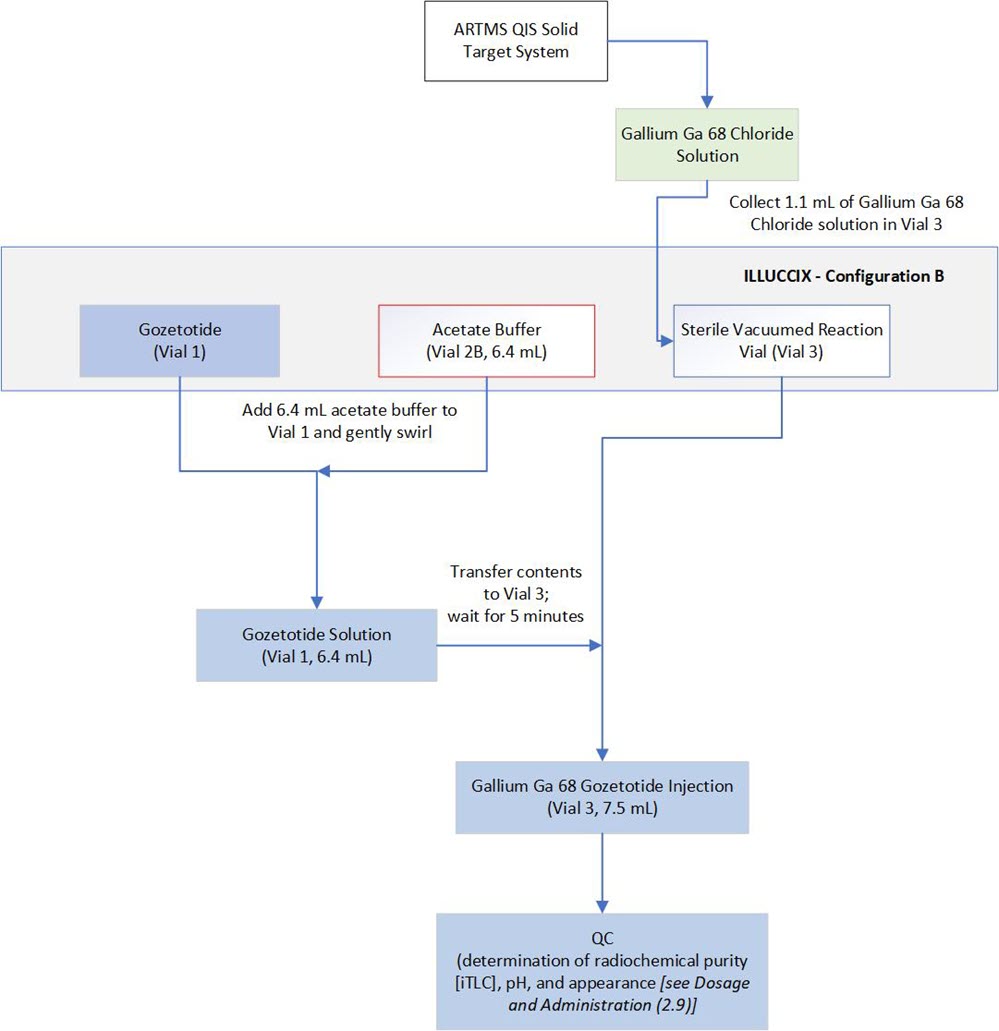
  • Use ILLUCCIX "Configuration B" with cyclotron-produced Ga 68 via ARTMS QIS Solid Target System.
  • A schematic diagram for the preparation is provided in Figure 3.
  • Pierce Vial 3 (Sterile Vacuumed Reaction Vial) with a sterile needle connected to a 0.2 micron sterile vented filter (not supplied) to maintain atmospheric pressure within the vial during the reconstitution process.
  • Collect 1.1 mL of Gallium Ga 68 Chloride solution made using the ARTMS QIS Solid Target System into Vial 3.
  • Insert a sterile 10 mL syringe with a needle into Vial 2 (Acetate Buffer Vial Configuration B) and draw up the contents of the vial (target 6.4 mL).
  • Inject the contents of the 10 mL syringe into Vial 1 (Gozetotide Vial).
  • Gently swirl Vial 1 to ensure the product is thoroughly dissolved.
  • Insert a sterile 10 mL syringe with a needle into Vial 1 containing the dissolved gozetotide and draw up the entire contents of the vial.
  • Transfer the contents of the 10 mL syringe to Vial 3 (Sterile Vacuumed Reaction Vial) containing the Gallium Ga 68 Chloride.
  • Wait for 5 minutes for radiolabeling to take place at room temperature (25°C (77°F); excursions permitted to 15°C to 30°C (59°F to 86°F)).
  • Assay the whole vial containing the Gallium Ga 68 Gozetotide Injection for total radioactivity using a dose calibrator, calculate the radioactivity concentration, and record the result.
  • Perform the quality control of Gallium Ga 68 Gozetotide Injection according to the recommended methods [see Dosage and Administration (2.9)].
  • Prior to use, visually inspect the solution behind a shielded screen for radioprotection purposes. Only use solutions that are clear without visible particles.
  • Keep the vial containing the Gallium Ga 68 Gozetotide Injection upright in a radioprotective shield container at room temperature until use.
  • The final volume of the Gallium Ga 68 Gozetotide Injection is 7.5 mL.
  • Use within 4 hours.
  • Figure 3: Drug Preparation with Cyclotron-Produced Ga 68 via ARTMS QIS Solid Target System

    Figure 3 (Illuccix 03)

    Figure 3 (Illuccix 03)

2.8 Preparation With Ire Elit Galli Eo Generator

Follow the generator manufacturers' instructions for generator preparation, controls, and continuous routine elution.

Radiolabeling Procedure

  • Use ILLUCCIX "Configuration B" with an IRE ELiT Galli Eo generator.
  • A schematic diagram for the preparation is provided in Figure 4.
  • Connect the male luer of the outlet line of the Galli Eo generator to a sterile needle.
  • Connect Vial 3 directly to the outlet line of the Galli Eo generator by pushing the needle through the rubber septum and place the vial in a radiation shielded container.
  • Ensure the needle to the generator outlet is pulled up as far as possible to not contact the solution in the vial.
  • Elute 1.1 mL from the generator directly into Vial 3 (Sterile Vacuumed Reaction Vial) according to the instructions for use of the Galli Eo generator that are supplied by IRE. Collect 1.1 mL of eluate.
  • At the end of the elution, disconnect the generator from Vial 3 by removing the needle from the rubber septum.
  • Insert a sterile 10 mL syringe with a needle into Vial 2 (Acetate Buffer Vial Configuration B) and draw up the contents of the vial (target 6.4 mL).
  • Inject the contents of the 10 mL syringe into Vial 1 (Gozetotide Vial).
  • Gently swirl Vial 1 to ensure the product is thoroughly dissolved.
  • Insert a sterile 10 mL syringe with a needle into Vial 1 containing the dissolved gozetotide and draw up the entire contents of the vial.
  • Transfer the contents of the 10 mL syringe to Vial 3 (Sterile Vacuumed Reaction Vial) containing the Gallium Ga 68 Chloride.
  • Wait for 5 minutes for radiolabeling to take place at room temperature (25°C (77°F); excursions permitted to 15°C to 30°C (59°F to 86°F)).
  • Assay the whole vial containing the Gallium Ga 68 Gozetotide Injection for total radioactivity using a dose calibrator, calculate the radioactivity concentration, and record the result.
  • Perform the quality control of Gallium Ga 68 Gozetotide Injection according to the recommended methods [see Dosage and Administration (2.9)].
  • Prior to use, visually inspect the solution behind a shielded screen for radioprotection purposes. Only use solutions that are clear without visible particles.
  • Keep the vial containing the Gallium Ga 68 Gozetotide Injection upright in a radioprotective shield container at room temperature until use.
  • The final volume of the Gallium Ga 68 Gozetotide Injection is 7.5 mL.
  • Use within 4 hours.
  • Figure 4: Preparation with IRE ELiT Galli Eo Generator

    Figure 4 (Illuccix 04)

    Figure 4 (Illuccix 04)

6.1 Clinical Trials Experience

Because clinical trials are conducted under widely varying conditions, adverse reaction rates observed in the clinical trials of a drug cannot be directly compared to rates in the clinical trials of another drug and may not reflect the rates observed in practice.

The safety of ILLUCCIX has been established based on three prospective studies of gallium Ga 68 gozetotide in patients with prostate cancer (i.e., Studies 1, 2, and 3). Adverse reactions from these studies are reported below.

In Studies 1 and 2 using another formulation of gallium Ga 68 gozetotide injection, 960 patients received one dose of gallium Ga 68 gozetotide intravenously with the amount (mean ± SD) of radioactivity 188.7 ± 40.7 MBq (5.1 ± 1.1 mCi) [see Clinical Studies (14.1, 14.2)]. The most commonly reported adverse reactions were nausea, diarrhea, and dizziness, occurring at a rate of <1%.

In a randomized, multicenter, open-label clinical study (NCT03511664, referred to as Study 3) in which gallium Ga 68 gozetotide was used to identify PSMA-positive patients on PET imaging to determine eligibility for PSMA-directed therapy, 1,003 patients with progressive metastatic castration-resistant prostate cancer (mCRPC) received one dose of gallium Ga 68 gozetotide intravenously with the amount of radioactivity 167.1 ± 23.1 MBq (4.52 ± 0.62 mCi). Patients were males with median age of 70 years (range, 40 to 94 years), were White (87%), Black or African American (7%), or Asian (2.4%), and had median baseline PSA levels of 74 ng/mL (range, 0 to 8,995 ng/mL).

Adverse reactions occurring at ≥ 0.5% in patients with metastatic prostate cancer who received gallium Ga 68 gozetotide injection in Study 3 are presented in Table 4.

Table 4: Adverse Reactions (≥ 0.5%) in Patients with Metastatic Prostate Cancer Who Received Gallium Ga 68 Gozetotide Injection in Study 3

Adverse Reaction

Gallium Ga 68 Gozetotide Injection

N = 1,003

n (%)

General disorders

Fatigue

12 (1.2)

Gastrointestinal disorders

Nausea

8 (0.8)

Constipation

5 (0.5)

Vomiting

5 (0.5)

Adverse reactions occurring at a rate of < 0.5% in the study were diarrhea, dry mouth, injection site reactions, including injection site hematoma and injection site warmth and chills.

6.2 Postmarketing Experience

The following adverse reactions have been identified during postapproval use of ILLUCCIX. Because these reactions are reported voluntarily from a population of uncertain size, it is not always possible to reliably estimate their frequency or establish a causal relationship to drug exposure.

General Disorders and Administration Site Conditions: injection site pain.

14.1 Imaging Prior To Initial Definitive Therapy

The efficacy of ILLUCCIX for PET of PSMA-positive lesions in men with prostate cancer with suspected metastasis who are candidates for initial definitive therapy has been established based on a study of another formulation of gallium Ga 68 gozetotide. Below is a display of the results of the prospective, open label study PSMA-PreRP (NCT03368547 and NCT02919111, referred to as Study 1).

This two-center study enrolled 325 patients with biopsy-proven prostate cancer who were considered candidates for prostatectomy and pelvic lymph node dissection. All enrolled patients met at least one of the following criteria: serum prostate-specific antigen (PSA) of at least 10 ng/mL, tumor stage cT2b or greater, or Gleason score greater than 6. Each patient received a single gallium Ga 68 gozetotide PET/CT or PET/MR from mid-thigh to skull base.

A total of 123 patients (38%) proceeded to standard-of-care prostatectomy and template pelvic lymph node dissection and had sufficient histopathology data for evaluation (evaluable patients). Three members of a pool of six central readers independently interpreted each PET scan for the presence of abnormal gallium Ga 68 gozetotide uptake in pelvic lymph nodes located in the common iliac, external iliac, internal iliac, and obturator subregions bilaterally as well as in any other pelvic location. The readers were blinded to all clinical information except for the history of prostate cancer prior to definitive treatment. Extrapelvic sites and the prostate gland itself were not analyzed in this study. For each patient, gallium Ga 68 gozetotide PET results and reference standard histopathology obtained from dissected pelvic lymph nodes were compared by region (left hemipelvis, right hemipelvis, and other).

For the 123 evaluable patients, the mean age was 65 years (range 45 to 76 years), and 89% were White. The median serum PSA was 11.8 ng/mL. The summed Gleason score was 7 for 44%, 8 for 20%, and 9 for 31% of the patients, with the remainder of the patients having Gleason scores of 6 or 10.

Table 8 compares majority PET reads to pelvic lymph node histopathology results at the patient-level with region matching, such that at least one true positive region defines a true positive patient. As shown, approximately 24% of subjects studied were found to have pelvic nodal metastases based on histopathology (95% confidence interval: 17%, 32%).

Table 8: Patient-Level Performance of Gallium Ga 68 Gozetotide PET for Detection of Pelvic Lymph Node Metastasis

with region matching where at least one true positive region defines a true positive patient

in Men with Prostate Cancer with Suspected Metastasis in Study 1 (n=123)
HistopathologyPredictive value

PPV: positive predictive value, NPV: negative predictive value


(95% CI)
PositiveNegative
PET scanPositive149PPV
61% (41%, 81%)
Negative1684NPV
84% (79%, 91%)
Total3093
Diagnostic performance
(95% CI)
Sensitivity
47% (29%, 65%)
Specificity
90% (84%, 96%)

Among the pool of six readers, sensitivity ranged from 36% to 60%, specificity from 83% to 96%, positive predictive value from 38% to 80%, and negative predictive value from 80% to 88%.

In an exploratory subgroup analysis based on summed Gleason score, there was a numerical trend toward more true positives in patients with Gleason score of 8 or higher compared to those with Gleason score of 7 or lower.

An exploratory analysis was performed to estimate the sensitivity and specificity for pelvic nodal metastasis detection in all scanned patients, including the patients who were lacking histopathology reference standard. An imputation method was used based on patient-specific factors. This exploratory analysis resulted in an imputed sensitivity of 47%, with a 95% confidence interval ranging from 38% to 55%, and an imputed specificity of 74%, with a 95% confidence interval ranging from 68% to 80% for all patients imaged with gallium Ga 68 gozetotide PET.
14.2 Imaging Of Biochemical Recurrence

The efficacy of ILLUCCIX for PET of PSMA-positive lesions in men with prostate cancer with suspected recurrence based on elevated serum PSA level has been established based on a study of another formulation of gallium Ga 68 gozetotide. Below is a display of the results of the prospective, open label study PSMA-BCR (NCT02940262 and NCT02918357, referred to as Study 2).

This two-center study enrolled 635 patients with biochemical evidence of recurrent prostate cancer after definitive therapy, defined by serum PSA of >0.2 ng/mL more than 6 weeks after prostatectomy or by an increase in serum PSA of at least 2 ng/mL above nadir after definitive radiotherapy. All patients received a single gallium Ga 68 gozetotide PET/CT or PET/MR from mid-thigh to skull base. Three members of a pool of nine independent central readers evaluated each scan for the presence and regional location (20 subregions grouped into four regions) of abnormal gallium Ga 68 gozetotide uptake suggestive of recurrent prostate cancer. The readers were blinded to all clinical information other than type of primary therapy and most recent serum PSA level.

A total of 469 patients (74%) had at least one positive region detected by gallium Ga 68 gozetotide PET majority read. The distribution of gallium Ga 68 gozetotide PET positive regions was 34% bone, 25% prostate bed, 25% pelvic lymph node, and 17% extrapelvic soft tissue. Two hundred and ten patients had composite reference standard information collected in a PET positive region (evaluable patients), consisting of at least one of the following: histopathology, imaging (bone scintigraphy, CT, or MRI) acquired at baseline or within 12 months after gallium Ga 68 gozetotide PET, or serial serum PSA. Composite reference standard information for gallium Ga 68 gozetotide PET negative regions was not systematically collected in this study.

In the 210 evaluable patients, the mean age was 70 years (range 49 to 88 years) and 82% were 65 years of age or older. White patients made up 90% of the group. The median serum PSA was 3.6 ng/mL. Prior treatment included radical prostatectomy in 64% and radiotherapy in 73%.

Of the 210 evaluable patients, 192 patients (91%) were found to be true positive in one or more regions against the composite reference standard (95% confidence interval: 88%, 95%). Among the pool of nine readers used in the study, the proportion of patients who were true positive in one or more regions ranged from 82% to 97%. The prostate bed had the lowest proportion of true positive results at the region-level (76% versus 96% for non-prostate regions).

An exploratory analysis was also performed in which gallium Ga 68 gozetotide PET positive patients who lacked reference standard information were imputed using an estimated likelihood that at least one location-matched PET positive lesion was reference standard positive based on patient-specific factors. In this exploratory analysis, 340 of 475 patients (72%) were imputed as true positive in one or more regions (95% confidence interval: 68%, 76%).

In another exploratory analysis using the same imputation approach for PET positive patients who lacked reference standard information, 340 of 635 patients (54%) were correctly detected as true positive (95% confidence interval: 50%, 57%) among all BCR patients who received a PET scan, whether it was read as positive or negative.

The likelihood of identifying a gallium Ga 68 gozetotide PET positive lesion in this study increased with higher serum PSA level. Table 9 shows the patient-level gallium Ga 68 gozetotide PET results stratified by serum PSA level. The mean time between PSA measurement and PET scan was 40 days with a range of 0 to 367 days. Percent PET positivity was calculated as the proportion of patients with a positive gallium Ga 68 gozetotide PET out of all patients scanned. Percent PET positivity includes patients determined to be either true positive or false positive as well as those in whom such determination was not made due to the absence of composite reference standard data.

Table 9: Patient-Level Gallium Ga 68 Gozetotide PET Results and Percent PET Positivity Stratified by Serum PSA Level in Men with Prostate Cancer with Suspected Recurrence in Study 2 (n=628)

7 patients were excluded from this table due to protocol deviations

PSA
(ng/mL)
PET positive patientsPET negative patientsPercent PET positivity

Percent PET positivity = PET positive patients/total patients scanned


(95% CI)
TotalTP

TP: true positive, FP: false positive

FPWithout reference standard
With reference standard
<0.548111368736%
12(27%, 44%)
≥0.5 and <144153263556%
18(45%, 67%)
≥1 and <271291411583%
30(75%, 91%)
≥2299137131492991%
150(88%, 94%)
Total4621921825216674%
210(70%, 77%)

14.3 Imaging To Select Patients For Psma-Directed Therapy

Refer to the prescribing information of the PSMA-directed therapy for description of the studies in which the efficacy of gallium Ga 68 gozetotide for selecting patients has been established.

* Please review the disclaimer below.