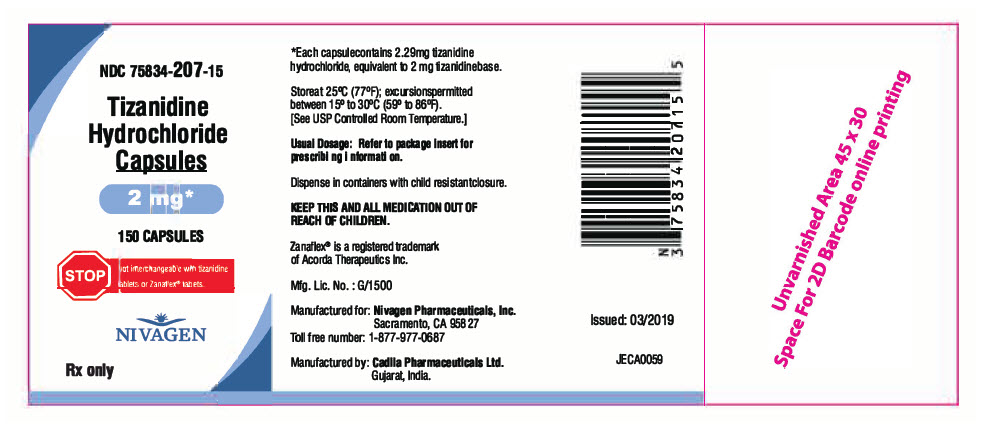
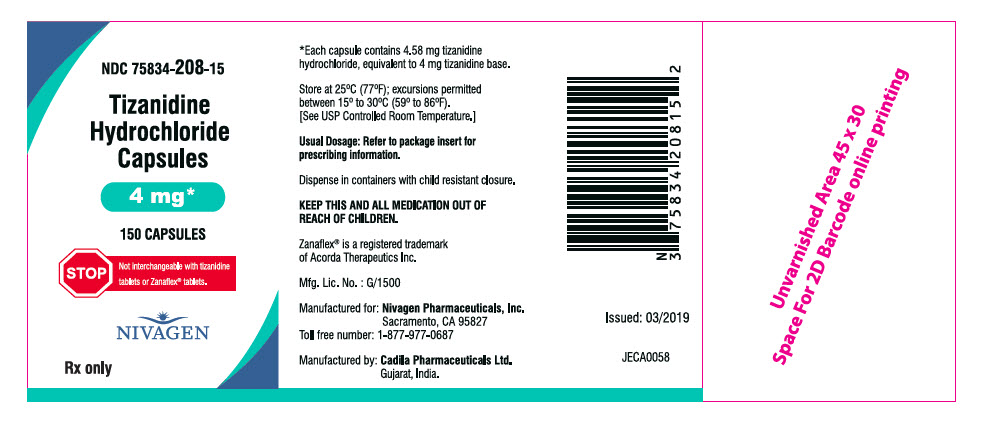
Capsules
2 mg: Light yellow powder filled in size "3" hard gelatin capsule wHh opaque light blue cap imprinted "2 MG" and opaque light blue body
4 mg: Light yellow powder filled in size "3" hard gelatin capsule with opaque blue cap imprinted "4 MG" and opaque white body
6 mg: Light yellow powder filled in size "2" hard gelatin capsule with opaque blue cap imprinted "6 MG" and opaque blue body
Absorption and Distribution
Following oral administration, tizanidine is essentially completely absorbed. The absolute oral bioavailability of tizanidine is approximately 40% (CV - 24%), due to extensive first-pass hepatic metabolism. Tizanidine is extensively distributed throughout the body with a mean steady state volume of distribution of 2.4 l/kg (CV = 21 %) following intravenous administration in healthy adult volunteers. Tizanidine is approximately 30% bound to plasma proteins.
Differences between tizanidine capsules and tizanidine tablets
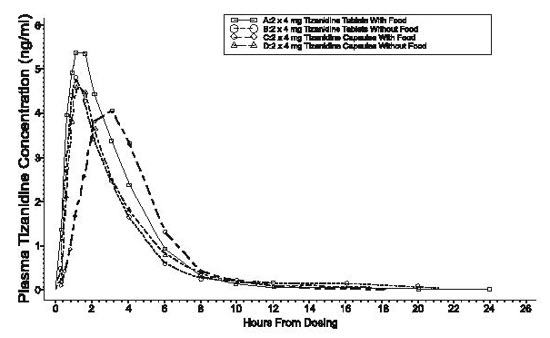
Tizanidine capsules and tizanidine tablets are bioequivalent to each other under fasting conditions, but not under fed conditions. A single dose of either two 4 mg tablets or two 4 mg capsules was administered under fed and fasting conditions in an open label, four period, randomized crossover study in 96 human volunteers, of whom 81 were eligible for the statistical analysis. Following oral administration of either the tablet or capsule (in the fasted state), peak plasma concentrations of tizanidine occurred t .0 hours after dosing with a half-life of approximately 2 hours. When two 4 mg tablets were administered with food, the mean maximal plasma concentration was increased by approximately 30%, and the median time to peak plasma concentration was increased by 25 minutes, to 1 hour and 25 minutes. In contrast, when two 4 mg capsules were administered with food, the mean maximal plasma concentration was decreased by 20%, the median time to peak plasma concentration was increased 2 to 3 hours. Consequently, the mean c_ for the capsule when administered with food is approximately 66% the C"' for the tablet when administered with food.
Food also increased the extent of absorption for both the tablets and capsules. The increase with the tablet (~30%) was significantly greater than with the capsule (~10%). Consequently when each was administered with food, the amount absorbed from the capsule was about 80% of the amount absorbed from the tablet. Administration of the capsule contents sprinkled on applesauce was not bioequivalent to administration of an intact capsule under fasting conditions. Administration of the capsule contents on applesauce resulted in a 15%-20% increase in Cmax and AUG of tizanidine and a 15 minute decrease in the median lag time and time to peak concentration compared to administration of an intact capsule while fasting.
Figure 1: Mean Tizanidine Concentration vs. Time Profiles For Tizanidine Tablets and Tizanidine Capsules (2 × 4 mg) Under Fasted and Fed Conditions
Metabolism and Excretion
Tizanidine has linear pharmacokinetics over the doses studied in clinical development (1-20 mg). Tizanidine has a half-Iife of approximately 2.5 hours (CV-33%). Approximately 95% of an administered dose is metabolized. The primary cytochrome P450 isoenzyme involved in tizanidine metabolism is CYP1A2. Tizanidine metabolites are not known to be active; their half-lives range from 20 to 40 hours.
Following single and multiple oral dosing of 14C-tizanidine, an average of 60% and 20% of total radioactivity was recovered in the urine and feces, respectively.
Special Populations
Age Effects
No specific pharmacokinetic study was conducted to investigate age effects. Cross study comparison of pharmacokinetic data following single dose administration of 6 mg tizanidine showed that younger subjects cleared the drug four times faster than the eldeny subjects. Tizanidine has not been evaluated in children. [see Use in Specific Populations (8.4, 8.5)]
Hepatic Impairment
The influence of hepatic impairment on the pharmacokinetics of tizanidine has not been evaluated. Because tizanidine is extensively metabolized in the liver, hepatic impairment would be expected to have significant effects on pharmacokinetics of tizanidine. Tizanidine is not recommended in this patient population [see Use in Specific Populations (8. 7)]
Renal Impairment
Tizanidine clearance is reduced by more than 50% in elderly patients with renal insufficiency (creatinine clearance< 25 ml/min) compared to healthy elderly subjects; this would be expected to lead to a longer duration of clinical effect. Tizanidine should be used with caution in renally impaired patients [see Warnings and Precautions (5.7) and Use in Specific Populations (8. 6)].
Gender Effects
No specific pharmacokinetic study was conducted to investigate gender effects. Retrospective analysis of pharmacokinetic data, however, following single and multiple dose administration of 4 mg tizanidine showed that gender had no effect on the pharmacokinetics of tizanidine.
Race Effects
Pharmacokinetic differences due to race have not been studied.
Drug Interactions
CYP1 A2 Inhibitors
The interaction between tizanidine and either fluvoxamine or ciprofloxacin is most likely due to inhibition of CYP1A2 by fluvoxamine or ciprofloxacin. The effect of fluvoxamine on the pharmacokinetics of a single 4 mg dose of tizanidine was studied in 10 healthy subjects. The Cmax AUC, and half-life of tizanidine increased by 12- fold, 33-fold, and 3-fold, respectively. The effect of ciprofloxacin on the pharmacokinetics of a single 4 mg dose of tizanidine was studied in t O healthy subjects. The Cmax and AUC of tizanidine increased by 7-fold and 10-fold, respectively. [see Contraindications (4)].
Although there have been no clinical studies evaluating the effects of other CYP1A2 inhibitors on tizanidine, other CYP1A2 inhibitors, such as zileuton, other fluoroquinolones, antiarrythmics (amiodarone, mexiletine, propafenone and verapamil), cimetidine, famotidine oral contraceptives, acyclovir and ticlopidine, may also lead to substantial increases in tizanidine blood concentrations [see Warnings and Precautions (5.5)].
In vitro studies of cytochrome P450 isoenzymes using human liver microsomes indicate that neither tizanidine nor the major metabolites are likely to affect the metabolism of other drugs metabolized by cytochrome P450 isoenzymes.
Oral Contraceptives
No specific pharmacokinetic study was conducted to investigate interaction between oral contraceptives and tizanidine. Retrospective analysis of population pharmacokinetic data following single and multiple dose administration of 4 mg tizanidine, however, showed that women concurrently taking oral contraceptives had 50% lower clearance of tizanidine compared to women not on oral contraceptives [see Warnings and Precautions (5.5)].
Acetaminophen
Tizanidine delayed the Tmax of acetaminophen by 16 minutes. Acetaminophen did not affect the pharmacokinetics of tizanidine.
Alcohol
Alcohol increased the AUG of tizanidine by approximately 20%, while also increasing its Cmax by approximately 15%. This was associated with an increase in side effects of tizanidine. The CNS depressant effects of tizanidine and alcohol are additive.
Carcinogenesis
Tizanidine was administered to mice for 78 weeks at oral doses up to t 6 mg/kg/day, which is 2 times the maximum recommended human dose (MRHD) on a mg/m2 basis. Tizanidine was administered to rats for 104 weeks at oral doses up to 9 mg/kg/day, which is 2.5 times the MRHD on a mg./m2 basis. There was no increase in tumors in either species.
Mutagenesis
Tizanidine was negative in in vitro (bacterial reverse mutation [Ames], mammalian gene mutation, and chromosomal aberration test in mammalian cells) and in vivo (bone marrow micronucleus, and cytogenetics) assay.
Impairment of fertility
Oral administration of tizanidine resulted in reduced fertility in male and female rats following doses of 30 and 1 O mg/kg/day, respectively. No effect on fertility was observed at doses of 10 (male) and 3 (female) mg/kg/day, which are approximately 8 and 3 fimes, respectively, the MRHD on a mg/m2 basis).
Single-Dose Study in Patients with Multiple Sclerosis with Spastictly
In Study 1, patients with multiple sclerosis were randomized to receive single oral doses of drug or placebo. Patients and assessors were blind to treatment assignment and efforts were made to reduce the likelihood that assessors would become aware indirectly of treatment assignment (e.g., they did not provide direct care to patients and were prohibited from asking questions about side effects). In all, 140 patients received placebo, 8 mg or 16 mg of tizanidine.
Response was assessed by physical examination; muscle tone was rated on a 5 point scale (Ashworth score), with a score of 0 used to describe normal muscle tone. A score of 1 indicated a slight spastic catch while a score of 2 indicated more marked muscle resistance. A score of 3 was used to describe considerable increase in tone, making passive movement difficult. A muscle immobilized by spasticity was given a score of 4. Spasm counts were also collected.
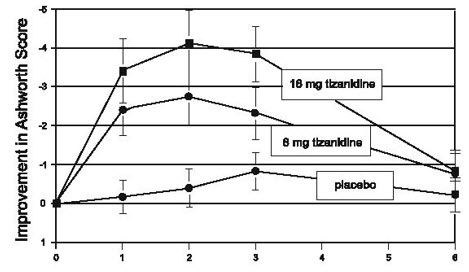
Assessments were made at 1, 2, 3 and 6 hours after treatment. A statistically significant reduction of the Ashworth score for tizanidine compared to placebo was detected at 1, 2 and 3 hours after treatment. Figure 2 below shows a comparison of the mean change in muscle tone from baseline as measured by the Ashworth scale. The greatest reduction in muscle tone was 1 to 2 hours after treatment. By 6 hours after treatment, muscle tone in the 8 and 16 mg tizanidine groups was indistinguishable from muscle tone in placebo treated patients. Within a given patient, improvement in muscle tone was correlated with plasma concentration. Plasma concentrations were variable from patient to patient at a given dose. Although 16 mg produced a larger effect, adverse events including hypotension were more common and more severe than in the 8 mg group. There were no differences in the number of spasms occurring in each group.
Figure 2: Single Dose Study-Mean Change in Muscle Tone from Baseline as Measured by the Ashworth Scale ±95% Confidence Interval (A Negative Ashworth Score Signifies an Improvement in Muscle Tone from Baseline)
Hours Post- Dose
Seven-Week Study in Patients with Spinal Cord Injury with Spasticity
In a 7-week study (Study 2), 118 patients with spasticity secondary to spinal cord injury were randomized to either placebo or tizanidine. Steps similar to those 1aken in the first study were employed to ensure the integrity of blinding.
Patients were titrated over 3 weeks up to a maximum tolerated dose or 36 mg daily given in three unequal doses (e.g., 10 mg given in the morning and afternoon and 16 mg given at night). Patients were then maintained on their maximally tolerated dose for 4 additional weeks (i.e., maintenance phase). Throughout the maintenance phase, muscle tone was assessed on the Ashworth scale within a period of 2.5 hours following either the morning or afternoon dose. The number of daytime spasms was recorded daily by patients.
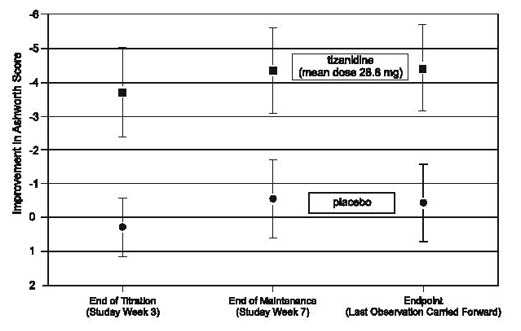
At endpoint (the protocol-specified time of outcome assessment), there was a statistically significant reduction in muscle tone and frequency of spasms in the tizanidine treated group compared to placebo. The reduction in muscle tone was not associated with a reduction in muscle strength (a desirable outcome) but also did not lead to any consistent advantage of tizanidine treated patients on measures of activities of daily living. Figure 3 below shows a comparison of the mean change in muscle tone from baseline as measured by the Ashworth scale.
Figure 3: Seven Week Study-Mean Change in Muscle Tone 0. 5-2. 5 Hours After Dosing as Measured by the Ashworth Scale ±95% Confidence Interval (A Negative Ashworth Score Signifies an Improvement in Muscle Tone from Baseline).
Serious Drug Interactions
Advise patients they should not take tizanidine if they are ta⍰ng fluvoxamine or ciprofloxacin because of the increased risk of serious adverse reactions including severe lowering of blood pressure and sedation. Instruct patients to inform their physicians or pharmacists when they start or stop taking any medication because of the risks associated with interaction between tizanidine and other medicines.
Tizanidine Dosing
Tell patients to take tizanidine exactly as prescribed (consistently either with or without food) and not to switch between tablets and capsules. Inform patients that they should not take more tizanidine hydrochloride capsules than prescribed because of the risk of adverse events at single doses greater than 8 mg or total daily doses greater than 36 mg. Tell patients that they should not suddenly discontinue tizanidine, because rebound hypertension and tachycardia may occur.
Effects of Tizanidine
Warn patients that they may experience hypotension and to be careful when changing from a lying or sitting to a standing position. Tell patients that tizanidine may cause them to become sedated or somnolent and they should be careful when performing activities that require alertness, such as driving a vehicle or operating machinery. Tell patients that the sedation may be additive when tizanidine is taken in conjunction with drugs (baclofen, benzodiazepines) or substances (e.g., alcohol) that act as CNS depressants. Remind patients that if they depend on their spasticity to sustain posture and balance in locomotion, or whenever spasticity is utilized to obtain increased function, that tizanidine decreases spasticity and caution should be used.
Manufactured by:
Cadila Pharmaceuticals Limited
1389 Trasad Road,
Dholka – 382225,
District - Ahmadabad, Gujarat, INDIA.
Manufactured for:
Nivagen Pharmaceuticals, Inc.
Sacramento, CA 95827
Toll free number: 1-877-977-0687
Revised: March, 2019