Description
Albuterol tablets contain albuterol sulfate USP, the racemic form of albuterol and a relatively selective beta 2-adrenergic bronchodilator. Albuterol sulfate has the chemical name α 1-[( tert-butylamino)methyl]-4-hydroxy- m-xylene- α,α-diol sulfate (2:1) (salt) and the following structural formula:
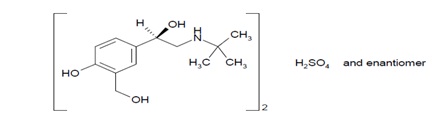
Structural Formula (91b62253 34a2 48e3 Bc29 7c1c189d60a6 01)
Albuterol sulfate has a molecular weight of 576.7, and the molecular formula is (C 13H 21NO 3) 2. H 2SO 4. Albuterol sulfate, USP is a white or almost white crystalline powder, freely soluble in water, practically insoluble or very slightly soluble in Methylene chloride and alcohol, slightly soluble in Chloroform and Ether.
The World Health Organization recommended name for albuterol base is salbutamol.
Each albuterol tablet for oral administration contains 2 mg or 4 mg of albuterol as 2.4 mg or 4.8 mg of albuterol sulfate USP, respectively. Each tablet also contains the following inactive ingredients: anhydrous lactose, hypromellose, magnesium stearate and sodium starch glycolate.
