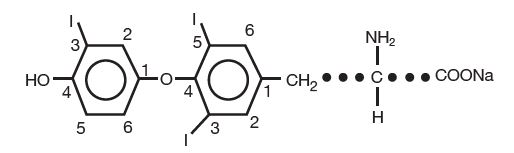
- Liothyronine sodium tablets are not indicated for suppression of benign thyroid nodules and nontoxic diffuse goiter in iodine-sufficient patients as there are no clinical benefits and overtreatment with liothyronine sodium tablets may induce hyperthyroidism [see Warnings and Precautions (5.4)].
- Liothyronine sodium tablets are not indicated for treatment of hypothyroidism during the recovery phase of subacute thyroiditis.
Adults
The recommended starting dosage is 25 mcg orally once daily. Increase the dose by 25 mcg daily every 1 or 2 weeks, if needed. The usual maintenance dose is 25 mcg to 75 mcg once daily.
For elderly patients or patients with underlying cardiac disease, start with liothyronine sodium tablets 5 mcg once daily and increase by 5 mcg increments at the recommended intervals.
Serum TSH is not a reliable measure of liothyronine sodium tablets dose adequacy in patients with secondary or tertiary hypothyroidism and should not be used to monitor therapy. Use the serum T3 level to monitor adequacy of therapy in this patient population.
Pediatric Patients
The recommended starting dosage is 5 mcg once daily, with a 5 mcg increase every 3 to 4 days until the desired response is achieved. Infants a few months old may require 20 mcg once daily for maintenance. At 1 year of age, 50 mcg once daily may be required. Above 3 years of age, the full adult dosage may be necessary [see Use in Specific Populations (8.4)].
Newborns (0 to 3 months) at Risk for Cardiac Failure:
Consider a lower starting dose in infants at risk for cardiac failure. Increase the dose as needed based on clinical and laboratory response.
Pediatric Patients at Risk for Hyperactivity
To minimize the risk of hyperactivity in pediatric patients, start at one-fourth the recommended full replacement dose, and increase on a weekly basis by one-fourth the full recommended replacement dose until the full recommended replacement dose is reached.
Pregnancy
Pre-existing Hypothyroidism: Thyroid hormone dose requirements may increase during pregnancy. Measure serum TSH and free-T4 as soon as pregnancy is confirmed and, at minimum, during each trimester of pregnancy. In patients with primary hypothyroidism, maintain serum TSH in the trimester-specific reference range. For patients with serum TSH above the normal trimester-specific range, increase the dose of thyroid hormone and measure TSH every 4 weeks until a stable dose is reached and serum TSH is within the normal trimester-specific range. Reduce thyroid hormone dosage to pre-pregnancy levels immediately after delivery and measure serum TSH levels 4 to 8 weeks postpartum to ensure thyroid hormone dose is appropriate.
Adults
In adult patients with primary hypothyroidism, monitor serum TSH periodically after initiation of the therapy or any change in dose. To check the immediate response to therapy before the TSH has had a chance to respond or if your patient's status needs to be assessed prior to that point, measurement of total T3 would be most appropriate. In patients on a stable and appropriate replacement dose, evaluate clinical and biochemical response every 6 to 12 months and whenever there is a change in the patient's clinical status.
Pediatrics
In pediatric patients with hypothyroidism, assess the adequacy of replacement therapy by measuring serum TSH and T3 levels. For pediatric patients three years of age and older, the recommended monitoring is every 3 to 12 months thereafter, following dose stabilization until growth and puberty are completed. Poor compliance or abnormal values may necessitate more frequent monitoring. Perform routine clinical examination, including assessment of development, mental and physical growth, and bone maturation, at regular intervals.
While the general aim of therapy is to normalize the serum TSH level, TSH may not normalize in some patients due to in utero hypothyroidism causing a resetting of pituitary-thyroid feedback. Failure of the serum TSH to decrease below 20 IU per liter after initiation of liothyronine sodium tablets therapy may indicate the child is not receiving adequate therapy. Assess compliance, dose of medication administered, and method of administration prior to increasing the dose of liothyronine sodium tablets[see Warnings and Precautions (5.1) and Use in Specific Populations (8.4)].
Secondary and Tertiary Hypothyroidism
Monitor serum T3 levels and maintain in the normal range.
Adverse Reactions in Pediatric Patients
Pseudotumor cerebri and slipped capital femoral epiphysis have been reported in pediatric patients receiving thyroid replacement therapy. Overtreatment may result in craniosynostosis in infants and premature closure of the epiphyses in pediatric patients with resultant compromised adult height.
Hypersensitivity Reactions
Hypersensitivity reactions to inactive ingredients have occurred in patients treated with thyroid hormone products. These include urticaria, pruritus, skin rash, flushing, angioedema, various gastrointestinal symptoms (abdominal pain, nausea, vomiting and diarrhea), fever, arthralgia, serum sickness and wheezing.
Risk Summary
Experience with liothyronine use in pregnant women, including data from post-marketing studies, have not reported increased rates of major birth defects or miscarriages (see Data). There are risks to the mother and fetus associated with untreated hypothyroidism in pregnancy. Since TSH levels may increase during pregnancy, TSH should be monitored and liothyronine sodium tablets dosage adjusted during pregnancy (see Clinical Considerations). There are no animal studies conducted with liothyronine during pregnancy. Liothyronine sodium tablets should not be discontinued during pregnancy and hypothyroidism diagnosed during pregnancy should be promptly treated.
The estimated background risk of major birth defects and miscarriage for the indicated population is unknown. In the U.S. general population, the estimated background risk of major birth defects and miscarriage in clinically recognized pregnancies is 2 to 4% and 15 to 20%, respectively.
Clinical Considerations
Disease-associated maternal and/or embryo/fetal risk
Maternal hypothyroidism during pregnancy is associated with a higher rate of complications, including spontaneous abortion, gestational hypertension, pre-eclampsia, stillbirth, and premature delivery. Untreated maternal hypothyroidism may have an adverse effect on fetal neurocognitive development.
Dose adjustments during pregnancy and the postpartum period
Pregnancy may increase liothyronine sodium tablets requirements. Serum TSH levels should be monitored and the liothyronine sodium tablets dosage adjusted during pregnancy. Since postpartum TSH levels are similar to preconception values, the liothyronine sodium tablets dosage should return to the pre-pregnancy dose immediately after delivery [see Dosage and Administration (2.3)].
Data
Human Data
Liothyronine is approved for use as a replacement therapy for hypothyroidism. Data from post-marketing studies have not reported increased rates of fetal malformations, miscarriages, or other adverse maternal or fetal outcomes associated with liothyronine use in pregnant women.
Risk Summary
Limited published studies report that liothyronine is present in human milk. However, there is insufficient information to determine the effects of liothyronine on the breastfed infant and no available information on the effects of liothyronine on milk production. The developmental and health benefits of breastfeeding should be considered along with the mother's clinical need for liothyronine sodium tablets and any potential adverse effects on the breastfed infant from liothyronine sodium tablets or from the underlying maternal condition.
Congenital Hypothyroidism [see Dosage and Administration (2.2, 2.6)]
Rapid restoration of normal serum T4 concentrations is essential for preventing the adverse effects of congenital hypothyroidism on intellectual development as well as on overall physical growth and maturation. Therefore, initiate thyroid hormone immediately upon diagnosis. Thyroid hormone is generally continued for life in these patients.
Closely monitor infants during the first 2 weeks of thyroid hormone therapy for cardiac overload, arrhythmias, and aspiration from avid suckling.
Closely monitor patients to avoid undertreatment or overtreatment. Undertreatment may have deleterious effects on intellectual development and linear growth. Overtreatment is associated with craniosynostosis in infants, may adversely affect the tempo of brain maturation, and may accelerate the bone age and result in premature epiphyseal closure and compromised adult stature [see Dosage and Administration (2.6) and Adverse Reactions (6)].
Acquired Hypothyroidism in Pediatric Patients
Closely monitor patients to avoid undertreatment and overtreatment. Undertreatment may result in poor school performance due to impaired concentration and slowed mentation and in reduced adult height. Overtreatment may accelerate the bone age and result in premature epiphyseal closure and compromised adult stature.
Treated children may manifest a period of catch-up growth, which may be adequate in some cases to normalize adult height. In children with severe or prolonged hypothyroidism, catch-up growth may not be adequate to normalize adult height [see Adverse Reactions (6)].
Absorption
T3 is almost totally absorbed, 95 percent in 4 hours. The hormones contained in the natural preparations are absorbed in a manner similar to the synthetic hormones.
Distribution
Liothyronine sodium (T3) is not firmly bound to serum protein. The higher affinity of levothyroxine (T4) for both thyroid-binding globulin and thyroid-binding prealbumin as compared to triiodothyronine (T3) partially explains the higher serum levels and longer half-life of the former hormone. Both protein-bound hormones exist in reverse equilibrium with minute amounts of free hormone, the latter accounting for the metabolic activity.
Elimination
Metabolism
The major pathway of thyroid hormone metabolism is through sequential deiodination. Approximately 80% of circulating T3 is derived from peripheral T4 by monodeiodination. The liver is the major site of degradation for both T4 and T3. T3 is further deiodinated to diiodothyronine. Thyroid hormones are also metabolized via conjugation with glucuronides and sulfates and excreted directly into the bile and gut where they undergo enterohepatic recirculation.
Excretion
Thyroid hormones are primarily eliminated by the kidneys. A portion of the conjugated hormone reaches the colon unchanged and is eliminated in the feces. The biological half-life is about 2-1/2 days.
Dosing and Administration
- Instruct patients that liothyronine sodium tablets should only be taken as directed by their healthcare provider.
- Instruct patients to notify their healthcare provider should they become pregnant or breastfeeding or are thinking of becoming pregnant, while taking liothyronine sodium tablets.
Important Information