Microgestin Fe 1.5/30 Kit
Product Images NDC 75907-081

View Photos of Packaging, Regulatory Labels, and Product Appearance

Product Visual Gallery

This gallery contains 10 technical images submitted to the FDA as part of the official labeling for Microgestin Fe 1.5/30 (NDC 75907-081). Unlike standard consumer photos, these assets often include clinical data figures, molecular chemical structures, and official manufacturer packaging layouts.

As provided by Dr. Reddy�s Laboratories Inc, these visuals offer a comprehensive scientific overview of the product's physical and chemical identity, aiding pharmacists and researchers in product verification and study.

FDA Label Image

Carton (Carton)

Carton (Carton)
Packaging label for Microgestin Fe 1.5/30 kit containing Norethindrone Acetate, Ethinyl Estradiol, and Ferrous Fumarate tablets. It includes product strengths, tablet counts (6 blister cards of 28 tablets each), storage instructions, a barcode, and distributor information from Dr. Reddy's Laboratories Inc. Tablets include 21 yellow and 7 brown tablets per dispenser.*
FDA Label Image

Figure2 (Figure 2)

Figure2 (Figure 2)
Data table showing the annual number of birth-related or method-related deaths per 100,000 nonsterile women by fertility control method and age group. The table lists outcomes for ages 15-19 through 40-44 for several fertility control methods including no control, oral contraceptives (non-smoker and smoker), IUD, condom, diaphragm/spermicide, and periodic abstinence, with death rates noted for each.*
FDA Label Image

Structural Formula (Image 01)

Structural Formula (Image 01)
Chemical structures of the active ingredients Norethindrone Acetate and Ethinyl Estradiol, showing the molecular skeletons and functional groups characteristic of these steroid hormones.*
FDA Label Image

Image Relevant (Image 03)

Image Relevant (Image 03)
A forest plot comparing odds ratios (OR), relative risks (RR), and hazard ratios (HR) for different studies analyzing combined oral contraceptive (COC) use versus never use. The x-axis shows effect estimates ranging from approximately -1.5 to 2.0, with individual studies listed on the left and their respective risk estimates with confidence intervals on the right, reflecting the association between COC use and outcomes in multiple cohort and health studies.*
FDA Label Image
FDA Label Image

Picture1 (Picture 1)

Picture1 (Picture 1)
An instructional diagram showing how to use the Microgestin Fe 1.5/30 pill kit. It depicts a hand placing a day label sticker starting with the first day of a period. The pill pack contains yellow active and brown inactive tablets, organized by weeks with arrows indicating to take pills from left to right each week. Instructions clarify starting points for Sunday and Day 1 starters.*
FDA Label Image

Picture2 (Picture 2)

Picture2 (Picture 2)
An instructional diagram showing a hand placing a day label sticker on a Microgestin Fe 1.5/30 birth control pill kit to indicate the start day. The kit depicts four weeks with yellow active pills and a row of brown inactive pills, with arrows directing pill intake from left to right each week. Labels specify instructions for day 1 starters and Sunday starters.*
FDA Label Image

Table1 (Table1)

Table1 (Table1)
A table titled 'Lowest Expected and Typical Failure Rates During the First Year of Continuous Use of a Method,' showing percentages of women experiencing unintended pregnancy for various contraceptive methods within the first year of use. Methods listed include oral contraceptives, diaphragms, spermicides, vaginal sponges, implants, injections, IUDs, condoms, cervical caps, abstinence, withdrawal, and sterilization, with columns for lowest expected and typical failure rates.*
FDA Label Image

Table2 (Table2)

Table2 (Table2)
A bar chart titled 'Table II: Circulatory Disease Mortality Rates per 100,000 Woman Years by Age, Smoking Status and Oral Contraceptive Use.' The chart compares mortality rates for ever-users and controls of oral contraceptives, differentiated by smoking status and age groups (15-24, 25-34, 35-44, 45+). Mortality rates increase with age and are highest among ever-users who smoke at age 45 and older. The chart includes a legend for four groups: ever-users (non-smokers and smokers) and controls (non-smokers and smokers). Data source is attributed to P.M. Layde and V. Beral, Reference 18.*
FDA Label Image

Table3 (Table3)

Table3 (Table3)
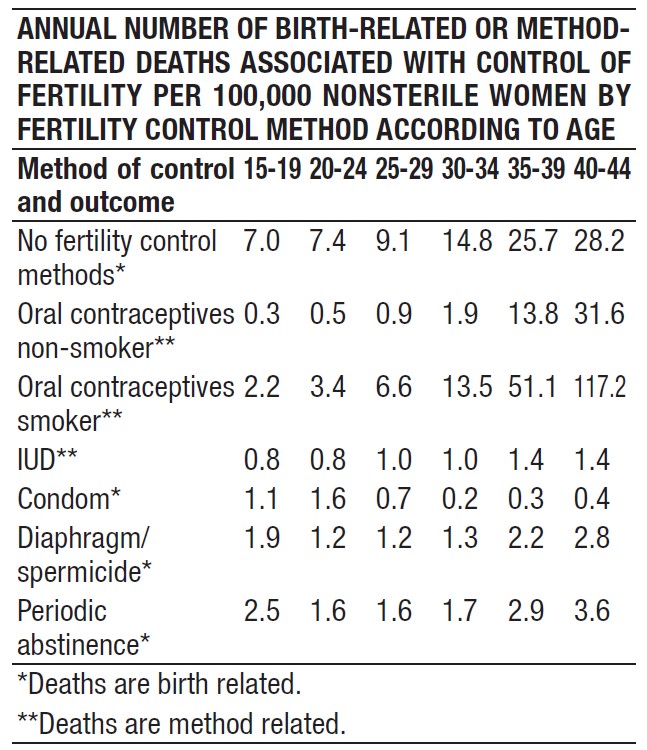
A data table titled 'Annual Number of Birth-Related or Method-Related Deaths Associated with Control of Fertility Per 100,000 Nonsterile Women by Fertility Control Method According to Age.' The table lists death rates by age groups 15-19 through 40-44 across various fertility control methods, including no control, oral contraceptives (smoker and non-smoker), IUD, condom, diaphragm/spermicide, and periodic abstinence, distinguishing birth-related and method-related deaths.*

* About these descriptions: Image descriptions on this page are generated by automated AI analysis of the product label images from the manufacturer's FDA label submission (SPL). They are provided for reference only and may contain errors or omissions. Always rely on the printed label itself and the official FDA labeling, and consult a pharmacist or healthcare professional with any questions about this product.